
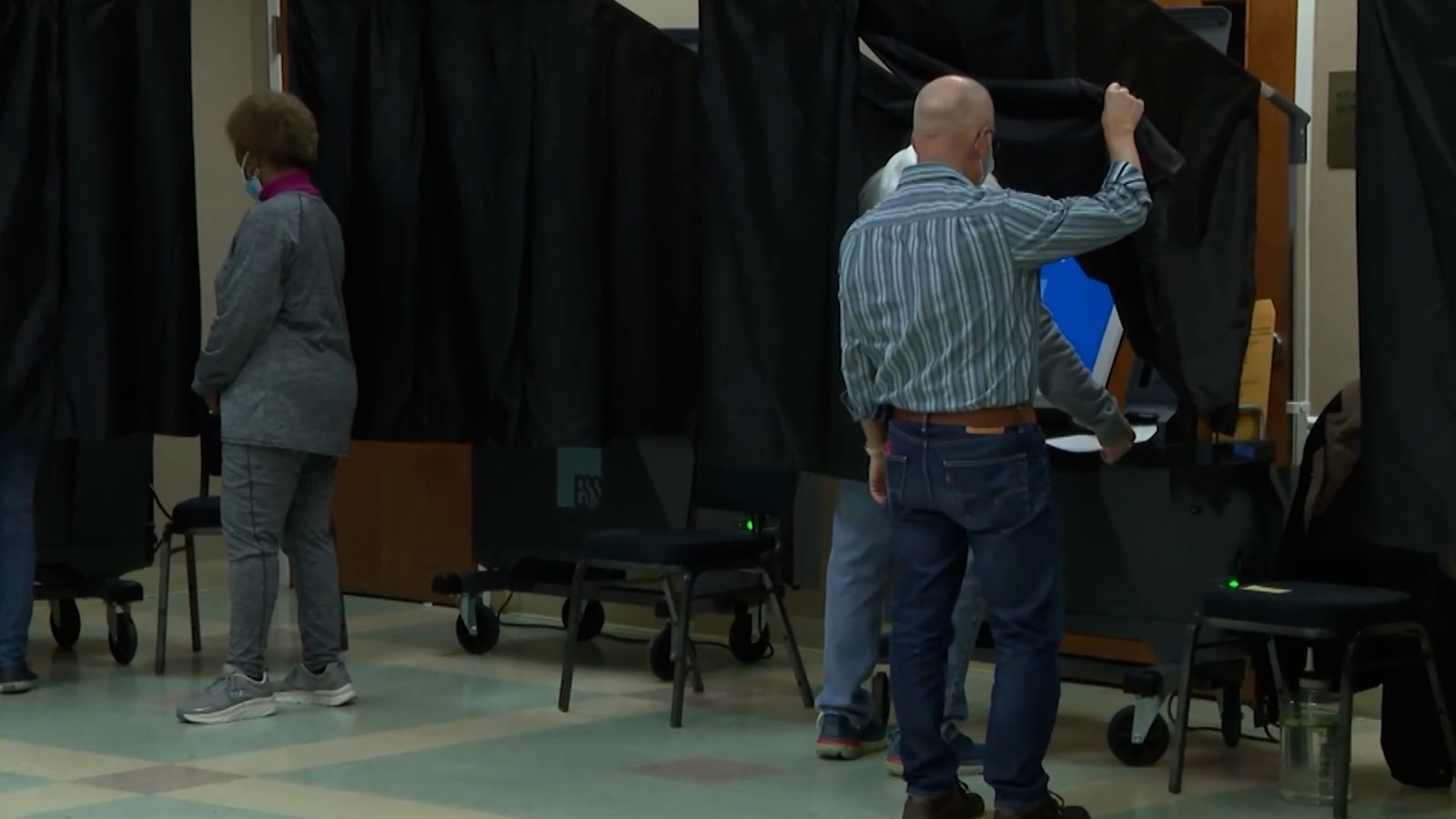
WASHINGTON — American voter fraud is extraordinarily rare. State election officials routinely cross-check registration rolls, and a task force from Donald Trump’s first administration turned up zero evidence of widespread malfeasance.
Still, Republicans are moving to pass a party-line bill that they say would ensure fairness and accuracy at the polls. Opponents call it something else entirely: a device to thwart democracy. The legislation — which the Senate is debating after it was passed in the House — would require U.S. citizens to show a passport or birth certificate to vote. Without those documents, millions of people, particularly immigrants and people of little means, would be struck from voter rolls.

“These are dangerous times,” Sen. Andy Kim (D-NJ) said. “We can never let our vigilance down.”
National contests in the fall will shape the legacy of the second Trump presidency. A record 57 representatives, mostly Republicans, are retiring. Democrats are favored to retake the House, a crucial step to check the administration’s legislative goals and a necessary one if they are to remove Trump from office, though that also would take a super-majority vote in the Senate.
In the public eye, Trump has become a liability to fellow some Republicans’ political fortunes, especially those in swing districts. Presidential approval dipped to 36% in February, according to an Associated Press-NORC Center for Public Affairs Research poll — and that was prior to the war against Iran that Trump launched without congressional approval.
“Instead of grappling with the extreme crises and problems facing our nation today, some lawmakers in Washington are pushing a bill that would make it harder for tens of millions of U.S. citizens to vote,” Laura Williamson, voting rights senior policy adviser at the Southern Poverty Law Center, an advocacy group, said Wednesday at a rally against the bill on the Capitol plaza. “This will be the first time that Congress has legislated to take away the freedom to vote ever, as far as I know.”
To pass the legislation, Trump and a faction of hard-right Republicans in Congress are demanding the elimination of a Senate rule requiring 60 votes to pass most bills. That could send a shock through national politics and upend the law-making process on Capitol Hill.
In 2022, during the Biden administration, most Democrats in the Senate voted to end the filibuster rule, which lets a minority of as few as 41 senators block legislation. Two Democrats voted with Republicans against changing the change, and the filibuster survived.
In the second Trump presidency, Democrats have leaned on the filibuster for leverage in negotiations over spending bills, to block Republican legislation and argue for federal immigration policy reform.
Pressing the elections bill, Trump called for the Senate to detonate the filibuster.
The easiest route to eliminate the rule, known as the “nuclear option,” would be for Republicans in the Senate to change the chamber rules with a party-line vote. Such a vote could pass with a simple majority.
In an interview Tuesday with NJ Spotlight News, Rep. Chris Smith endorsed the idea of lowering the threshold from 60 votes.
‘Wholesome debate’
Senate Majority Leader John Thune, a South Dakota Republican, has made protecting the filibuster a hallmark of his tenure. His Republican predecessor, Mitch McConnell of Kentucky, took a similar position.
Old-guard GOP lawmakers argue that without the filibuster, Democrats would be able to usher in a sweeping agenda and pass laws to stack the Supreme Court or grant statehood to Washington, D.C., and with it two more senators, who almost certainly would be Democrats, given the city’s political leaning.
To appease members on his right flank, Thune approved a process of debate that started Tuesday and could last days or weeks.
“We are having a wholesome debate on the floor of the United States Senate, which is something [the] Senate has done in the past, and probably should do a lot more of,” Thune told reporters Tuesday.
The voter-restriction bill “will be the subject of Senate consideration for the foreseeable future,” Thune said.
“It doesn’t silence voters. It empowers voters.” — Rep. Jeff Van Drew
If the Senate changes the text of the bill that passed the House, and that new version passes the Senate, the underlying legislation would have to clear the House again before Trump could sign it into law.
“It doesn’t silence voters. It empowers voters,” said Rep. Jeff Van Drew (R-2nd), who voted for the bill. The New Jersey House delegation split along party lines, with Republicans voting in favor and Democrats against.
The ID requirements are “not an onerous thing,” according to Smith.
“You go to a bank and you want to cash a check, what do you?” Smith said Tuesday in an interview with NJ Spotlight News. “The key to the whole bill is the ID.”
Asked to pinpoint an example of fraud in a previous election the bill under consideration would have stopped, Speaker Mike Johnson, who sets the House floor agenda, could not.
“We’re not going to litigate all that,” Johnson told reporters.
That bill would require Americans to show passports or birth certificates to register to vote. About 21 million people lack easy access to these documents, according to the Brennan Center, a New York City-based legal and policy group.
‘Sorry, you can’t vote’
Indigenous citizens born at home, with midwives attending, might have a hard time voting, according to New Mexico Democrat Ben Ray Lujan. “They’re going to get told: ’Sorry, you can’t vote anymore,’” he said.
Women who use their married names, different from those on their birth certificates, could have paperwork problems, too.
Rep. Bonnie Watson Coleman (D-12th) called the ID requirement a poll tax, like those designed to disenfranchise Black people and others until they were abolished nationally in 1966.
“There’s this onerous burden put on people to identification that’s not very readily available to them,” Watson Coleman said in an interview with NJ Spotlight News. “This is a solution for which there is no problem.”
Watson Coleman added: “This is all about making it harder for people to vote. It’s a form of suppression. I hope that the Senate holds up.”
If the bill does become law, state elections officials would have a daunting deadline to act before the November midterms.
The House version would curtail vote by mail, empower the Department of Homeland Security to seize state voter rolls and require proof of citizenship.
The bill’s voting barriers are “significant,” Rep. Josh Gottheimer (D-5th) told NJ Spotlight News.
“You’re raising the barrier to a near-impossible level for people that are actually qualified to vote,” Gottheimer said. “You’re just going to make it tougher for them to vote.”
The cost of a passport in effect would be a modern-day poll tax, he said. “It’s very expensive to get a passport,” he said. “Why would you do that to people?”



