
This article first appeared in South Jersey Climate News, a content-sharing partner of NJ Spotlight News.
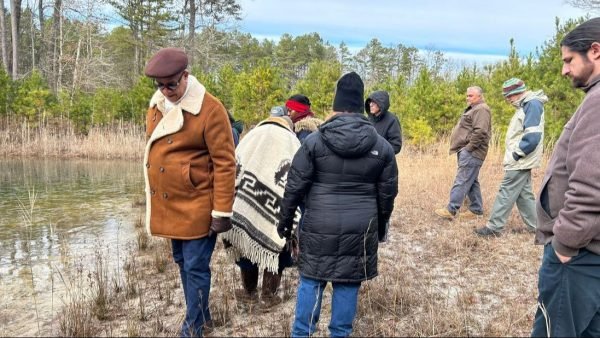
A few miles from the state’s southernmost tip, the Cohanzick Nature Reserve is a cultural center and meeting place for South Jersey’s Indigenous community. It also serves as a testament to the sustainable practices that have helped the Nanticoke Lenni-Lenape people and other Native communities for generations.
Aside from the former church building, parking lot and a wooden pavilion, most of the land at Cohanzick, in Quinton Township, is untouched forest. Plans call to incorporate a garden and clear walking trails, although most of the work is preservation-related so that future generations can also enjoy the surroundings and embrace their culture, avoiding what can be seen as the land’s exploitation.
“Everything we do affects every generation in front of us. We believe that we have to be responsible for everything … the Earth, the land and the water, because it’s not just for us and we don’t own it,” said Tyrese Gould Jacinto, president and chief executive officer of Native American Advancement Corp., the Bridgeton non-profit group that owns the property. “These things are gifts, and we are here as gifts, so therefore we have to take care of it because it’s not just us, it’s our children and grandchildren into the next seven generations.”
The reserve was established in 2023 on 63 acres first inhabited by Native people and eventually owned by a church. The purchase was a collaborative effort involving the advancement corporation, the New Jersey Conservation Foundation, the state Green Acres Program and The Nature Conservancy.
The name Cohanzick was brought back into popularity in 2007 after a reclamation ceremony for 28 acres of sacred land repatriated to the Nanticoke Lenni-Lenape people. The term roughly translates as “that which was taken out,” a reference to land lost through colonialism and land deals.
The conservationist philosophy that Jacinto describes, seventh-generation thinking or seventh-generation sustainability, is often associated with the Haudenosaunee Confederacy in the Northeastern U.S. and Canada. Many projects at Cohanzick follow that thinking.
A few Indigenous traditions, like raised bed gardening and foraging for berries and mushrooms, caught on among home gardens and high-end restaurants across the country. Some practices, though, are at odds with the state’s approach to conservation.
“Even in New Jersey, they don’t let you do foraging, which is crazy,” Jacinto said. “Conservation also has its downfall, and what happens with our communities or communities just like ours? We become collateral damage. We are in the middle because we don’t want to exploit and we don’t want to conserve, but we want to live one with.”
At an early April pre-Easter celebration, some of those traditions were on full display.
Arborist John Barry helped young community members to gather wood from a fallen white pine to make a traditional staff for the spring solstice.
“My grandfather used to come in and clear each section of the forest, and the burnt material from the clearing would be organic fertilizer for the soil,” said Barry, founding director of the Cohanzick Climate Corps. The practice, known as prescribed burning, was used by area Indigenous groups for centuries to maintain the forest and ease travel.
Another participant with ties to the land was Cohanzick field manager Sean Torres, the 24-year-old grandson of former Chief Mark “Quiet Hawk” Gould. Torres was proudest of work to clear and reopen trails that hadn’t been touched since automobiles replaced horses as transportation.
 Credit: (Photo courtesy of the Cohanzick Nature Reserve via South Jersey Climate News)
“This is something that I love to do. I come out here during my free time when I’m not even on the clock, just to get peace of mind,” Torres said.
At the same time, it can be challenging to embrace the land and culture.
“A lot of the places our ancestors fish are all bought up and private property now, so it’s a little heartbreaking to see the things where you hear these stories from your elders and to not be able to follow through with that,” said Lia “Watching Sparrow” Gould, who arranges youth programming for the Lenni-Lenape Nanticoke Nation.
In August, a camping retreat was moved indoors, to the former church building, because temperatures topped 100 degrees, the fallout from climate change.
“The toughest part is we can’t control Mother Earth, right? So all we can do is grow with it,” said Gould’s husband, Ty “Dancing Wolf” Ellis. “There is a decent blend of modern living and our traditional ways that we’re beginning to see, and we’re acting accordingly. It’s good to have this [building] because we can’t control the weather. We can’t control any of this, and I think human beings have that habit of thinking that we can.”



