
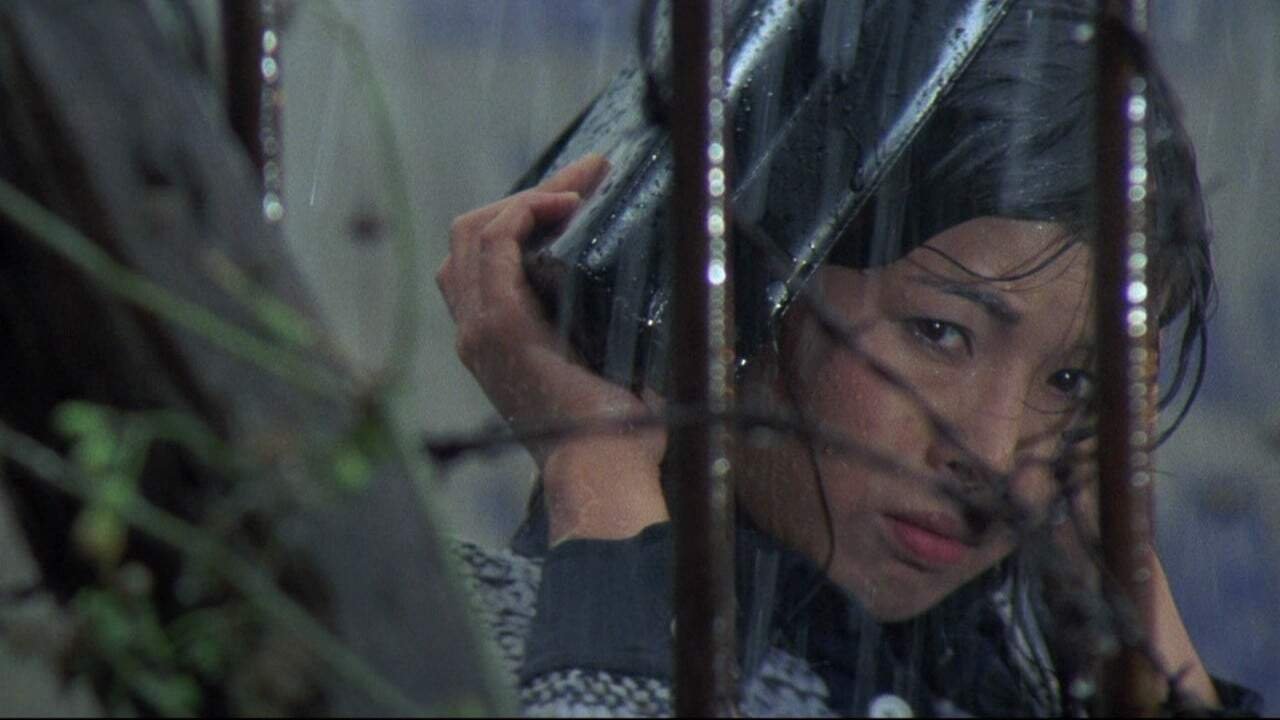
the article focuses on the five entries of the series included in the Angel Gust Collection by Third Window, excluding the first entry in the series, “High School Co-Ed”.
Few Japanese film cycles embody the contradictions of pink cinema as vividly as the “Angel Guts” series. Produced between 1978 and 1994, primarily under Nikkatsu’s Roman Porno banner, the six films adapt the manga by Takashi Ishii and revolve around a recurring heroine named Nami. Sex is central, as expected within pinku eiga, but so is violence. More specifically, sexual violence becomes the recurring narrative trigger that drives romance, obsession, and tragedy.
Buy This Title
on Terracotta by clicking on the image below
Originally serialized in 1977 in the magazine Young Comic, Ishii’s manga introduced the fatal pairing that would define the films: Nami and Muraki. In each variation, Nami is a woman caught between vulnerability and destructive allure, while Muraki, or any male protagonist, represents the man whose fate becomes twisted after encountering her. Their professions and circumstances change from film to film, but the symbolic dynamic remains consistent: a femme fatale who is not necessarily malicious, and a man undone by desire, guilt, or obsession.
From the beginning, the series occupied a paradoxical space. It belonged to Roman Porno, Nikkatsu’s attempt to elevate pink films with stronger production values and more artistic ambition. Directors such as Noboru Tanaka, Chusei Sone and Toshiharu Ikeda brought distinct stylistic signatures to their entries. Tanaka himself once noted that each film in the cycle was different in tone and energy, suggesting that the audience should not be bored by repetition. Indeed, the four installments reveal a surprising diversity in approach.
“Angel Guts: Red Classroom” (1979), directed by Chusei Sone, is perhaps the most openly self-reflexive. Set partly within the adult film industry, it critiques exploitation even as it relies on it. Through fractured imagery, mirrors and layered framing, Sone exposes pornography as both spectacle and purgatory. Nami becomes trapped in a world that promises liberation but delivers stagnation. Violence is not separate from sex; it is embedded within it.
In “Angel Guts: Nami”, Noboru Tanaka pushes the series toward psychological horror and documentary realism. Here Nami works as a journalist investigating rape survivors, only to become consumed by the very subject she studies. Tanaka’s mix of guerrilla-style camerawork and stylised expressionism implicates the viewer in the act of watching. The film oscillates between empathy and exploitation, revealing how easily moral critique can slide into voyeurism.
By the time Toshiharu Ikeda directed “Angel Guts: Red Porno” in 1981, the series reached its slickest form. Though built on a questionable premise, it displayed surprisingly polished craft. Ikeda’s careful use of colour, slow motion and framing suggested ambitions beyond simple titillation. Performances, particularly from the female leads, hinted that Roman Porno could serve as a stepping stone to more conventional acting careers, even if that rarely materialized.
The turning point came with “Angel Guts: Red Vertigo” (1988), when Takashi Ishii himself assumed the director’s chair. Unlike the previous films, which filtered his material through distinct cinematic sensibilities, “Red Vertigo” returned fully to Ishii’s own obsessions. The narrative once again hinges on rape evolving into romance, a concept rooted in outdated psychoanalytic tropes. Nami, now a nurse, is abducted and eventually falls for her captor. The premise is disturbing, and Ishii offers little moral counterbalance. Stylistically, he relies heavily on dim neon lighting, oblique angles and long takes, creating atmosphere but not narrative richness.
When Roman Porno collapsed in 1988, the series appeared to end. Yet Ishii revived it in 1994 with “Angel Guts: Red Flash”, also known as “Red Lightning”. By then, the genre landscape had shifted. Hollywood erotic thrillers were entering global markets, and the boundaries between pornography, softcore and mainstream cinema were evolving. “Red Flash” mixes crime noir with erotic melodrama, offering a labyrinthine plot involving murder, memory loss and paranoia. Though uneven and at times convoluted, it remains entertaining and visually striking, with strong performances and moody cinematography.
Across its six films, the “Angel Guts” cycle repeatedly stages the same unsettling equation: sexual violence as catalyst for intimacy. Nami oscillates between victim, erotic object, scream queen and tragic romantic figure. Muraki, in his various incarnations, embodies obsession and moral weakness. The films critique exploitation while participating in it, creating an uneasy tension that defines the series.
Today, the “Angel Guts” films can feel deeply problematic. Their treatment of rape as narrative device, sometimes even as romantic trigger, clashes sharply with contemporary sensibilities. Yet dismissing them entirely would ignore their historical significance. They document a specific era of Japanese cinema, when Nikkatsu sought to reconcile commercial necessity with artistic ambition. Directors experimented within tight constraints, occasionally achieving surprising visual sophistication.
Ultimately, “Angel Guts” stands as both relic and revelation. It exposes the contradictions of pink cinema: ambition and exploitation, critique and complicity, artistry and sleaze. It also charts the evolution of Takashi Ishii, who would later refine his noir sensibilities in more mainstream projects. Whether seen as troubling artifact or daring experiment, the series remains a fascinating chapter in Japanese genre cinema, anchored forever by the tragic, elusive figure of Nami.



