
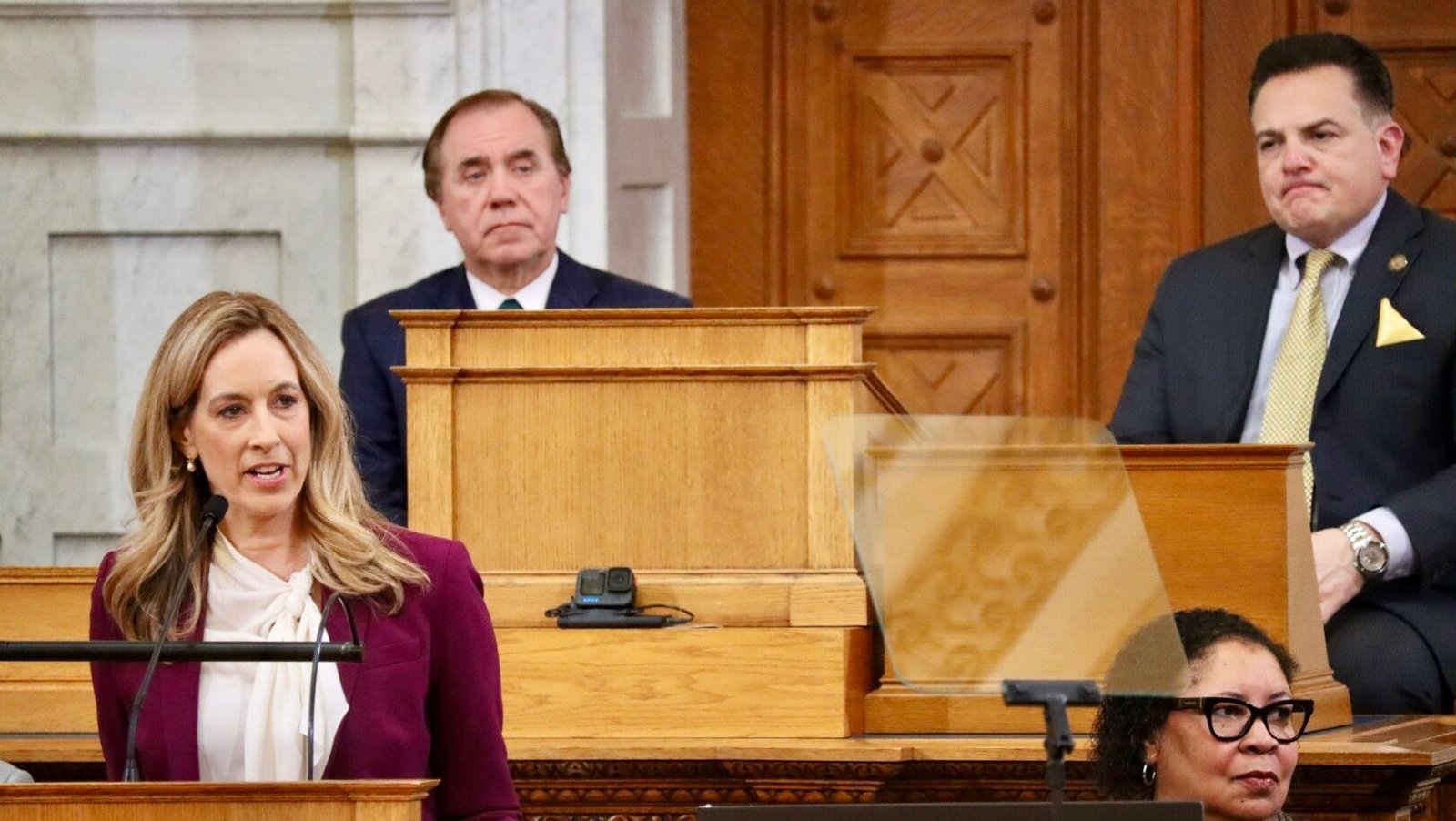
Gov. Mikie Sherrill has proposed a record, $60.7 billion state budget that calls for increased spending on public education and mass transit, and continued major investment in direct property tax relief and worker pensions.
As state government grapples with a significant structural budget imbalance, Sherrill, a first-term Democrat, is also calling for some reductions in planned spending as part of the budget she’s proposed for the fiscal year that begins July 1.
Among the belt-tightening initiatives are proposed changes to the Stay NJ property tax relief program, which currently benefits senior homeowners earning up to $500,000 annually.
Other proposed spending cuts, including numerous line items inserted by lawmakers into the current state budget that didn’t make it into Sherrill’s, are detailed in budget documents released Tuesday afternoon as Sherrill delivered the annual budget message to a joint session of the Legislature in Trenton.
On the revenue side of the ledger, Sherrill is asking lawmakers to approve a series of proposed policy changes to generate an estimated $750 million in new funding for the annual budget, according to estimates shared with reporters during a background briefing Monday.
Administration officials have described these proposals, which would require legislation to enact, as a paring back of corporate tax breaks and related policies.
Taken together, the combination of proposed increases, cuts and revenue changes put forward by Sherrill would result in a reduced — but not eliminated — structural gap between planned annual revenues and future expenditures. But the budget Sherrill proposed for the coming fiscal year, as required by the state Constitution, would be balanced and carry forward a more than $5 billion surplus.
In the run up to the budget address, Sherrill had identified making progress on the structural imbalance, which was estimated to be as large as $3 billion in recent weeks, as a key fiscal-policy goal. Her proposed budget seeks to narrow the gap to $1.6 billion.
“If we do nothing, our entire $7.2 billion surplus will be gone in less than two years – and we’ll be another $750 million in the hole,” Sherrill said during the budget address. “Since our Constitution requires a balanced budget, failing to act now would trigger far worse in the future.”
“It could mean blunt cuts to public services, for everything from school funding to pensions,” she said. “It could mean credit downgrades and higher interest rates, pushing us deeper into debt. And it could mean tax hikes for businesses and families. I won’t let that happen.”
Increased spending
Still, Sherrill’s budget would result in overall annual spending growth during the next fiscal year of about 3% compared to the $58.8 billion budget former Gov. Phil Murphy, also a Democrat, signed into law for the current fiscal year, which ends June 30.
But the annual spending increase sought by Sherrill drops to less than 2% — lower than the rate of annual inflation — when measured against the adjusted budget for the current fiscal year.
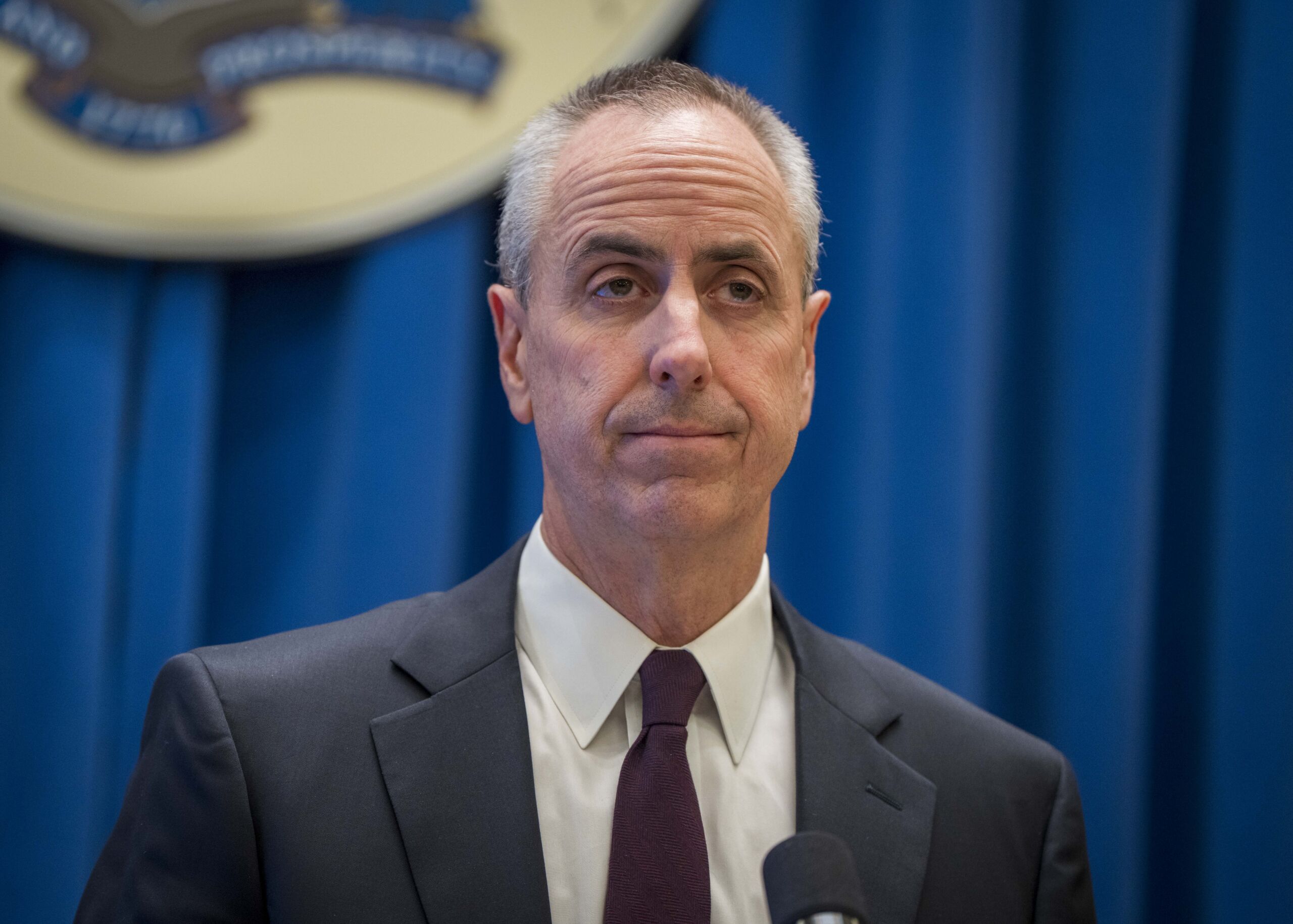 Credit: (Office of Governor / Tim Larsen)
That adjusted version of the current fiscal year budget factors in several supplemental spending items, including new appropriations Murphy enacted in his final weeks in office in early January that were not funded with offsetting cuts or revenue increases.
Meanwhile, Sherrill’s proposed budget also calls for spending down some of the state’s budget surplus during the new fiscal year, with a projected $7.2 billion opening surplus dropping to $5.4 billion by June 30, 2027, state treasurer Aaron Binder said during Monday’s briefing.
That surplus is a key budget reserve used to hedge against unforeseen revenue losses or spending needs, such as those that emerged at the onset of the COVID-19 pandemic in 2020.
And this year, the need to have a robust surplus could become more important due to the ongoing war in Iran, which has already caused a significant increase in gas prices and could threaten to hike inflation and bring on additional economic turbulence.
When asked how the war could influence economic conditions going forward, an administration official said during the briefing with reporters that there’s “a great deal of uncertainty.”
Just getting started
The governor’s annual budget message before the Legislature is just the start of a lengthy public debate about spending and fiscal policy that will play out over the next several months leading up to the July 1 start of a new fiscal year.
Under the state Constitution, the governor has the power to propose a new annual budget, but lawmakers are given the authority to draft an annual spending bill that will become the next budget, assuming it can win the governor’s signature. The new budget must be balanced, and in place by July 1, or the state Constitution requires a government shutdown.

In recent years, majority Democrats in the Legislature have continued a practice of inserting hundreds of millions of dollars in last-minute spending into the governor’s final draft of the budget.
That practice has helped prolong the structural imbalance the state has been running in recent years that Sherrill is now raising as a key concern, setting up a potential point of intraparty conflict as the budget-approval process plays out this spring and into late June.
After the budget address, Assembly Budget Committee Chair Eliana Pintor Marin (D-Essex) told NJ Spotlight News the “devil’s always in the detail” and she was waiting to see more detailed budget documents that are due out in the next few weeks.
“I think there are things that we can all applaud, and there are things that, obviously, we’ve worked very hard as a Democratic caucus to be able to fund,” Pintor Marin said.
For their part, many Republican lawmakers said they were looking to see more fiscal restraint and structural reform than what’s been proposed by Sherrill.
Sen. Declan O’Scanlon (R-Monmouth), a leading GOP voice on fiscal issues, told NJ Spotlight News that Sherrill had “fully vindicated Republican contentions about the dismal shape that the Murphy administration has left us in.”
Still, O’Scanlon said, he wasn’t confident that Sherrill’s spending proposal was the right approach. He criticized what he called higher business taxes and a proposed new income cap for Stay NJ property tax relief.
“This is going to be the largest budget in history,” said O’Scanlon, who was first elected to the Legislature in 2008. “Government taking more money isn’t the way to make things more affordable. This budget is going up by almost $2 billion.”
Helping to drive state spending increases in recent years have been rising allocations for public education, including aid for K-12 public schools provided through the state’s school funding formula.
Under Sherrill’s proposed budget, total spending on formula aid will increase by more than $350 million year over year, according to budget documents distributed during the briefing, to a record $12.4 billion. Five years ago, the state was spending less than $9.3 billion on this line item.
Officials from the New Jersey Education Association, an influential teacher’s union, issued a statement praising Sherrill for prioritizing education funding in her first budget.
“The record level of state aid for school districts that she included will help ensure that New Jersey’s students have the resources and support they need to thrive. That aid also helps keep her affordability promise by reducing property tax pressure at the local level,” the NJEA officials said.
Property tax relief
Meanwhile, planned spending on direct property tax relief programs — another area of the budget that has seen a big increase over the last decade — will top $4 billion in the new fiscal year, according to the budget documents.
Included in this allocation is $2.3 billion for the Anchor property tax relief program, which benefits nearly 2 million income-qualified homeowners and renters in New Jersey.
However, the size of the Anchor benefits themselves would remain flat under Sherrill’s budget. That means the benefits, ranging from $450 to $1,750, will not keep pace with the increased local property taxes and rents many in New Jersey have been forced to cover over the last year as the average property tax bill has risen to a record high, according to data collected by the Department of Community Affairs. 
Meanwhile, Sherrill’s budget would seek to save about $500 million by making changes to the current rules in place for the Stay NJ relief program.
That recently established program sends quarterly rebates to thousands of senior homeowners that are intended to help recipients continue to afford to live out their retirements, and stay in New Jersey, in the face of their rising local property taxes.
However, Sherrill is seeking to lower the Stay NJ income ceiling to $250,000, which would match the upper limit for Anchor eligibility. She is also seeking to also cap the maximum Stay NJ benefit at $4,000, down from $6,500.
Also requiring legislation to enact is Sherrill’s call for increasing revenue by paring back corporate tax breaks and adopting other related policy changes.
The largest item in this category is a proposed temporary capping of a corporate tax deduction for net operating losses, administration officials said. The use of this specific tax break has increased since a 2023 law was enacted by Murphy, they said.
Business-lobbying groups raised concerns about the revenue proposals following Tuesday’s budget address, including a plan to establish a new, per-employee fee that businesses with more than 50 employees receiving Medicaid benefits would be forced to pay.
“This establishes a situation where employers can be penalized even if they offer health coverage for their workers, which is already one of the largest expenses they absorb every year,” said Christopher Emigholz, chief government affairs officer for the Trenton-based New Jersey Business & Industry Association.
In the new fiscal year, a surcharge on top-earning businesses put in place during Murphy’s tenure will generate an estimated more than $765 million in statutorily dedicated funding for New Jersey Transit. The statewide bus and rail agency will also receive a $282 million operating subsidy from the state budget’s general fund under Sherrill’s proposed spending plan.
Meanwhile, more than $7 billion will be earmarked for the state’s public-worker pension fund, a sum that covers the full amount calculated as the next annual employer contribution by the state’s actuaries.
The bulk of that planned annual spending on pension benefits is making up for the many years that saw the state underfund its annual pension obligation or make no pension contribution at all.
That practice of underfunding benefits, which was halted during Murphy’s tenure, built up a significant unfunded liability that will take decades to pay off, according to the latest long-range actuarial estimates.
“New Jersey owes nearly $6 billion a year in back-payments – because for 30 years, other administrations, Democratic and Republican alike, simply refused to pay our bills,” Sherrill said during her budget address.
However, the Sherrill administration has given no indication that any relief will be provided in the new fiscal year to pensioners who have been going without annual cost of living adjustments known as COLAs for more than a decade due to a cost-saving measure enacted during former Gov. Chris Christie’s tenure.
Calls to lift that cost-saving hold have been growing louder amid a period of significant inflation – and after lawmakers, whose jobs are part time, received 67% pay increases this year.
— Elise Young and John Mooney contributed to this report.



