
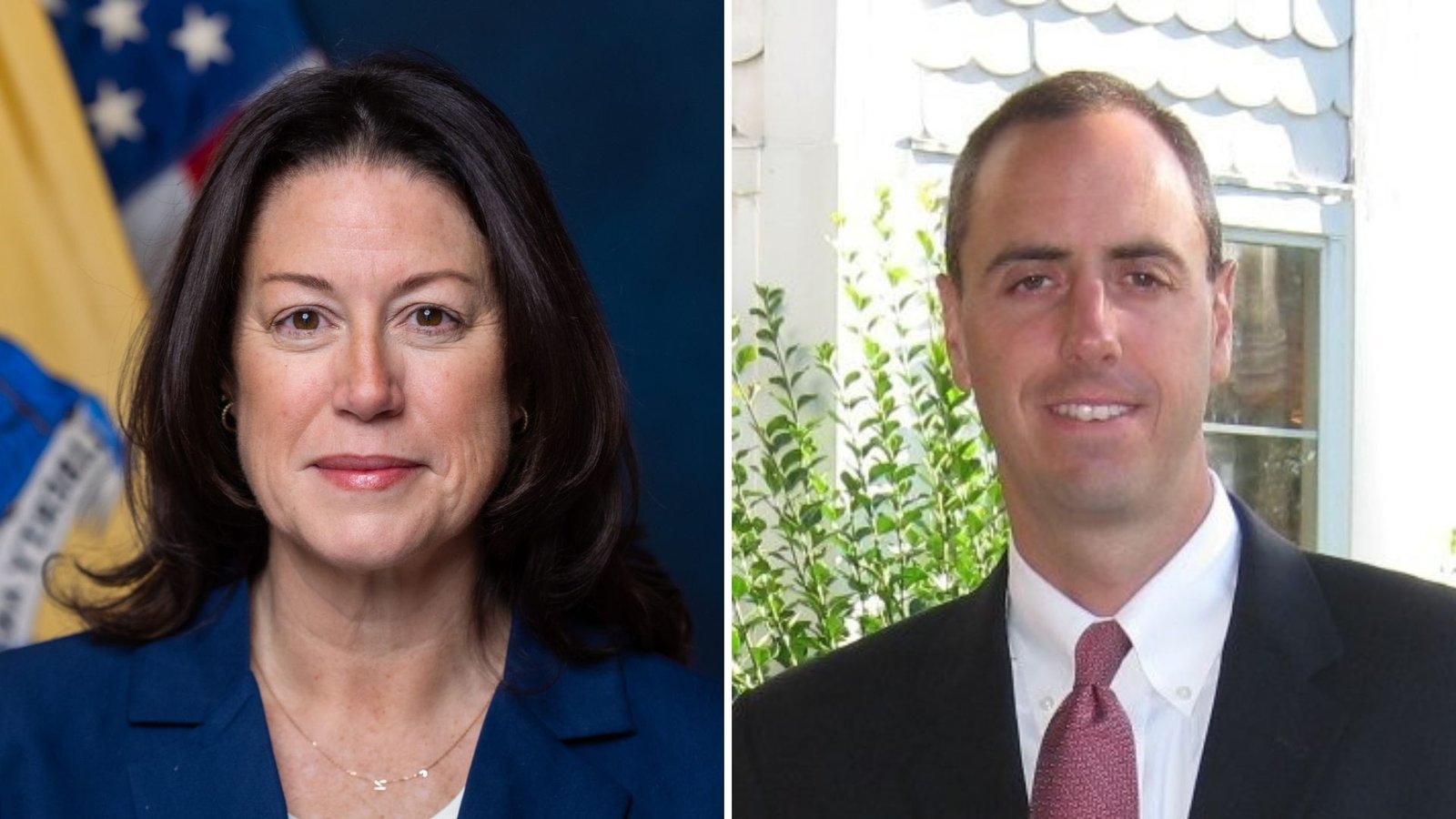
 Two of Gov. Mikie Sherrill’s top cabinet members cleared a key hurdle on their way to winning confirmation from the state Senate.
The Senate Judiciary Committee on Monday approved the governor’s nomination of Jennifer Davenport to serve as New Jersey’s attorney general, the highest-ranking law enforcement position in the state.
That sign off came after a lengthy hearing dominated by concerns about aggressive actions being taken by federal agents seeking to enforce President Donald Trump’s hardline immigration policies.
Also getting the approval of the Senate committee — something needed before the full Senate can consider a gubernatorial nominee – was Aaron Binder, Sherrill’s pick to serve as state treasurer.

Key issues that came up for discussion during Binder’s appearance were the sizable structural gap built into state government’s current fiscal year budget, as well as rising costs that will make it harder to balance the next one.
Sherrill, a Democrat, is a newcomer to state government, but many of her cabinet picks, including both nominees who advanced Monday, have prior experience working in or leading the respective departments they now head in an acting capacity.
Davenport, an attorney, previously worked in the attorney general’s office before spending the last few years in private practice. Binder was recently elevated to acting treasurer after serving the Department of the Treasury as a deputy treasurer during former Gov. Phil Murphy’s tenure.
Davenport went first during Monday’s hearing, and she discussed a wide range of topics with the senators on the panel, including the morale of police officers working in New Jersey and the effectiveness of recent bail reform efforts.
“I think it’s really important to remember how critical independent investigations are, and I think it’s something that we’re not seeing, frankly, from the federal side,” — acting state Attorney General Jennifer Davenport
But it was the concerns about federal immigration enforcement, both within New Jersey, and in places like Minnesota, which has been flooded with federal agents in recent weeks, that were top of mind for many senators as they interviewed Davenport.
“In the absence of sufficient training, they’re operating like a secret police, and violating practices widely accepted by law enforcement, across our country . . . using tactics that endanger all of us,” said Sen. Raj Mukherji (D-Hudson) while discussing the federal agents.
At one point, Davenport was asked by Sen. Jon Bramnick (R-Union) whether state prosecutors can pursue charges against federal agents who violate state law during enforcement operations.
That’s an issue that’s become a key concern in Minnesota after two U.S. citizens were killed in recent weeks during separate incidents involving federal agents.
 Credit: (New Jersey Department of Law & Public Safety)
While Davenport started out by saying most in law enforcement officers act appropriately, she added “there are those that do not.”
“It’s our job to make sure that we hold those folks accountable, regardless of the entity that employs them,” she said. “The unconstitutional nature of actions by law enforcement is something that can be brought, based on state laws, and it’s something that we would look at, for sure.”
“Any of the laws and the rights of the people in our state, if they’re violated by law enforcement, regardless of if it’s state, federal or county, you name it, [that] is something that we would want to make sure that we’re taking seriously,” Davenport went on to say.
Moments later, Davenport also stressed the importance of having law enforcement agencies conducting investigations that are free from political interference. She also contrasted that with the current practice of the Trump administration and its handling of the U.S. Department of Justice.
“I think it’s really important to remember how critical independent investigations are, and I think it’s something that we’re not seeing, frankly, from the federal side,” Davenport said during Monday’s hearing.
“We see this weaponization of the Department of Justice and it’s the complete opposite of the approach that I have to law enforcement, and to prosecution, and how I’ve always handled every case in my career, which is you follow the facts, and you follow the law, and politics is not a part of it,” she went on to say.
Ultimately, Davenport was approved by the committee in a unanimous, bipartisan vote.
When it was his turn, Binder faced mostly technical questions about state finances and individual programs before his nomination was also unanimously approved.
This included the structural budget gap, and what many view as a difficult task that will be facing Sherrill and Treasury officials as they prepare to put forward her first annual budget for state government in a matter of weeks.
Binder said addressing the affordability concerns of residents is a key concern for Sherrill, and finding ways to cut spending is a top priority in the face of the structural gap.
When asked by Sen. Mike Testa (R-Cumberland) if any across-the-board cuts of a certain percentage are being sought by Sherrill, Binder said there have been no “blanket, percentage-based targets” set at this point.
But he quickly added: “Gov. Sherrill is taking a serious approach to finding spending reductions in the budget.”
“The goal is to look at this entire budget, in totality, and find spending cuts in this budget,” Binder said.
Testa also pressed Binder on the issue of added spending that majority Democratic lawmakers have inserted into the annual budget in recent years, often just days before the June 30 deadline for the adoption of a new spending plan, and with little public oversight or transparency.
The awarding of such noncompetitive grants, often referred to as Christmas tree items inside the State House, has drawn scrutiny from Republican lawmakers and others in recent years as the size of the state’s annual budget has grown dramatically.
“I think we all want a commitment that there will be fairness to the Christmas tree, pork process, you know, open transparency, application processes [and] not favoritism,” Testa said.
Later during the same exchange with Testa, Binder said he is “very interested in taking a hard look” at the current budgeting policies to make sure “these funds are spent appropriately.”
This story is made possible in part by the Corporation for Public Broadcasting, a private corporation funded by the American people.



