
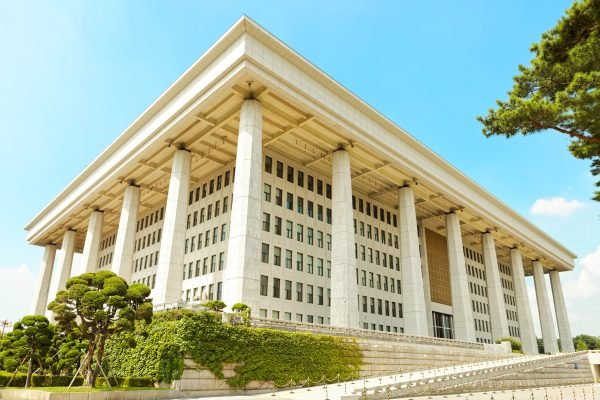
The South Korean government and rival parties in the National Assembly are mounting a rare, concerted effort to avert U.S. tariffs. In an astonishing act of solidarity, the ruling Democratic Party (DP) and the main opposition People Power Party (PPP) agreed to form a special committee to draft and finalize a special bill aimed at fulfilling South Korea’s $350 billion investment pledge to the United States.
Despite persistent gridlock and an ongoing standoff between the two opposing parties, the fact that people’s livelihoods and the national interest are at stake has prompted them to rise above their political differences and join hands in a compromise to fast-track the special bill. This move follows U.S. President Donald Trump’s announcement on January 26, in which he threatened to raise reciprocal tariffs on South Korea from 15 percent to 25 percent, citing delays in the National Assembly’s legislative process to implement the trade deal struck last November.
Given the urgency of the matter, it is evident that both President Lee Jae-myung and the National Assembly are seeking to send a clear message to Washington that they are doing everything at their disposal to expedite the implementation of the trade deal. Furthermore, this bipartisan surprise agreement serves as a testament to the South Korean public that the National Assembly is willing to set aside its differences and cooperate in times of crisis.
Although Lee is not necessarily back to square one on the bilateral trade deal, his pragmatic diplomacy will once again come under scrutiny as he seeks to balance between accommodating Washington’s demands and safeguarding South Korea’s sovereignty.
The ruling and opposition parties have been at odds over whether the Korea-U.S. joint fact sheet on tariffs requires ratification by the National Assembly. The Lee administration and the DP have maintained that, since the document is a non-binding memorandum of understanding (MOU) rather than a treaty, it does not require ratification. They asserted that ratification is unnecessary and could potentially tie South Korea’s hands by binding Seoul to unfavorable clauses.
Speaking at a parliamentary committee on November 17, Industry Minister Kim Jung-kwan warned, “There are concerns that [ratification] could become a shackle while negotiations are continuing.”
The PPP, however, has strongly objected, asserting that a trade deal of this magnitude requires formal ratification and parliamentary consent. Dismissing the PPP’s call, the DP instead proposed a special bill to support outbound investment and swiftly fulfill the pledge.
Amid this political stalemate over the implementation of the trade deal, South Korea was caught off guard by Trump’s sudden announcement to reimpose tariffs. Washington is reportedly wary that Seoul will backtrack on its investment pledge, as the DP has failed to pass the special act despite holding a majority of seats in parliament.
Against this backdrop, National Assembly Speaker Woo Won-shik’s behind-the-scenes mediation played a pivotal role in brokering an agreement between the DP and the PPP. Thanks to Woo’s mediation, DP floor leader Han Byung-do and PPP floor leader Song Eon-seok met on February 4 and agreed to form a special committee to review the “Special Act on Investment in the United States.”
Recognizing the gravity of the situation, the PPP decided to step back from its previous stance of demanding legislative ratification of the trade deal and instead pledged to cooperate with the DP in passing the special bill. Both parties agreed to launch the “Special Committee for the Handling of the Special Act on Investment in the United States” on February 9 and to pass the special bill no later than March 9.
The two floor leaders announced that the special committee will be chaired by the PPP and consist of a total of 16 members: eight from the DP, seven from the PPP, and one from a non-negotiating group. Moreover, both sides decided to include at least one member from each party from the Strategy and Finance Committee, the Political Affairs Committee, and the Trade, Industry, Energy, SMEs and Startups Committee.
Regarding the PPP’s concessions, Song stated, “We made this decision based on national interest considerations following President Trump’s message of tariff hikes.” In tandem, Han said, “By specifying that the Special Act on Investment in the United States will be handled by early March, we have increased predictability.”
Since the reimposition of U.S. tariffs would negatively impact the Korean economy by imposing an additional 4 trillion won ($2.8 billion) annual burden on the auto industry alone, both parties were quick to strike a compromise.
Trade Minister Yeo Han-koo welcomed the move, noting, “I believe the National Assembly’s commitment to moving forward with the legislative process through the rival parties’ agreement will definitely be helpful as Washington has cited the delay in the legislation of the U.S. investment bill as the biggest reason for its tariff hike plan.”
Concurrently, the South Korean government has repeatedly dispatched high-ranking officials to Washington to resolve the ongoing trade tensions, albeit to little avail. Yeo flew to Washington last week in hopes of assuaging U.S. concerns but was unable to meet his counterpart, U.S. Trade Representative Jamison Greer. Instead, he met with Deputy U.S. Trade Representative Rick Switzer, held private meetings with 20 members of Congress, and also met with representatives from the U.S. Chamber of Commerce. Further, from January 29 to 30, Industry Minister Kim Jung-kwan held a two-day meeting with U.S. Secretary of Commerce Howard Lutnick but failed to reach a conclusion on the tariff issue.
On February 2, Foreign Minister Cho Hyun met with U.S. Secretary of State Marco Rubio in Washington to reiterate Seoul’s commitment to fulfilling its investment pledges. The South Korean Foreign Ministry stated in a subsequent press release, “To ensure smooth discussions between the two countries’ trade authorities, they agreed to continued cooperation between their diplomatic agencies.” However, the U.S. Department of State’s press release did not mention whether the tariff issue was discussed. Hence, concerns are rising in Seoul as its top negotiators have returned home empty-handed, with no tangible results emerging from any of the high-level meetings regarding the U.S. tariff hike.
Meanwhile, critical voices are emerging within the National Assembly and political circles over mounting U.S. pressure and Washington’s interference in South Korea’s legislative process through economic statecraft. Speaker Woo expressed regret over Trump citing the legislature’s delay as the reason for the tariff hike, saying, “The National Assembly is proceeding with legislation according to normal procedures.” The ruling party has also defended itself by arguing that the delay in implementing the trade deal was a procedural rather than a political problem.
In a similar vein, Lim Lee-ja, chairperson of the National Assembly’s Strategy and Finance Committee and a PPP lawmaker, asserted, “There was no instance in which the National Assembly delayed the law.”
Minor opposition parties, including the Rebuilding Korea Party and the Jinbo Party, have been critical of U.S. interference in South Korea’s legislative sovereignty.
Nonetheless, the high economic risks at stake have led both the South Korean government and the National Assembly to avoid taking any chances and accommodate U.S. demands.
The larger takeaway from this episode is that Seoul must come to terms with Washington’s transactional diplomacy and remain flexible yet resilient as it navigates growing geopolitical uncertainty. Given that Trump’s tariff hike is not a foregone conclusion, Lee will make every effort to reassure Washington about South Korea’s investment pledge and prevent further escalation. As time is of the essence, the National Assembly’s bipartisan support for a special committee and bill comes at an opportune time for Lee as he leads a concerted effort to alleviate trade tensions with Washington.



