
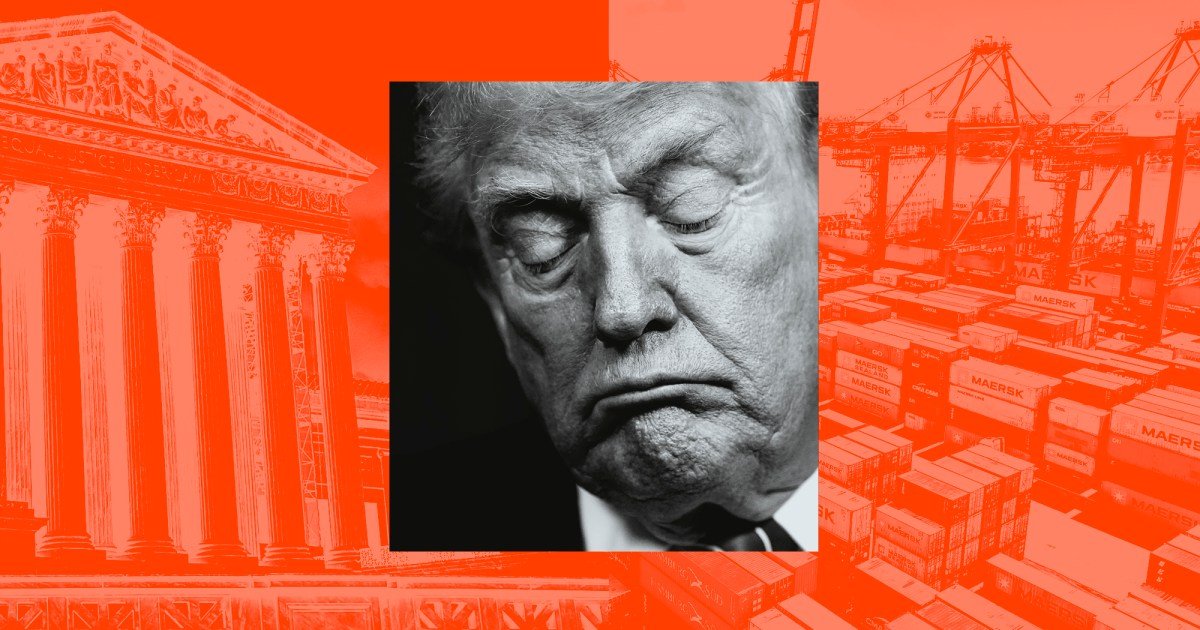
Mother Jones illustration; Alex Brandon/AP; Unsplash
The Supreme Court ruled Friday that most of President Donald Trump’s world-wide tariffs are illegal, dealing a setback to one of the president’s top priorities. Since his second month in office, Trump has set about to impose drastic, varying, and haphazard tariffs on countries across the globe. Trump purported that most of these tariffs were authorized under the 1977 International Emergency Economic Powers Act. But in a 6-3 decision, the justices ruled that IEEPA did not give the president power to impose tariffs. Trump will now have to turn to other, more limited statutes to impose his unilateral tariffs.
Although the outcome is a clear loss for Trump, the court is likely doing him a favor.
IEEPA authorizes the president to respond to “any unusual and extraordinary threat” from abroad, including through the power to “regulate… importation or exportation.” The Trump administration argued that the word “regulate” encompassed “tariff regulation,” which Solicitor General John Sauer described during oral arguments as “the quintessential, most historically-tested method of regulating imports.” But the justices disagreed, finding the words “regulate” and “importation” are not enough to give the president uninhibited tariff power.
“Based on two words separated by 16 others in Section 1702(a)(1)(B) of IEEPA—’regulate’ and ‘importation’—the President asserts the independent power to impose tariffs on imports from any country, of any product, at any rate, for any amount of time,” Chief Justice John Roberts wrote in his majority opinion. “Those words cannot bear such weight.”
To use IEEPA, Trump had taken a capacious view of the meaning of “unusual or extraordinary threat.” For tariffs on Canada and Mexico, he said it was because they were letting fentanyl across the border. For dozens of other countries, he seized on decades-old trade deficits that most economists agree are not a big deal. For Canada (a second time), he pointed to a World Series TV ad that offended him. For Brazil, it was the gall to prosecute a former president for trying to overturn the results of an election. Trump argued that it was his power alone to declare such emergencies, and that these declarations were unreviewable, even by the courts.
Roberts dispatched with this argument by saying that Congress could not have handed the president such broad powers over matters generally reserved for itself—the power to impose tariffs—without more explicit language: This view “would replace the longstanding executive-legislative collaboration over trade policy with unchecked Presidential policymaking,” Roberts wrote. “Congress seldom effects such sea changes through ‘vague language.’”
Although the outcome is a clear loss for Trump, the court is likely doing him a favor. Trump’s sweeping and erratic tariffs are a drag on the economy. They increase uncertainty and stymie investment. They raise prices and decrease employment. The result is a weaker economy heading into this year’s midterms—a downward trend that is likely to continue through the 2028 elections.
The Republican-appointed 6-3 court majority depends on Republicans winning at the ballot box, as does the pro-business, pro-Christian nationalist, anti-democratic agenda the conservative justices are enacting. They surely understand that this project could be undermined by a tariff-fueled recession, even if Trump himself doesn’t seem to get it. To bring the point home, the case was argued the day after Democrats overperformed in November elections in New Jersey, New York City, and Virginia, winning voters worried about high prices.
The best way to understand this case was not as a tricky task of legal or constitutional interpretation, but rather as an attempt to mediate between two competing factions of the Republican firmament. On one side is Trump, who has used tariffs to dole out rewards and punishments on businesses, individuals, and other countries. On the other side were some of the biggest GOP funders, including the Koch network, who are generally committed to a pro-corporate, libertarian capitalism. These longtime GOP funders prefer Trump to a Democratic president, but they don’t want him to completely take over the levers of the economy. Groups funded by the Kochs and likeminded tycoons funded some of the libertarian legal nonprofits that launched lawsuits challenging the tariffs. These same funders also poured millions into the Federalist Society and other outside groups that helped ensure each of the six Republican appointees made it to the high court.
The result is that the court’s GOP-appointees were mediating a disagreement between two parents who maintain a sometimes rocky marriage—the funders who enabled their majority, and the president who will protect it and who personally appointed three of them. The justices had to pick a parent in this fight, and enough of the conservative wing picked the billionaires and big business over Trump.



