
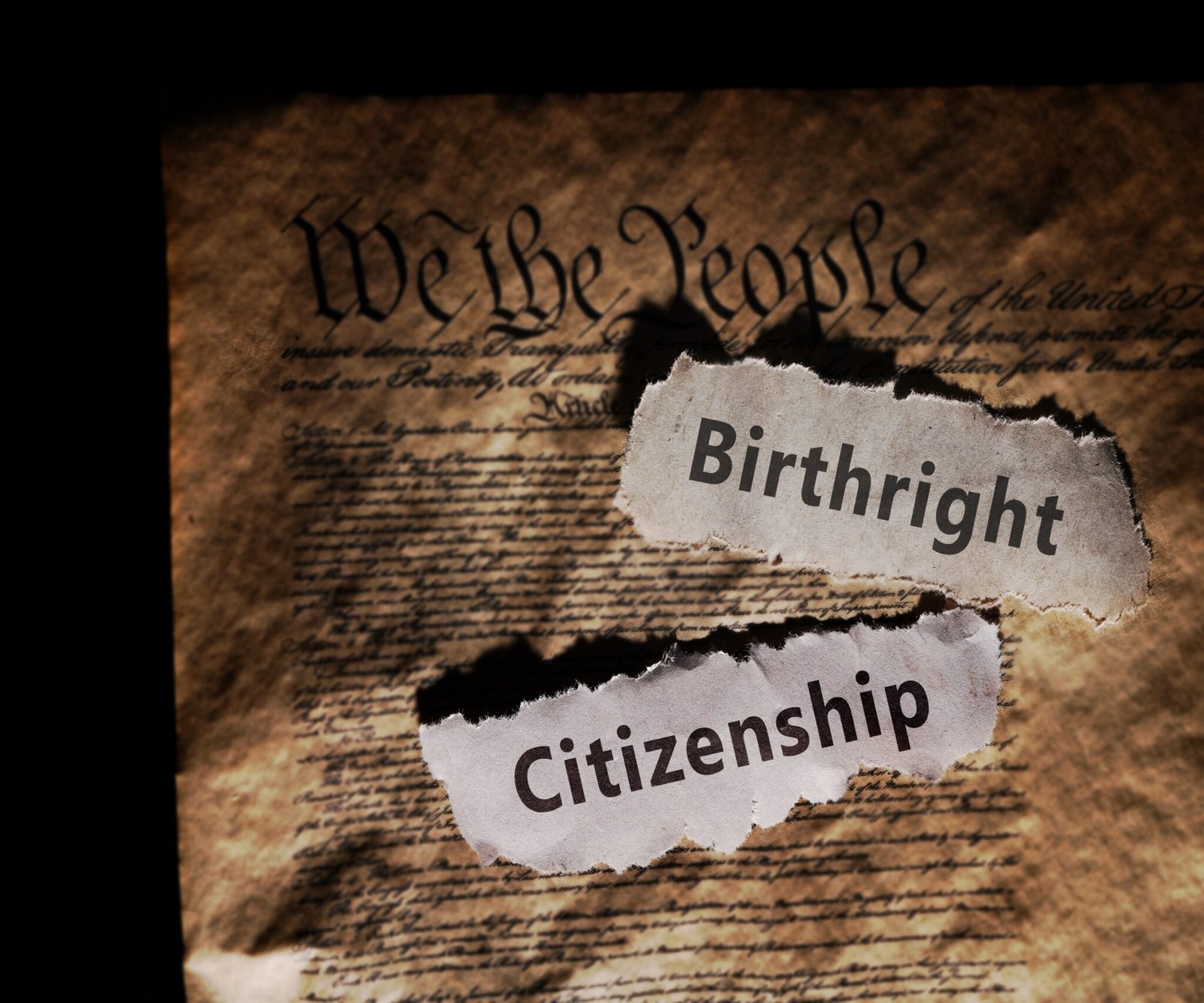
WASHINGTON — The U.S. Supreme Court will hear oral arguments Wednesday in a case that could reshape the understanding of who is American by birth.
The case, Trump v. Barbara, challenges President Donald Trump’s executive order that redefines citizenship to exclude children born to parents who either do not have legal status, or hold temporary legal visas.
It has the potential to upend the guarantee of birthright citizenship in effect since a Supreme Court decision in 1898 that extended citizenship to virtually anyone born in the United States. There is a small carveout for children born to foreign diplomats.
The Trump administration petitioned the high court in December after multiple lower courts struck down the executive order, finding it violated the Constitution.
Birthright citizenship has been a longstanding core principle in the United States, where nearly any child — regardless of their parents’ immigration status — born on U.S. soil is automatically granted citizenship. Experts have warned that if birthright citizenship were struck down, it would effectively create a class of millions of stateless people.
But what was once a fringe legal theory has been pushed into the mainstream by the president and his far-right allies, who have sought to redefine who is American.
They argue the citizenship clause of the Constitution’s 14th Amendment, which is the basis for birthright citizenship, was meant to apply to newly freed African American slaves after the Civil War, not to children of immigrants. Most legal scholars and historians disagree with that interpretation.
The text of the clause is: “All persons born or naturalized in the United States, and subject to the jurisdiction thereof, are citizens of the United States and of the State wherein they reside.”
After oral arguments are heard on Wednesday, a decision from the Supreme Court is expected before the court’s summer recess begins at the end of the term in late June or early July.
19th-century case
This is not the first time the Trump administration has brought a birthright citizenship case before the Supreme Court.
Last year, after federal judges in Maryland, Massachusetts, New Hampshire and Washington state struck down the president’s executive order, the Trump administration appealed to the Supreme Court, but asked the justices to consider the lower courts’ use of universal injunctions, rather than the merits of birthright citizenship.
The justices took up the case, and in a 6-3 vote divided along ideological lines, the use of universal injunctions was curtailed by the conservative wing of the high court.
After the ruling, immigration advocates and the American Civil Liberties Union filed class action suits, which were successful in blocking the birthright citizenship executive order. The suits argued that future children born in the United States without gaining citizenship constituted a nationwide class.
Cody Wofsy, of the ACLU, is a co-lead attorney in the case and told reporters last week that the Supreme Court already decided the issue of birthright citizenship in 1898.
“The constitutional text is clear, the precedent is clear and the history is clear,” Wofsy said.
The 1898 case, United States vs. Wong Kim Ark, settled the idea that automatic citizenship was granted to children born on U.S. soil, Wofsy said.
Ark, born in San Francisco, was denied entry back into the country after visiting China. Officials at the time argued that because his parents were Chinese citizens in the United States on temporary visas at the time of his birth, and therefore were not “subject to the jurisdiction” of the U.S., he was not a citizen. He took the issue to the high court and in 1898 the Supreme Court affirmed that children born in the United States were guaranteed citizenship.
Arguing on behalf of the Trump administration, Solicitor General D. John Sauer has said that the 1898 case is being misinterpreted, and that it meant to only include children born to parents who were granted authorization to be in the U.S.
“Illegal aliens are not ‘permitted by the United States to reside here,’ and thus their children are excluded from citizenship,” Sauer argued in briefs.
However, Trump’s executive order would also deny citizenship to children born to parents on temporary visas, such as for work or school.
Sauer also relies on an 1884 Supreme Court decision that denied citizenship to John Elk, a Native American man born in Nebraska, who was no longer a member of his tribe and tried to become a naturalized U.S. citizen in order to vote.
Elk was denied citizenship, because he was not “subject to the jurisdiction of” the U.S. because of his “political allegiance” to his tribe, even though he had renounced his tribal citizenship. Congress extended citizenship to all Native Americans in 1924.
Sauer cites the Elk case in his argument that the citizenship clause does not apply to children born to immigrants on temporary visas or undocumented people and “only to those born of parents with primary allegiance to the United States.” The administration is not arguing that Indigenous people should be denied birthright citizenship.
Torey Dolan, an assistant professor at the University of Wisconsin Law School, said Sauer’s argument wrongly conflates Indigenous people with migrants, despite a long U.S. legal tradition of treating them distinctly.
“American law has always found a way to distinguish Indigenous people from non-Indigenous people in a way that has never been applied to immigrants,” Dolan, an enrolled citizen of the Choctaw Nation of Oklahoma, said.
She noted that in the Declaration of Independence, which includes the grievances of the colonists, one complaint was how British King George III refused to allow for migration into the colonies in order to occupy land stolen from Indigenous tribes.
“This conflation of immigrants and Indigenous people, for the sake of this argument, I think, is pretty egregious, and I think it really obfuscates American history and its colonial history in particular,” she said.
‘Pure chaos’
Legal advocates challenging the executive order are confident they will win at the Supreme Court.
“President Trump’s executive order is plainly unconstitutional and unlawful, and we’re confident that the Supreme Court will reaffirm existing legal precedent and strike down this executive order once and for all,” Hannah Steinberg, a staff attorney for the ACLU’s Immigrants’ Rights Project, told reporters.
In briefs, the ACLU has also argued that if Trump’s executive order were to go into effect, it would create a stateless class of people. The Migration Policy Institute, a think tank that studies migration, found that the end of birthright citizenship would increase the unauthorized population by an additional 2.7 million by 2045.
Trump’s push to end birthright citizenship is part of the administration’s broader goal to curtail migration to the U.S., arguing that birthright citizenship is an incentive for unauthorized immigration.
But the idea that people migrate to the U.S. so their children can be born as citizens is not supported by research, Julia Gelatt, the associate director of the U.S. Immigration Policy Program at the Migration Policy Institute, said.
“People move mainly for opportunity for themselves and their children and also for safety,” she said. “There are many unauthorized immigrants who have come to the United States with their own children, who were born in another country, who won’t be U.S. citizens, and they still come.”
“I don’t think there’s any evidence that birthright citizenship specifically is an independent pull factor. It’s more the safety, the rule of law and the earnings potential that people see in the United States, and the opportunity to reunite with other families is another major factor,” she continued.
Ama S. Frimpong, the legal director for the immigrant rights group We Are CASA, told reporters that there are practical questions to how Trump’s executive order would even work.
“What happens in a household in which there are older children who are born here and now, suddenly they have a new baby who’s born tomorrow, and that baby is not going to have the same rights that their siblings have?” she asked. “Is a baby going to be subject to detention and deportation by their very own government that is meant to protect them because they were born here?”
That reality of birthright citizenship being stripped, Frimpong said, would be “just pure chaos.”



