
Published February 11, 2026 06:00AM
It’s late at night, you’re in a bar, and the alcohol is flowing. What’s more natural than to trace a route across an archipelago on a napkin and challenge your mates to a race – losers buy dinner? It’s the sort of carefree multisport yarn that’s awash with nostalgia and ripe for embellishment that helps sell a sport to the masses.
In this case, it was 2002, the destination was Sandhamn in Sweden, and the “Original Four” were Anders Malm, his friend Janne Lindberg, and two staff from Malm’s Utö Värdshus hotel. SwimRun was conceived that night, the race was completed in 24 hours, and despite a chunk of chafing and some discombobulation, there was a real belief that this weird little race might just catch on.
Has it? Well, roll forward almost a quarter of a century, and World Triathlon approved a congress motion in Australia last fall to formally add SwimRun as an official discipline under its umbrella. This rubber-stamping by the international federation was taken as part of a broader effort to drive sustainable growth and commercial evolution of the sport, as recommended in last year’s World Triathlon and Deloitte Events Study.
But will more formal inclusion help elevate SwimRun’s visibility and credibility, attract more athletes, national federations, and event organizers to the discipline? Or will it remain as a niche for pioneering adventurers who like open-water swimming in remote locations, scrambling over rocks, and don’t shudder at the thought of cutting the legs off expensive neoprene so they can run more efficiently?
Big dreams for SwimRun
John Wyatt is World Triathlon’s secretary general, charged with setting up a task force of national federations to explore SwimRun’s potential.
“At the end of last year, we sent surveys to national federations to ask who has SwimRun interest and athletes, and we had a good response,” he explains. “We’re in the early stages of planning, but working on two workstreams, focusing on one with Ötillö as a private organization, and the other with national federations.”
That work should be completed in the first half of the year, with targets to follow. For now, Wyatt cited one piece of feedback that suggested athletes often race to “complete rather than compete,” but the more elite attention SwimRun gains, the more clarity will be required on governance.
“It’s not [World Triathlon] coming in and saying SwimRun needs to conform, but the sport coming to us to improve existing frameworks and the rules and regulations of events.”
Wyatt mentions Ötillö (pronounced err-till-err), which is Swedish for “island to island.” It is not just the best-known brand of the sport but perhaps the best definition of how SwimRun differs from the more sanitized version of aquathlon, with multiple swims and runs back-to-back over various distances.
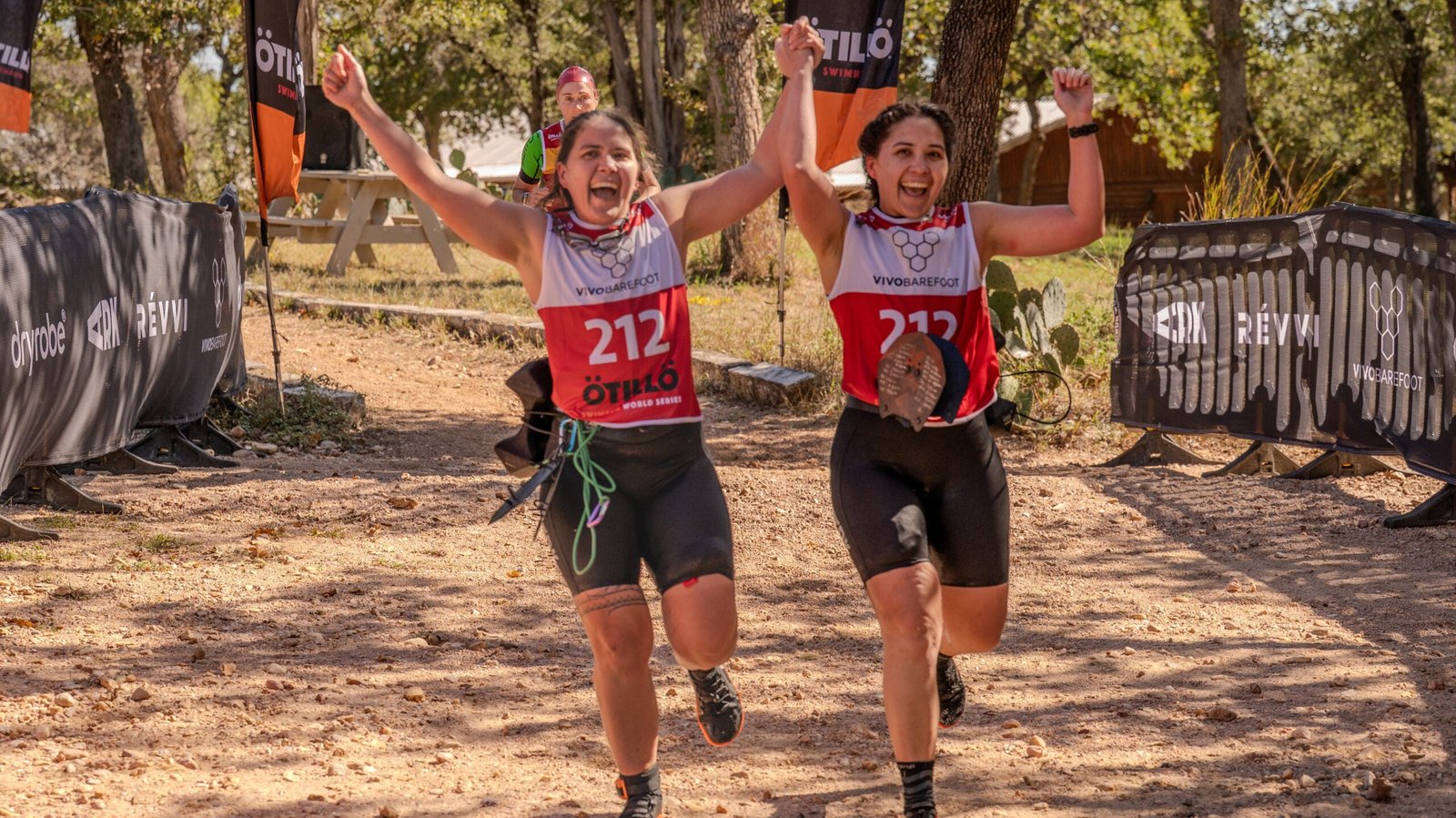
Under Swedish adventure racers Michael Lemmel and Mats Skott, Ötillö began in 2006 with just a handful of participants. While SwimRun has since grown into a global movement, with races across multiple continents serving as qualifiers for the World Championship in Sweden, it still attracts a select field.
Who races SwimRun?
Just over 150 SwimRun races are listed for 2026 by the Löw Tide Böyz, SwimRun enthusiasts based in Northern California. Data provided by TriFind found that the number of Ötillö finishers globally has grown steadily from 2,979 in 2022 to 3,831 in 2025 as the series expanded from 10 to 13 races.
But that’s a fraction of the 250,000-plus athletes who signed up for Ironman last year. Despite not having a bike element, hosting events isn’t necessarily cheaper. SwimRun’s course logistics mean costs are on par with triathlon—$100-$600 in the USA, with prices going up in line with distances.
Lars Finanger, who runs Ötillö in the USA, says 2026 will mark a decade of SwimRun in North America with Ötillö Casco Bay Islands in Portland, Maine, on Sunday, August 9, being the first and longest-running event.
Finanger says over 7,000 athletes have tried one of the races across the different categories on offer from super sprint (called “experience”) to long distance (“World Series”).
“We’ve had events struggling to reach 200 athletes, including Mackinac Island, Michigan, and Whistler, Canada,” he explains. “While others like Austin, Texas; Orcas Island, Washington; and Casco Bay Islands, Portland, Maine, are seeing participation reach 400-plus athletes.”
While traditionally a long-distance team sport, Finanger also says that they’re seeing the biggest growth in the sprint and solo divisions. “We think solo is popular because SwimRun is still a fairly new sport,” he explains. “It is easier for someone to merely sign themselves up instead of making the effort to look for a friend or training partner who might be a good match for the team division.”
“Also, many of our athletes have some level of triathlon racing in their background, so an individual pursuit is an easier concept for them to imagine.”
As with a lot of multisport terminology, the term “sprint” is somewhat misleading. While distances vary depending on the course, a “sprint” distance of 7 miles of trail running and 2 ½ miles of swimming would give the uninitiated a few shivers, no matter how thick the neoprene.
The elite have few such concerns. In a contest routinely dominated by the Scandinavians, the World Championship mirrors Ironman times for completion, with an attritional 20-plus miles of trail running – including scrambling over rocks – and almost 5 miles of swimming.
“Think: triathlon in the 1990s”
Andy Blow is the founder of Ironman’s global nutrition partner, Precision Hydration, and also a talented amateur multisport athlete. He’s taken part in numerous SwimRun adventure races, making him ideally placed to give his view on its attractions from both an athlete and brand perspective.
“The appeal for me, and I think for many others, is that it’s raw, adventurous with the outdoor element, and takes place in some epic places so you get to scratch a travel itch,” Blow says. “It also feels, or maybe felt, more friendly and niche – think: triathlon in the 1990s – and there are less established performance norms, so people are having fun playing with kit selection, such as working out the best shoes, wetsuits, floats and paddles.
“If you like tinkering with gear, this is a big plus. The pairs idea is also huge. It’s rare to find an endurance event where you get to race with a mate, and I think the team element is a big part of the appeal for many people.”
In terms of why SwimRun might struggle to break from its multisport niche, Blow believes it appeals to athletes of a rarer skillset. “From the participant’s point of view, being a strong swimmer is mandatory, so that can be limiting because many athletes coming to multisport late, who struggle with the swim anyway, are put off by that.”
No bike, no problem?
On first take, removing the bike element from a triathlon – often the part that gives organizers the most logistical challenge – should make finding suitable venues easier. The reality is different.
With most entrants drawn by scenery and adventure, the idea of multiple swims in the same lake, for example, rarely cuts it. Instead, the hunt is on for multiple bodies of water to create a unique, compelling course, such as the Stockholm Archipelago in Sweden or the Isles of Scilly, situated 20 miles off the south-west English coast, or the San Juan Islands of Washington State.
Blow agrees. “Venues are obviously way more limited than for tri/run/cycle events so that limits the potential scale. Safety is also an issue for organisers, as keeping a lot of cold, tired people safe in the water over a vast distance is tricky.”
This is the reason Rob Macleod, who runs Epic Events in the UK, has never hosted a dedicated SwimRun event, despite layering on aquathlons as part of a larger multisport festival.
“I felt it would be too expensive to attract enough participants due to several hundred SwimRunners getting in and out of the water in several different places, and sometimes in different bodies of water, which would mean the water safety teams would need to be considerably larger than for a triathlon or open water swim race that followed the same lap course,” he says. “Among the different types of events that we operate, we have three end-to-end lake swims which require large water safety teams – 90 kayakers and 20 motor boats for our end-to-end Windermere swim [in the Lake District] with approx 500-600 swimmers in the water.”
If, for example, there was a SwimRun route with four different swim sections that were too far apart to logistically get the water safety teams to cover more than one section at a time, Macleod says it could easily require similar levels of water safety resource, which totalled £30k [for the Windermere event] in 2025. “That’s just for water safety at the event,” he says. “It is a similar story with the medic team, which would need to be able to cover the swim sections and the run sections simultaneously.”
By the time Macleod factors in the remaining costs such as venue hire, insurance, permanent and contract staff, volunteer support costs, vehicles, medals, timing and more, then to make it commercially sustainable he believes SwimRun becomes a “very expensive sport.”
The business of SwimRun
Given its niche nature, does it make SwimRun an attractive proposition for brands? “It’s hard to say how much product we’re selling to SwimRun specifically,” Blow says, with his Precision Fuel and Hydration hat on, but it’ll be a tiny amount in comparison with all of our mainstream endurance sports.
“It would not feature in a strategic conversation around business growth. We support it and support some races and racers because we really believe it’s a great, cool sport that we do ourselves. But the limited size of the market means it’s not really a growth opportunity for a business at the scale we’re at now.”
Dean Jackson, founder of wetsuit specialists, Huub, is less charitable, describing SwimRun as a “fad” that started in 2015 and doesn’t expect it to ever rise beyond a specialist niche.
“SwimRun came at us like a tidal wave of excitement, like disc brakes for road bikes,” he explains. “We were expecting a [changing] trend in athletes’ racing habits, but sadly, the shift of multisport athletes to this new category was short-lived. Demand and noise were high, but the true volume was overestimated and quickly disappeared.”
A page on the Huub website details how SwimRun wetsuits vary from typical triathlon wetsuits by having a front (not rear) zipper to allow for easier access when going from swim to run and vice versa, and a thinner crotch to allow for more fluent running. They also come with sealed leg seams so you can choose where to cut them off yourself – usually just above the knee, and neoprene arms that can also be cut, although many athletes leave them intact.
Jackson continues: “Thankfully, we came away from large production volumes before we got stung with inventory. We now produce for major global retailers wanting a value offering for those racing SwimRun as hobbyists and as suits for training and warmer weather in order to make the small sales numbers match the minimum order quantities from our factories.”
SwimRun’s biggest barrier? The swim.
Jackson suggests that, given the financial outlay for a destination SwimRun event in the fjords of Scandinavia or exclusive islands away from main transport hubs, most triathletes would rather take their bikes and make it a triathlon. More pertinent still is the barrier to entry: swimming.
“Here’s a sport that is predominantly swimming, and 85% of triathletes do not come from a swim background. You’re [looking to attract] the 15% [Triathlon Industry Alliance puts the figure closer to 20%] that enjoy and excel at it, and you’ve got to get used to swimming with shoes on. It’s like fell running, a niche, unique sport, and those who do it enjoy being the continued pioneers.”
Despite the cautionary notes, World Triathlon’s Wyatt remains optimistic that SwimRun’s future can continue to be complementary in the multisport space, even the already existing discipline of aquathlon.
“Hopping in and out of lakes and lagoons is just really different,” he says. “And the biggest thing [from the survey feedback] is the number of federations who have shown an interest, and the number of athletes and events being bigger than we thought.”



