
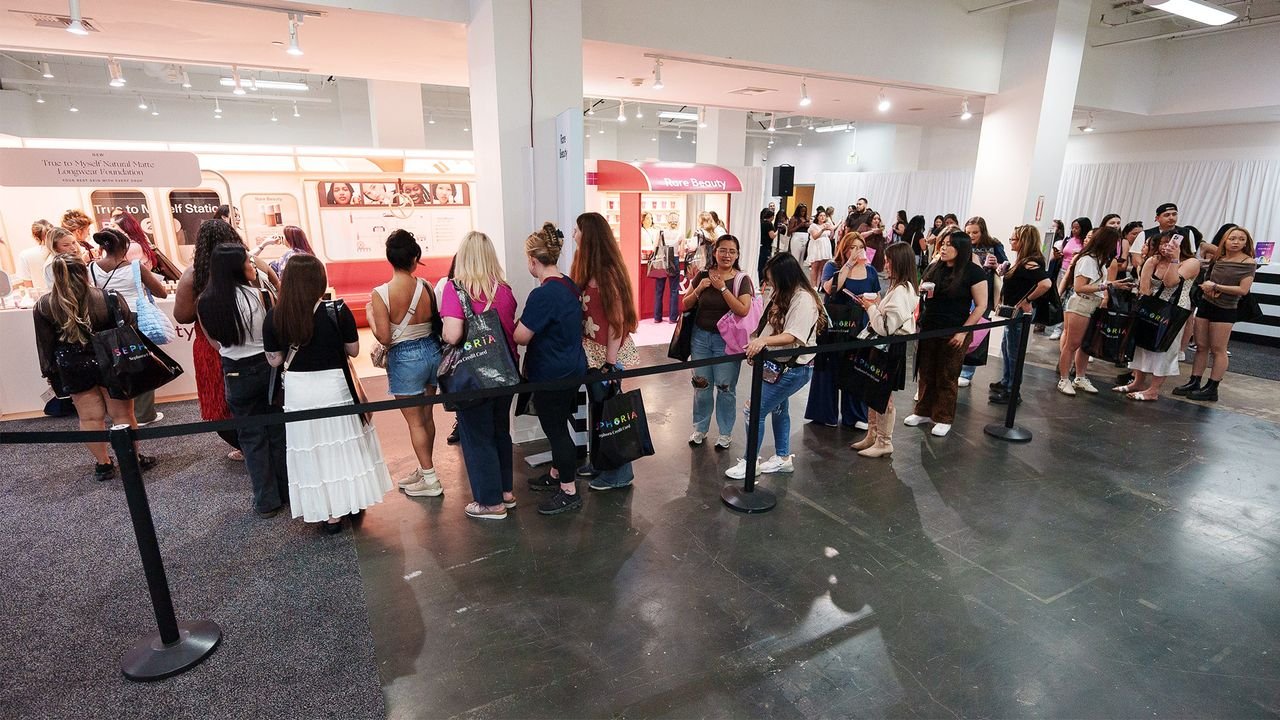
“I want a beauty freak show,” my friend Chelsea Fairless said as we were weaving our way through the line to enter Sephoria. Together, as women in our 40s, we had made the pilgrimage to the warehouse-like Magic Box at The Reef in downtown LA, where the multinational beauty chain Sephora was staging its annual fan conference. It started in 2018 in LA and did a detour over the last few years in other cities (Atlanta, Paris, Shanghai, Rio de Janeiro). And now it was back on the West Coast. Over 8,000 attendees gathered over two days in March to see elaborate booths from more than 65 companies, including Rare Beauty, Kiehl’s, YSL, and Summer Fridays. But what attendees had really spent between $155 to $465 on, beyond the VIP tickets and the heaving bags of swag, was the chance to see master classes and fireside chats from founders of the brands who had become celebrities in their own right: Pat McGrath, Jen Atkin, Danessa Myricks, Mario Dedivanovic, and Patrick Ta. The event had sold out in less than three hours when tickets were first released.
Inside, spread out over three floors, was a 14-year-old girl’s personal obsessions all brought to life under one roof. Almost everything was pastel, from the product packaging to the colors of T-shirts attendees favored. There were certainly plenty of beauty products to sample, from toners and foundations to lip stains and gourmand perfumes, but there were other freebies that catered more widely to the adolescent demographic: chilled Alani Nu and La Croix (the latter was also giving out baseball caps); a nylon holder that an iced coffee could fit into that could be worn around the wrist; a thumb-size bottle of sunscreen meant to dangle from a handbag. I can understand why spending a Saturday among the kind of person who screams, “Look at that,” with the shrill urgency of a fire in a theater, only to see it was Pat McGrath lining someone’s lips may not be everyone’s personal idea of heaven.
There were fewer children than I had anticipated but the median age was nonetheless people born after Y2K: late teens or very early 20s. It was as crowded as a Friday night at a county fair, with similar energy of people being hopped up on sucrose and novelty: long lines that fans were all too happy to wait in, selfies being snapped everywhere all the time. The brand’s most notable demographic has become teens. These teens have a different relationship to beauty than any previous generation. They have been raised on YouTube makeup-artists-cum-influencers like Jackie Aina or actors like Issa Rae, both of whom have beauty brands at Sephora and both of whom attended Sephoria. Sephora is undeniably an entrenched part of pop culture. And the global beauty industry is, well, enormous. It was valued at $450 billion in 2025, with McKinsey analysts expecting the market to grow 5% annually through 2030. Sephora, which is owned by LVMH, employs roughly 56,000 people and makes more than $18 billion in revenue a year. Sephora teens, as the demographic is jokingly known, are now a consumer class with real buying power now. Or at least the ability to successfully influence their parents that $45 eyeshadow pallets and contour and face stars are worth bumping up their allowances for.
To disregard Sephora and its fans would be like writing off Bravo Con or Comic Con. Chelsea, a proud Swiftie, compared it to the Eras Tour. “It’s positive, inclusive, hyper-feminine and the kind of place where people hold open the door for you.” Still I felt out of place. It was loud. There was nowhere to sit. It was so crowded that people were bumping into each other everywhere. And I am no stranger to Sephora. I started shopping there in the late ’90s on European vacations, before they came to America. It felt like a very hallowed temple to feminine arts, a place where employees wore all black and a single glove and would carefully select the right shade of cool red lipstick for your complexion. By the time they expanded to the United States in 1998, it was my beauty go-to rather than the department stores where my mother and her fellow Baby Boomers stocked up. I bought my first moisturizer at Sephora’s SoHo location, and I still shop at Sephora to this day. My last visit had been just three days before to buy a mini hair spray and mascara to wear to a party. But Sephora no longer feels pristine and adult. Seemingly half of the testers in the gondolas (Sephora-speak for brand shelving) at their Beverly Hills location looked like they had been ransacked by zombies. As far as market share. Sephora is experiencing the creep of competition from the likes of Ulta, which has many of the same brands, Amazon, and TikTok Shop.



