
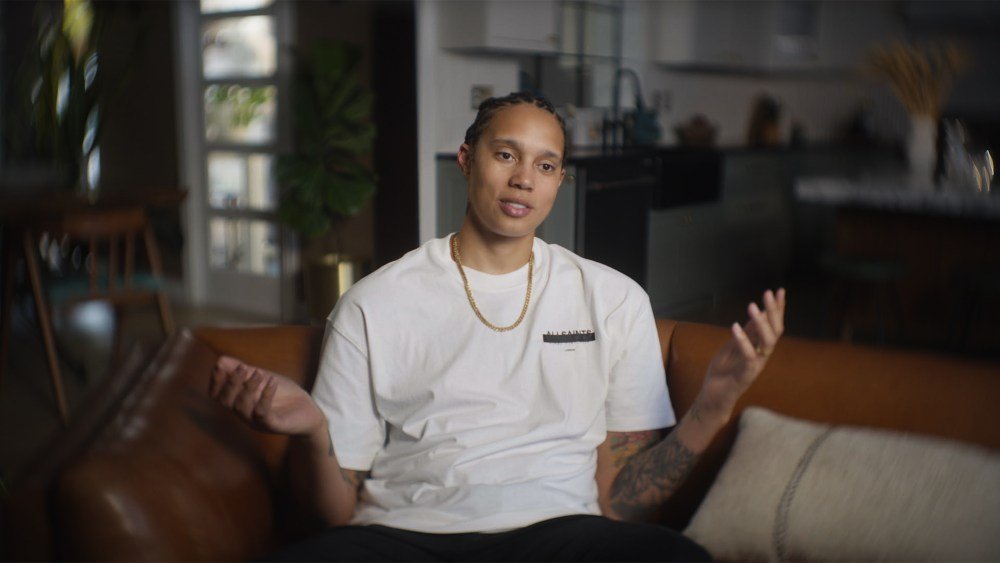
The use of close-circuit video footage in a film has a way of suggesting a crime. The images from a ceiling surveillance camera of the basketball star Brittney Griner approaching the screening machinery in the Sheremetyevo International Airport in Moscow and, a short time later, of the security officers working their way through her baggage offers a case in point. Only the crime in the “The Brittney Griner Story” — an ESPN “30 for 30” documentary that premiered at the Sundance Film Festival — isn’t the half-empty cannabis cartridge pen they find but the wrongful detainment of an American citizen for political purposes. Doubtful? You won’t be after watching the biographical dive into the live and ordeal of the WNBA star by director Alexandria Stapleton (“Sean Combs: The Reckoning”).
It’s been nearly four years since Griner was tried and sentenced to nine years in prison and then released in a prisoner swap between the U.S. and Russia 294 days later.
Stapleton braids Griner’s detention with her biography: her upbringing in Houston (her police officer father was a great influence and her No. 1 fan); her quasar-like rise as a basketball player (her relationship to her Baylor University coach, Kim Mulkey, is treated briskly); her freighted journey to coming out (her best friend shares how hard it was for two queer girls of color to figure out things in high school, in Texas); her short-lived and fraught first marriage to another WNBA player (that touches but does not linger on domestic abuse charges); her romance and marriage to Cherelle Watson in 2018.
Cherelle Griner has more than a cameo in this documentary. As a dogged advocate for her wife, she is as much the film’s subject as Griner — and its hero. In 2022, Cherelle was able to extend a brief meeting with President Biden into a two-hour conversation, in which they discussed Griner’s release but also the detention status of Paul Whelan — the Marine veteran accused of spying and imprisoned in Russian since 2018 — and others unlawfully detained. When people tried to pit the Whelan case against that of Griner, Cherelle Griner and the Whelan family refused to take the bait.
Sports agent Lindsay Kagawa Colas figures significantly in Griner’s rise, and also her release. Colas secured Russian attorneys Maria Blagovolina and Alexander Boykov for Griner in those early hours when her detention seemed like something that might be navigated quickly. Griner was detained on Feb. 17, 2022. Russian launched its initial attacks on Ukraine, Feb. 24. Nothing was going to happen quickly. “The attack really sunk us,” says Roger Carstens, who at the time was the special presidential envoy for hostage affairs. Her trial didn’t begin until July.
Although likable, Griner isn’t as persuasive as the many other interviewees speaking on her behalf, in part because even now she doesn’t seem comfortable with public speaking. The camera’s fly-on-the-wall buzzing seems to make her mildly uncomfortable. And, given her accounts of conditions in jail and then the penal colony, it’s reasonable to think Griner is still working through a trauma. (For a richer version of Griner’s ordeal, especially her time in Russia penal system, read “Coming Home,” by Griner and author and memoir-whisperer Michelle Burford.)
Since its brand launch in 1988, ESPN’s documentary series “30 for 30” has underscored the ways the stories of sports and sports figures encapsulate, distill and reveal cultural, political and personal themes like few other genres. (There’s a reason why clips of Muhammad Ali speaking out on the Vietnam War still appear in movies about the roiling sixties.) Converging in Griner’s story are issues around gender, pay disparity in professional sports and evidence of progress of but also hostility to the rights of LGBTQ citizens. The frothing tweets of strangers regarding Griner’s social justice activism and “wokeness” show that race has a place in understanding her saga as well.
Early in the documentary, Griner stands on the podium during the medal ceremony at the 2024 Olympics. The U.S. women’s team won the gold that year, and as the flag rises and the anthem plays, Griner tears up. Unsurprisingly, there were those in the chatter-sphere who attacked her for crying. In the wake of the George Floyd and Breanna Taylor murders, like many other Black athletes, Griner questioned the use of the National Anthem.
Many of the comments were ad hominem, tiresome and familiar. No doubt a few Russian bots had their say, too. But the “The Brittney Griner Story” is that challenging your nation and being grateful for it don’t have to be a contradiction. That there are lessons for all of us in those tears, this journey.



