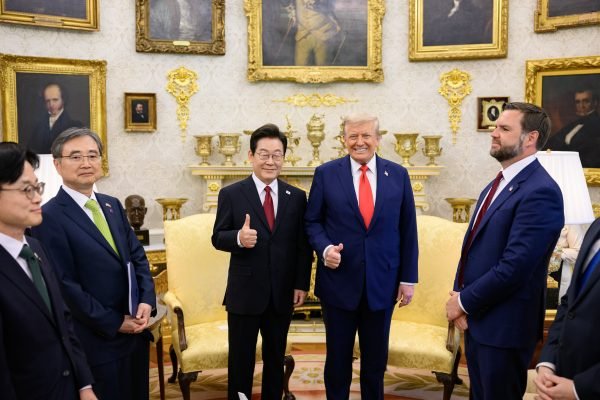
South Korean President Lee Jae-myung is doing his best to maintain a diplomatic balancing act among China, Japan, and the United States to push for a revival of inter-Korean talks, but he also has another balancing act to perform at home. Disagreements over North Korea policy between Minister of Unification Chung Dong-young and Minister of Foreign Affairs Cho Hyun as well as National Security Advisor Wi Sung-lac risk derailing Lee’s agenda. The disagreements cover major aspects of Lee’s North Korea policy, including Seoul’s vision of unification, the role of the South Korea-U.S. working group in coordinating the two allies’ respective North Korea policies, and the authority of the United Nations Command (UNC) in administering cross-border exchanges with North Korea.
After North Korea abandoned its goal of unification in January 2024 and adopted a “hostile two-state theory” in October the same year, Lee’s North Korea policy ran into a major political problem – can Seoul treat Pyongyang as a separate state when its constitution does not recognize North Korea? Chung and Wi clashed over this question, with Chung claiming that the two Koreas have already been two states in reality, and the goal of Seoul’s North Korea policy is to turn the hostile two-state relationship into a peaceful one. Wi disagreed. To him, the two Koreas are not two states but two parts of one Korean nation in a special relationship until unification.
Before Lee can resume engagement with the North, he must sort out the political meaning of the talks. Do these talks constitute steps toward unification? Or are they simply diplomatic exchanges between states? Failing to codify what these talks mean politically could be unconstitutional, because South Korea’s constitution commits to peaceful unification.
Another obstacle that Lee must overcome is the quarrel between Chung and Cho over the South Korea-U.S. working group’s role in shaping North Korea policy. The group was established in 2018 under liberal President Moon Jae-in. However, it was often characterized as a U.S. veto over Moon’s North Korea policy because South Korea’s initiatives must obtain Washington’s approval. The group was dissolved in 2021, but it was brought back in December as Lee laid out his vision of engagement with North Korea.
Chung’s Unification Ministry communicated that it would not participate in the group even as Cho’s Foreign Ministry went forward with it. Chung also emphasized that the working group and the Foreign Ministry could not supersede his ministry’s leading role in crafting policy toward North Korea and consulting with the United States on this matter.
The UNC’s authority to administer the Demilitarized Zone (DMZ) is also subject to an inter-ministerial feud. Chung supported the ruling Democratic Party’s bill to grant the South Korean government the power to approve civilian access to the DMZ for peaceful purposes without authorization from the UNC. Under Moon, the UNC stopped Seoul’s plan to link inter-Korean railways and roads by denying passage over the military demarcation line. Chung wanted his future initiatives to avoid the same fate.
The UNC, however, opposed the bill on the ground that the 1953 Armistice Agreement granted it the sole authority to administer the DMZ. South Korea’s national defense and foreign ministries backed the UNC’s stance on access to the DMZ. Inter-ministerial differences can damage the cohesion of the South Korea-U.S. alliance as the United States heads the UNC and it opposes scaling back military readiness and downplaying the North Korean threat.
Lee has managed to keep the policy disputes from undermining his North Korea vision and the South Korea-U.S. alliance. On the one hand, he launched a vice ministerial-level consultative channel between the unification and foreign ministries to ensure policy cohesion over North Korea. The Unification Ministry affirmed that although it and the Foreign Ministry differed over methods, they would unify their positions on resuming dialogue with Pyongyang. The Unification Ministry also pledged to consult with the United States when necessary.
On the other hand, Lee incorporated Washington into his North Korea vision by praising U.S. President Donald Trump’s role as a “peacemaker” and Trump’s cordial relationship with North Korean leader Kim Jong Un. Lee supported scaling down joint military exercises with the United States in support of his outreach to Pyongyang. At the same time, he tightened the alliance by investing $150 billion in shipbuilding cooperation with the United States to revive Washington’s naval capacity, which is 232 times less than that of China. Seoul also pledged to buy $25 billion of U.S. military equipment by 2030 and to spend $33 billion on supporting U.S. Forces Korea (USFK).
However, it is uncertain if Lee can patch over the internal feud to put his North Korea vision into practice. Despite Lee’s efforts to mediate between his ministers and advisers, Chung and Wi openly clashed over the possibility of resuming talks with North Korea after Pyongyang condemned South Korean drone incursions into its airspace. Wi also opposed scaling back joint drills to entice Pyongyang back to negotiation.
Lee will need to sort out his chain of command and the responsibility of each ministry in setting the agenda for North Korea if he wants to end inter-ministry disputes. Pyongyang will not trust Seoul’s promise of reward if the foreign or national defense ministries can challenge the Unification Ministry’s policy recommendations.
Other bodies with direct stakes in inter-Korean relations have a say in the inter-ministerial feud too. The UNC can challenge the long-term viability of any cross-border projects by blocking passage via the DMZ. The South Korea-U.S. working group can veto Lee’s North Korea initiatives by stressing denuclearization talks over peace talks, which classes with Lee’s preference for peace talks first. Washington pushing for the USFK to take on an expanded responsibility in deterring threats beyond the Korean Peninsula will clash with Lee’s strategy to win China’s and Russia’s support for his North Korea initiatives via high-speed railway and cross-border bridge projects connecting South Korea to China and Russia via North Korea.
This only makes sorting out each ministry’s responsibility within the bigger picture of Lee’s North Korea policy even more important, as their jobs should be complementary, not competitive, when communicating Seoul’s policy to the United States and the UNC. A mere unified position on North Korea is not enough. These ministries need to agree on the methods as well.
Seoul’s North Korea policy has been subject to the country’s domestic political swing between the liberal and the conservative. But inter-ministry disputes have not been resolved. Lee’s “pragmatic diplomacy” among the major powers has so far insulated Seoul from external turbulence, but he will have to pull off the same feat to calm the internal turbulence within his administration that can threaten his North Korea vision.