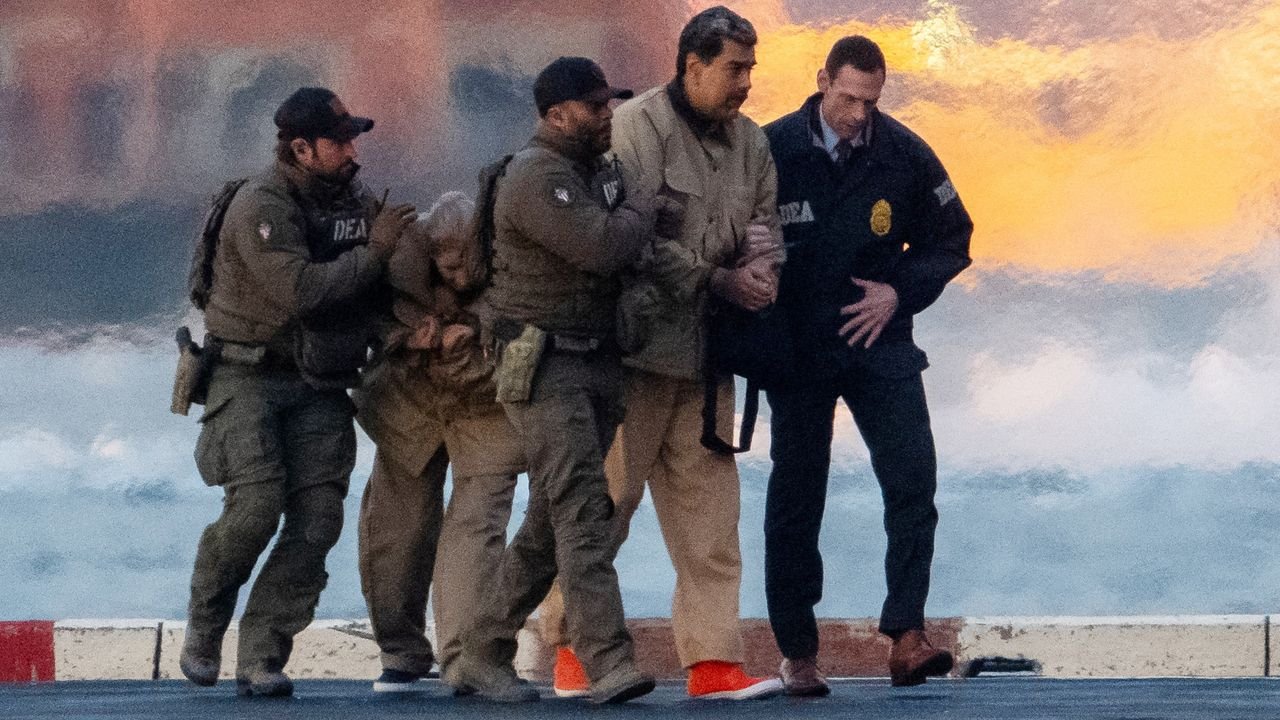
Depending on whom you ask, Nicolás Maduro is either the President, the former President, or the President turned dictator of Venezuela. In an indictment unsealed over the weekend, the Trump Administration calls him “the de facto but illegitimate ruler of the country.” But, in a Manhattan courtroom, on Monday, Judge Alvin Hellerstein wasn’t interested in Maduro’s title, formal or otherwise. He only asked what judges routinely ask federal defendants during their first appearances before a magistrate, right before they’re arraigned on criminal charges. “Are you, sir, Nicolás Maduro Moros?” the judge asked.
That’s when Maduro—dressed in navy, and wearing shackles and headphones, so that he could hear the court interpreter—stood up and, in his native Spanish, told the judge who he was and how he’d arrived inside a United States courtroom. “Soy el Presidente constitucional de la República Bolivariana de Venezuela,” Maduro responded, before explaining that the U.S. government had kidnapped him and his wife from their home in Caracas on January 3rd, and that he was invoking the protections of international treaties. “I consider myself a prisoner of war,” he said.
Judge Hellerstein interrupted Maduro and reminded him that he had asked a simple yes-or-no question. “I only want to know one thing: Are you Nicolás Maduro Moros?”
“I am Nicolás Maduro Moros,” the defendant confirmed. During her own allocution moments later, Maduro’s wife, Cilia Flores, likewise struck a note of defiance and introduced herself as the First Lady of Venezuela, her face appearing bruised and bandaged. (Later in the hearing, her lawyer indicated that she may have suffered a fracture or severe bruising to her ribs during her arrest.)
That was only the start of a simultaneously dramatic yet profoundly quotidian hearing in the U.S. District Court for the Southern District of New York, a venue long renowned for proceedings against corrupt politicians, Mafia figures, drug kingpins, and even former heads of state—such as Honduras’s Juan Orlando Hernández, who after his extradition, in 2022, was indicted, convicted, and imprisoned on federal drug-trafficking and weapons charges not unlike the ones Maduro faces. (On the week of Thanksgiving, President Donald Trump pardoned Hernández, just days after pardoning a turkey.) The Daniel Patrick Moynihan Courthouse, together with the neighboring Thurgood Marshall Courthouse, which houses the federal appeals court, has been the battleground for numerous Trump-era legal controversies across his two Presidencies. Steve Bannon, Michael Cohen, Stormy Daniels, E. Jean Carroll, Jeffrey Epstein, Ghislaine Maxwell, and Eric Adams are among the figures in the President’s orbit who have sought, faced, or eluded justice, in one way or another, in these marbled halls.
Trump wasn’t a subject of the hearing on Monday, yet it was impossible to take in the spectacle of Maduro denouncing the charges against him, in open court, without considering that, for much of the past year, his beleaguered nation has been a fixation of the Administration, more so than any other country in Latin America. From the hundreds of Venezuelans unlawfully disappeared to El Salvador, under the Alien Enemies Act, to the elimination of Temporary Protected Status for Venezuelans, to the lawless strikes against Venezuelan boats suspected of carrying drugs, Trump has continuously made the South American country a target of his fury, his policies, and a not-so-secret desire for regime change and its vast oil reserves. Hellerstein is well aware of this relentless campaign, having ruled in May that the American President could not invoke the Alien Enemies Act, a wartime law, to summarily deport Venezuelan migrants, because there was no war, invasion, or predatory incursion by or against Venezuela that justified its use. (The judge is also familiar with Trump’s thirty-four-count indictment in New York, over hush-money payments to Stormy Daniels, which Trump tried to push to federal court—a bid that Hellerstein denied.)
Neither geopolitics nor the broader constitutional and international-law implications of Maduro’s arrest and prosecution were a focus of Monday’s proceedings, but Hellerstein did inform Maduro, during his initial protest, that he’d have an opportunity to bring up those big-picture arguments ahead of trial. His lawyer, Barry Pollack, who once represented the WikiLeaks founder Julian Assange, later made reference to the expected pretrial motions seeking to quash the indictment—characterizing them as “substantial”—including one related to the question of whether Maduro enjoys head-of-state immunity. This thorny and contested issue, among others, may well reach the Supreme Court, which, like Hellerstein, has already reminded Trump twice not to play fast and loose with the due process owed to Venezuelans accused of being alien enemies.