
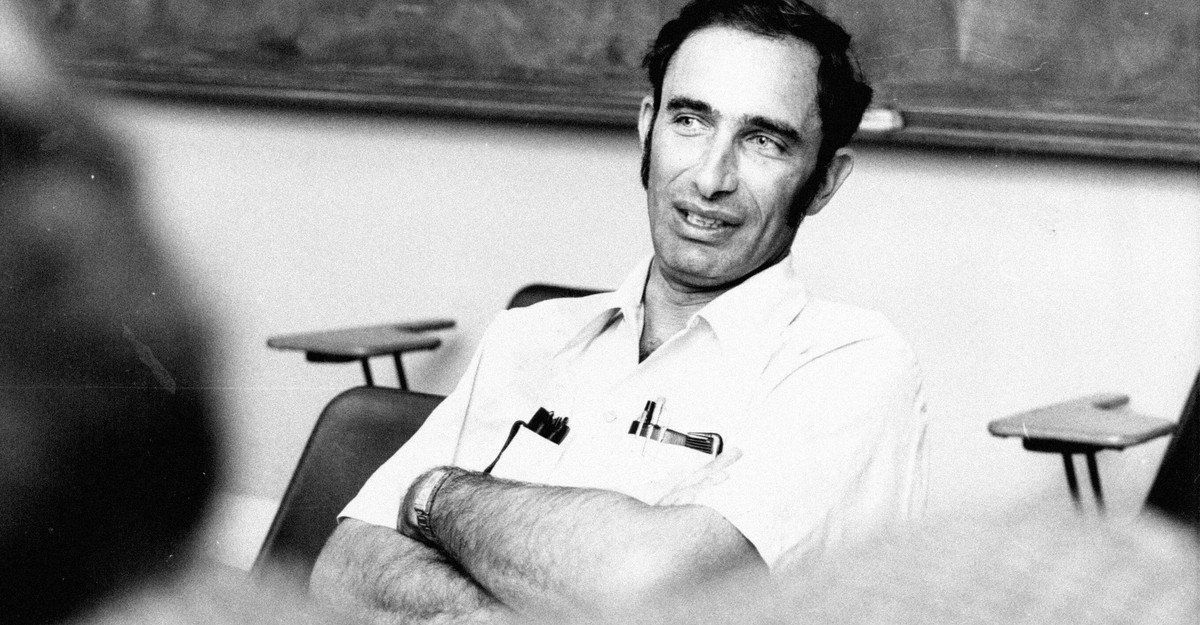
When the Stanford biologist and science writer Paul Ehrlich died last week at 93, the obituaries that followed were a fascinating exercise in editorial balance. As usual, most hesitated to speak too critically of the recently deceased. But they needed to point out why Ehrlich was famous in the first place: the many bold claims in The Population Bomb, his 1968 best-selling book about the impending crisis of overpopulation. Ehrlich’s lurid predictions of imminent planetary doom captivated the public, but they did not come true. Today the world’s population is leveling off. If anything, Americans might be having too few kids rather than too many. Yet even though overpopulation is an issue as dated as Dacron pants or disco, Ehrlich helped give an imprimatur of scholarly authority to a new kind of politics—a politics of scarcity—that has proved enduring in American life.
In The Population Bomb and subsequent writings, Ehrlich popularized a fundamental concept of environmental science: Natural systems have natural limits that could reveal themselves in catastrophic ways as their “carrying capacities” are approached. Crucially, Ehrlich also believed that the United States and the planet itself were in grave danger of reaching those limits soon if steps were not taken to curb population growth.
Today both the left and the right still act at times as if Ehrlich’s dystopia lurks just around the corner. Progressives remain divided over whether economic growth can truly go hand in hand with environmental protection, a major political liability when many voters say that they are struggling to achieve the standard of living they want. Many conservatives, meanwhile, view the world as a zero-sum game in which Americans must fight foreign powers and immigrants to keep our slice of a pie that isn’t growing. Both of these mindsets are children of the era that produced The Population Bomb.
In its day, the book was omnipresent. From 1968 to 1971, The Population Bomb went through 22 reprints. Ehrlich appeared on The Tonight Show Starring Johnny Carson at least 18 times, at a time when it was not unusual for a third of the country’s entire television audience to be watching.
Such exposure was unexpected for a young biologist who had graduated from the University of Kansas just over a decade prior with a dissertation about butterflies. During that early phase of Ehrlich’s career, the movement that came to be called environmentalism was embracing daring new ideas about how to care for the Earth. Whereas outdoor enthusiasts of the past had emphasized protecting exceptional landscapes from ruin or improving resource management, the emerging environmentalists viewed nature not as a thing that existed somewhere beyond the edge of civilization but rather as an extensive and delicate array of interrelated ecosystems.
This view, informed by headline-grabbing environmental crises in the ’50s and ’60s, held that the industrial age was throwing these ecosystems off-kilter. The wanton use of pesticides had begun to cause health problems in humans and other animals. Famines in developing countries called into question whether the modern world was capable of feeding itself. Acid rain discovered in the mountains of New Hampshire in 1963 underscored the consequences of reliance on fossil fuel. A massive oil spill in 1969 off the California coast highlighted the inherent danger of modern energy infrastructure.
Perhaps the most fundamental principle of the new movement, however, was the idea that scarcity, like gravity, was an invisible yet inescapable force governing life on Earth. Proposals for how to avoid “collapse mode,” as the influential report The Limits to Growth called it, varied wildly. Some population-control advocates emphasized coordinated international action not unlike the kind that would eventually produce major climate-change accords.
Ehrlich also dipped his toes in more controversial topics. Infamously, The Population Bomb discussed the prospect of involuntary sterilization “if voluntary methods fail.” Although overpopulation was a pressing issue in the developing world, Ehrlich wrote, our “overcrowded highways, burgeoning slums, deteriorating school systems, rising tax and crime rates, riots, and other social disorders” were proof that countries such as the United States were “overdeveloped” as well. Ehrlich’s organization, Zero Population Growth, sought a suite of reforms including the full legalization of abortion, promotion of family planning, and tax incentives to discourage couples from having too many children.
Yet even as Ehrlich was writing, the situation was changing. Disease-resistant crops introduced as part of the so-called Green Revolution were helping make food shortages far less frequent. Advancements in medicine, literacy, and access to voluntary contraception reduced poverty and unwanted pregnancy. In the developed world, efficiency standards and the shift toward cleaner energy meant that devices including cars, light bulbs, and washing machines now used fewer resources to do the same work.
Nevertheless, the politics of scarcity has persisted. Much of what makes Trumpism distinct from previous Republican presidents’ ideologies—above all, its insistence that immigration is per se undesirable—has roots in the right flank of overpopulation discourse, albeit stripped today of environmental pretense.
Several of the anti-immigration organizations that abetted the White House adviser Stephen Miller’s rise to power, for example, owe their origins to the work of John Tanton, a former head of ZPG and a Sierra Club leader who diverged from mainstream environmentalism as it moved toward more neutral views on immigration. Foremost among them is the Federation for American Immigration Reform, on whose board of advisers Ehrlich once sat. A New York Times investigation traced much of the funding for FAIR and its allies to the late billionaire Cordelia Scaife May, who divided her giving among anti-immigration organizations, conservation nonprofits, and population-control groups, and pushed the last of these to take stronger stances on border security. (May’s foundation also funded an English translation and reissue of The Camp of the Saints, the white-supremacist novel that inspired the “Great Replacement” conspiracy theory.)
The Population Bomb also foreshadowed the Trump administration’s particular disdain for foreign aid, which Ehrlich proposed conditioning on other countries’ ability to implement their own population-control policies. Some of his fellow travelers took this view further. The 1974 essay “Living on a Lifeboat,” popular in population-control circles, sought to undermine the idea that wealthy countries ought to help poorer ones. Its author, the biologist Garrett Hardin, concluded that foreign aid had become “a habit that can apparently survive in the absence of any known justification.” Later, Hardin would become a prominent white-supremacist voice in the dwindling community of anti-immigration environmentalists.
Democrats inherited a different but no less influential set of priors from the population panic. Absent from liberals’ environmental agendas today are the coercive overtones and the paternalistic descriptions of the developing world. Yet as the heated debate over Ezra Klein and Derek Thompson’s recent book, Abundance, has shown, a significant faction of Democrats remains skeptical that a revived pro-growth politics can be kept consistent with progressive values. Protests in deep-blue communities against dense housing and green-energy infrastructure recall Ehrlich’s insistence that America is already overdeveloped. And the small but growing number of young people who cite climate change as the reason they do not want children reflects a view that, in its way, is gloomier than anything Ehrlich wrote.
The line in political discourse between counterproductive pessimism and clarifying realism has always been a fine one. In light of Ehrlich’s death, however, the staying power of The Population Bomb’s scarcity mindset should give us pause. It is not, in fact, a law of nature that we can’t make the world of tomorrow better than the one we have now, and neither is the notion that the steps needed to get there are incompatible with broader civic values. Ehrlich built his reputation on unnervingly radical solutions to avoid what he believed was the planet’s imminent destruction. What he failed to understand was how, time and again, our ingenuity has proved that the limits to growth are not as immutable as we once believed.



