
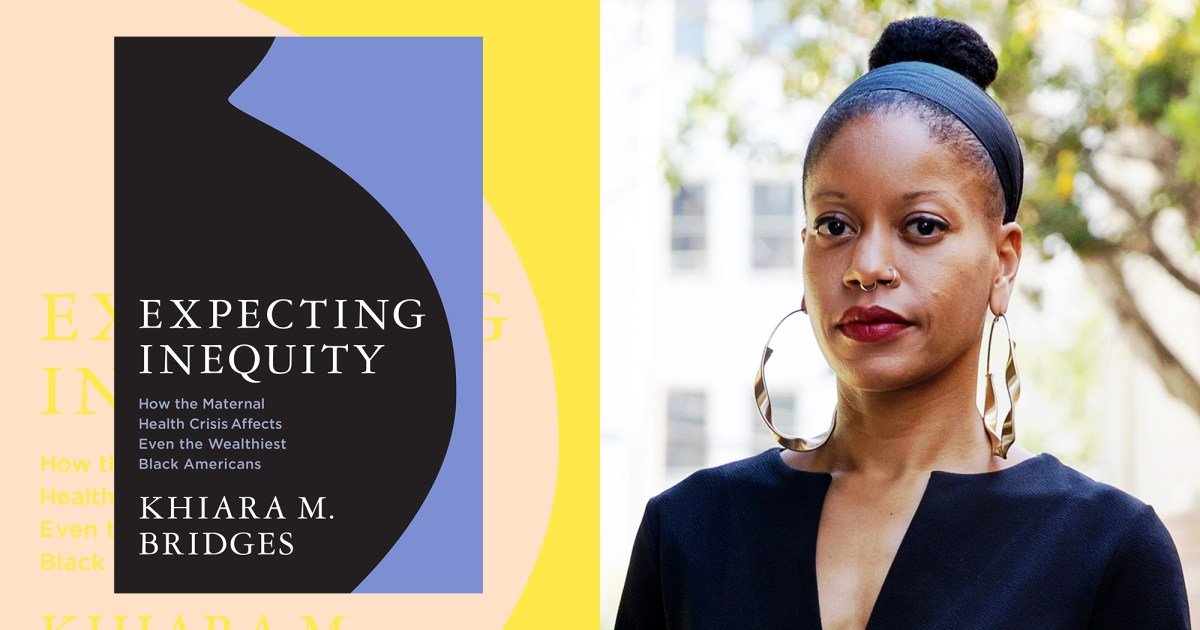
Mother Jones illustration; UC Berkeley Law
You may recall Khiara Bridges from That Video—the one from July 2022, where she calls Missouri Senator Josh Hawley “transphobic” to his face. As one of the leading scholars in the country on race and reproductive justice, the UC Berkeley law professor was testifying before Congress about the harms of the Dobbs decision overturning Roe v. Wade, including to Black maternal health. As she often does in her writing and conversation, she used gender-neutral language—“pregnant people” and “people with the capacity for pregnancy.” The ultraconservative Hawley, predictably, pounced, repeatedly emphasizing the “people” part and demanding, “Would that be women?”
“I saw that coming from a mile away,” Bridges tells me almost four years later, having witnessed the similar goading that future Justice Ketanji Brown Jackson received from a different Republican senator during her Supreme Court confirmation hearings. “I remember watching the hearing and thinking, she can’t really speak because she needs something.”
One reason the resulting 1:40-minute exchange went viral was that it had something for both sides: Bridges comes across as earnest and nervous and, yes, “woke”—a conservative’s caricature of a progressive, Black, female attorney. Hawley epitomizes liberal stereotypes about MAGA lawmakers as smirking, cynical, cruel, and determined to ignore and demean modern realities. Some time later, one of Bridges’s students sent her a thank-you note: The video had landed in his Twitter feed on the anniversary of the suicide of his sister, who’d been trans. “The erasure of trans individuals [is] such an incredible injustice,” she tells me. “I didn’t want to hide the fact that I think that trans people exist.”
Examining the structures that lead to injustice and erasure has been a central theme of Bridges’s scholarship for two decades. As a freshly minted Columbia Law grad in the early 2000s, she decided to pursue a PhD in anthropology. “I was interested in how law produces culture,” she says, “and how culture, in turn, produces the law.” Her dissertation became her first book, Reproducing Race: An Ethnography of Pregnancy as a Site of Racialization (2011), an influential study set in a publicly funded hospital in New York City. She has also written extensively about critical race theory and the relationship between privacy rights and class.
Now Bridges has published her fourth book, one that feels very much like a sequel to her first: Expecting Inequity: How the Maternal Health Crisis Affects Even the Wealthiest Black Americans. In it, she tries to answer a question that has perplexed researchers—and journalists like me—for at least a decade: Why don’t education and income protect Black women from disproportionately high rates of maternal mortality and life-threatening complications? The book focuses on San Francisco, which has one of the widest income gaps in the US and a Black population so small that encountering a Black woman with private insurance “was like seeing a mythical creature,” Bridges says. But her two years of research, including 200 interviews, deepened her understanding of the entire US maternal care system. “The healthcare segregation here,” she says, “looks a whole bunch like the healthcare segregation in New York City, in Chicago, in Atlanta, in Miami.”
Her anthropologist’s perspective isn’t the only thing that distinguishes Bridges from other legal scholars. A dancer since she was 3 years old, she performed professionally at small but prestigious ballet companies in New York City while earning her law and anthropology degrees. The double life continued after she started teaching at Boston University School of Law—on weekends, she commuted to New York to perform. She moved to UC Berkeley almost seven years ago, and though she no longer dances professionally, she works out with local ballet companies almost every day.
The afternoon of our chat, fresh from teaching a class, she greeted me wearing a pair of impossibly high-heeled black Louboutins and dangly hoop earrings the size of small tires. Her hair was swept into a ballerina-esque topknot, and her nails were impeccably manicured in lavender and black, the colors of her book jacket. The message to her students is subtle but empowering: They don’t have to erase themselves, either. As she tells me, “You just gotta do you.”
Our conversation has been edited for length and clarity.
How did you decide to turn your anthropological lens on reproduction and pregnancy?
My uncle, James Bridges, was one of the first Black board-certified OB-GYNs in Miami. He’s such a larger-than-life figure in the family. My interest in pregnancy began because he had made pregnancy his area of expertise.
But in law school in the late 1990s and early 2000s, “reproduction” meant “abortion.” There was not much [legal] scholarship about the intention and desire to carry a pregnancy to term. Family law has always had its place in law schools, but not maternal health. When I decided to pursue a PhD after law school, I thought that my dissertation project would be about abortion. Then the institutional review board at Columbia told me: “Not so fast.”
These boards exist to ensure that researchers do their work ethically and don’t abuse their subjects. IRBs are there to prevent the types of terrible injustices that have often occurred in the name of scientific inquiry.
Still, you would think that simply talking to a pregnant person about their pregnancy is a relatively low-risk kind of research. But pregnant persons are considered to be a vulnerable population. When you check the box that you’re going to be working with pregnant people, your work is going to take longer to get approved.
At Columbia, approval took 18 months. Under the IRB, I could only talk to adults with wanted pregnancies or who were recently postpartum. If a person started to indicate that they might not want to continue the pregnancy, I had to stipulate that I would stop the recorder and end the interview. There’s a critique of IRBs as being more interested in protecting institutions from liability than protecting research subjects. Columbia was very concerned about me perhaps influencing a [patient’s] decision one way or the other.
[Generally] researchers have a really hard time working with people who are thinking about undergoing an abortion. So a lot of the research that exists about abortion is with healthcare providers rather than patients. It’s created a gap in our knowledge. But I’m glad Columbia steered me away from abortion, because it set me on the path I’m still on today.
You ended up doing 18 months of field research at a big public hospital in New York City, which you call Alpha Hospital to give the institution some degree of anonymity. Its patients are mostly Black and brown, low-income, and reliant on Medicaid. How did being both an anthropologist and a lawyer help you understand what you were seeing?
As an anthropologist, I was examining how people were navigating health care systems and bureaucracies. And because I had a law degree, I could look at the Medicaid statutes and see the difference between the law on the books and the law on the ground. Until I started doing the research, I didn’t realize just how hyper-regulatory Medicaid is. There’s very little room for discretion for patients, but also for providers.
The [statutory] goal is to provide health care for incredibly vulnerable folks. And then you go to the clinic, and you see how the best of intentions are perverted—it’s underfunded, it’s overburdened, everybody’s at their wits’ end, ready to snap. Patients are treated terribly by providers. They are seen as being undeserving.
I’ve spoken with many patients of color over the years who talk about being disrespected, even abused, in health care settings, and many providers who dismiss these stories as not being credible.
The mistreatment ranges from two-hour wait times to see a provider, to basic rudeness, to much worse. These are pregnant people who just want to be affirmed that they and their baby are healthy, and are met with such unkindness.
There was a woman who went into labor one evening. She didn’t have anyone to care for her two older children, so she brought them with her to the hospital. But the hospital had a policy of no children in labor and delivery, so they called child protective services to take her children. She was laboring, so she couldn’t fight back. When I saw her at her eight-week postpartum appointment, she was still fighting to get her children back.
And of course, the state can justify the behavior by saying, ”The mother clearly doesn’t have support, she is nine months pregnant at home alone with two vulnerable kids, and has to go to the hospital by herself. So it’s in these children’s best interest not to be returned until the mother is stable.” But what a violence.
You found that health care for low-income women is a mechanism for surveillance and control. Poor people have different privacy rights from more affluent ones. Give me an example of what this looks like on the ground.
In New York state, before you begin prenatal care as a Medicaid beneficiary, you are required to have a consultation with a nutritionist, a social worker, and a financial adviser. You might hear, “You have food insecurity, let’s get you signed up for food stamps, let’s get you into the WIC program.” But the benefits come with strings attached, and you’re constantly having to prove that you’re eligible. You go to this institution that exists to provide health care, and you end up in this web of surveillance.
“The benefits come with strings attached, and you’re constantly having to prove that you’re eligible. You go to this institution that exists to provide health care, and you end up in this web of surveillance.”
I thought the consultation with the social worker was the most pernicious. You go into what seems like a therapeutic relationship, where the social worker should have a fiduciary duty to you. But, actually, their relationship is with the state, and the information you share with them could become the stuff of a CPS case. So you’re beginning your pregnancy already under suspicion for child abuse and neglect, and trying to rebut the presumption that you need surveillance. If you don’t go along, you can lose custody of your kid. You can be rendered ineligible for food, clothing, shelter, and healthcare.
In your first book, Reproducing Race, you focused on low-income pregnant women at a public hospital. Your new book, Expecting Inequity, looks at higher-income patients at an elite private hospital.
The punchline of that first book was, it’s really hard to hold on to your dignity and autonomy and agency when you’re low-income and pregnant, because all of these systems are designed to strip you of those very things. It’s a system that pathologizes Black people, always.
But one of the questions that often came up was: Was [what I was seeing] a function of people’s race or their class? Was I describing a system that demeaned low-income people and, as an unintentional consequence, demeaned people of color?
These questions were based on an assumption that if you have some degree of wealth and status as a person of color, then you can escape racism. And nothing is further from the truth. Racism looks different in the lives of wealthier people of color, but it’s there. What Expecting Inequity attempts to do is chart, identify, and describe how racism shows up in the lives of class-privileged people of color during pregnancy.
A major catalyst for the book was some very stark data on Black maternal mortality. Black women are more than three times as likelyto die from pregnancy-related causes as white women are. The disparities actually widen with education and income. Even women as healthy and wealthy as Serena Williams and Beyoncé have suffered from life-threatening complications.
I was under the assumption that the Black-white disparity in maternal mortality and morbidity exists because Black people disproportionately bear the burdens of poverty. But racial disparities in maternal health outcomes persist across income levels. In the US, college-educated Black people have higher rates of maternal deaths and morbidity than high school–educated white people.
What made me say this book has to be written was my dissatisfaction with the explanations for why those disparities persist. At the time, everything was “implicit bias.” Black women die at higher rates in pregnancy and childbirth? Implicit bias. A cop shoots a Black man dead in the street? Implicit bias. Starbucks managers call the police on two Black men just waiting for a friend? “Let’s do implicit bias training.” Implicit bias became this black hole of an explanation for every type of racial disparity.
But if the problem of racial disparities in maternal mortality and morbidity is due to providers’ implicit bias, then the solution becomes individualized. It’s about interpersonal interactions. And that just didn’t strike me as true. I wanted to investigate how the structural conditions in which we exist produce these racial disparities that result in class-privileged people being unable to leverage their class privilege to have maternal health outcomes that are on par with those of their white counterparts.
You focused on two hospitals. Zuckerberg San Francisco General Hospital, which you call the General, serves an indigent and low-income population. “Golden Health” is largely for patients with private insurance. My guess, based on Google, is that this is UC San Francisco, which is one of the best hospitals in the country. What did comparing these two hospitals help you see?
For one thing, it’s not just that the low-income people’s hospital is chaotic and the wealthier people’s hospital is really nice. Rather, the nice things in wealthier people’s hospitals are made possible by the chaos that is present in the hospitals for low-income people.
At Golden Health, for example, prenatal patients never had to wait more than 15 or 20 minutes to see a doctor. At the General, there are long wait times. And [a big reason] is that low-income people’s lives are more contingent than wealthier folks’. Low-income people work at places for minimum wage. They have no control over their schedules. They’re relying on public transportation and family and friends for childcare. They show up at 4 o’clock for a 3 o’clock appointment, and now the hospital has to fit them in. The General is a place that’s designed for vulnerable people, so they’re not going to turn you away because you’re late. They’re going to make it work.
Yet you also theorize that the regulation and standardization that go along with Medicaid may actually help reduce racial disparities in maternity care and outcomes. Having private insurance may actually make better-off Black women more vulnerable to bias.
The standardization piece is incredibly important. It was something I was highly critical of in my earlier research. [At Alpha,] I wondered, where’s your agency as a patient? Where’s your ability to direct your health care? The reality is, you can’t when you’re low-income.
But then I looked at the data showing how the Black-white disparities in maternal mortality and morbidity are actually wider at the upper end of the socioeconomic ladder than at the lower end. And [I’ve come to conclude that] standardization may actually be protective of Black women’s health. The physician can’t decide, for example, not to give you a particular screen. Everybody’s getting the same tests. Everybody’s getting the same consultations. The minimization of discretion helps reduce disparities in care. I’ve had to think—how do I talk about this? This lack of choice may be beneficial when it comes to racial equity, because that space for discretion becomes space for inequitable care.
Another structural issue you talk about is the physical toll that discrimination takes on Black women’s bodies, even affluent women, increasing the risk of chronic diseases that can make pregnancy more dangerous. The science of epigenetics shows that your prenatal environment can affect how your genes are expressed. Chronic stress in pregnancy can even have an impact on future generations.
Yes, we have these great jobs, and we live in these great neighborhoods. But privilege comes with its own price. Stress has real physiological consequences. And I say “we” because I’m certainly talking about me at this point in my life.
“Yes, we have these great jobs, and we live in these great neighborhoods. But privilege comes with its own price.”
In the book, I talk about my grandmothers, who were both maids in South Florida during the Jim Crow era. They cleaned white people’s houses their entire lives. My parents were born in the 1950s, before the civil rights movement. My grandmothers were pregnant while they were navigating the most brutal forms of anti-Black racism. There was food insecurity, housing insecurity, all of those things.
These are the prenatal environments in which my dad and my mom were living. And so it would be kind of fantastical to believe that those hostile environments didn’t influence the expression of their genes. And if epigenetics is a thing, then I have inherited those gene expressions. Epigenetics helps explain why class-privileged Black folks don’t have the same health outcomes as their white counterparts.
So Black women choose a place like Golden Health because they know there is a Black maternal health crisis—they want good outcomes, they want to survive. But as you describe in your chapter titled “Going to the Doctor in Yale Sweatpants,” they’re still hypervigilant.
It’s Performing Class Privilege 101. For example, even though your fingers are swollen from pregnancy, you do not take off your wedding ring, because then you might be perceived as Black, unmarried, and pregnant. It’s so interesting—since doing this research, I’ve realized that I engage in the same tactics. I wouldn’t say I dress up, because a lot of times I’m going to the doctor after working out, but I’m using language to signal my status. So I say things like “Is this idiopathic?” “I was asymptomatic,” signaling that I am educated, too.
There are a lot of interracial marriages. Women are bringing their non-Black husbands, their non-Black relatives, to their appointments. As one woman told me, “I want them to see a white man cares about me, and if a white man is invested in my well-being, then maybe that will cure whatever bias they might have.”
“For Black women, there’s no exit from a pathologizing discourse.”
I also had this lesson repeated: For Black women, there’s no exit from a pathologizing discourse. So if you sit there quietly and do as the provider says, then you’re not really invested in your care; you’re not doing enough. But then, when you say, “Wait, hold on a second. I specifically asked for x, y, and z,” then you’re complaining. You’re being aggressive. You are an “angry Black woman.”
I saw the same thing when I was teaching. If I come in and I’m super nice, then people will think that I’m unprepared and unprofessional. But if I come in and I say, “Hey, be on time, do the assigned reading,” they’re like, “Oh, she’s so aggressive. She’s so dominating.”
You’ve seen the ways racism persists across income, education, and insurance status. Are there any solutions to the kinds of inequities you’ve documented?
I don’t even know how to frame this, but we have to take racism seriously.
This book is coming out at a time when the entire apparatus of the federal government is attacking the idea of structural inequities. What does it mean to take racism seriously in the maternal health context?
For one thing, we have to stop normalizing healthcare segregation. In this country, we think it’s natural: We have different neighborhoods, different hospitals. Hospitals for poor people and hospitals for everybody else. In a country that has an Equal Protection Clause in its Constitution, we ought to think that it is wildly inconsistent to have unequal facilities for something as basic and necessary to life as health care.
We need more Black physicians, and midwives, and nurses. It’s been demonstrated that Black patients have improved health outcomes when they’re cared for by Black providers, but the percentage of Black physicians is tiny.
We need to get past this moment where it’s controversial to even mention racial inequality. To fix the maternal health system will involve massive structural reorganizations. We have to start thinking of solutions that are radical.



