
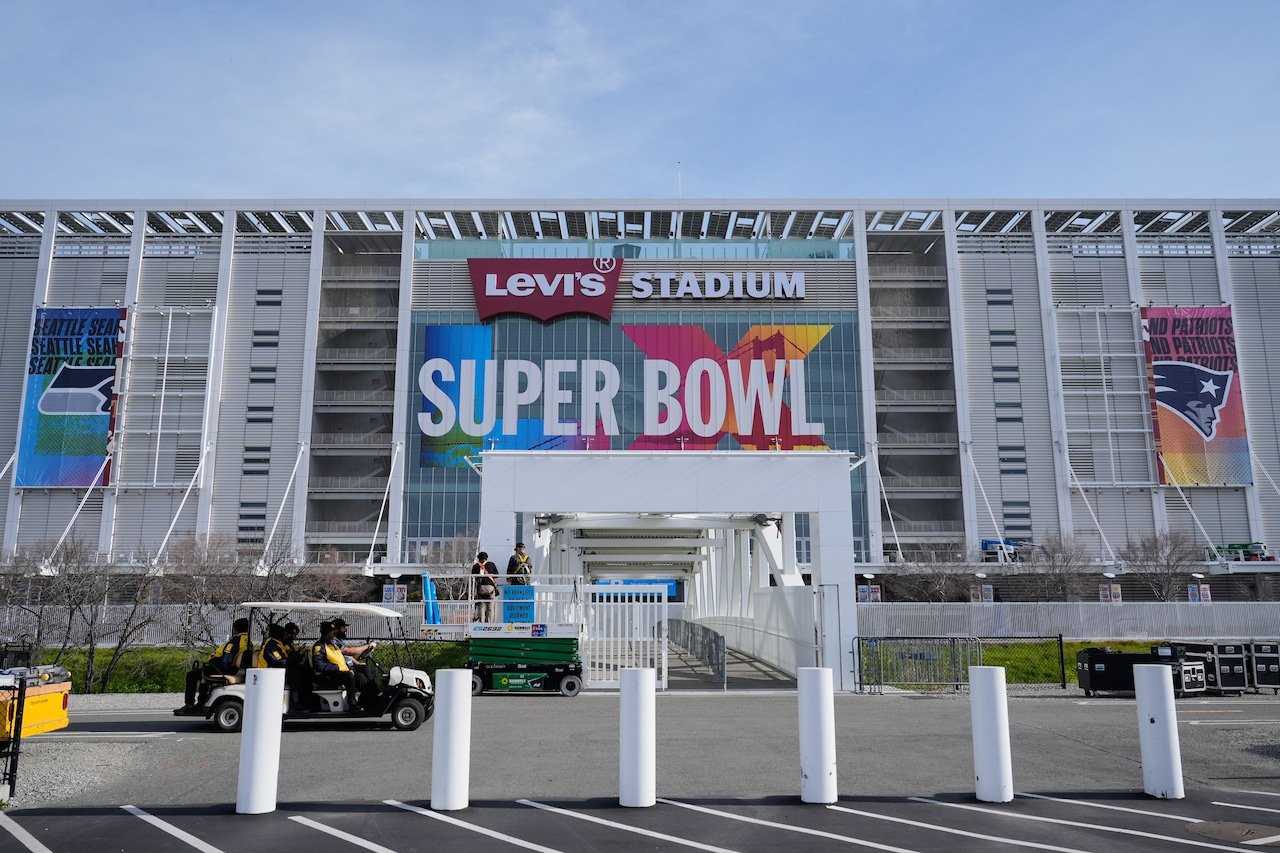
We were sitting in a Phoenix beef restaurant called The Stockyard during Super Bowl week a couple of decades back. Eventually, we would be the only two guys who covered the first 53 Super Bowls. Actually, the late Jerry Green of the Detroit News, my regular NFL postseason traveling buddy for more than a half century, would cover the first 54.
This was just before Super Bowl XLII and the steaks were medium rare and the conversation was even more. We were discussing how much the trappings of this game, whose name sounds more like a breakfast cereal than a 100-yard spectacle, had changed. Jerry was a football purist of the first order and his response was strictly professional.
“It’s still football,” he said, “and it generally has the best two teams.”
“You’re right as usual,” I told him. “But I’m talking about the mood. Have you noticed that nobody laughs anymore. It is so stage managed that we really can’t have a decent conversation with the players. We used to hear some great pre-game stories.”
And that was the kind of beginning the game deserved.
I remember two days before the first Super Bowl I was having breakfast in the coffee shop of a Long Beach, Calif., hotel with the big Kansas City linebacker named E.J. Holub, whom they called “The Beast.” This was the morning before Super Bowl I. After Super Bowl V this would have been unlikely, and after Super Bowl VI it would have been impossible.
This last was about the time that NFL Central took complete control of the minds, bodies and companions of every player during Super Bowl week. In any event, I will never forget what E.J. told me that morning. It became the barometer that enabled me to judge the year-by-year, ever-increasing distance between the game of the people and the people themselves.
When I asked him about this game between the upstart rebel Kansas City Chiefs and the old guard Green Bay Packers that had seemed for so long as though it could never happen, E.J. reached across the table and held out both hands, palms up.
“Feel them,” he told me.
I did and I told him that I had never seen hands sweat like that before.
“Is it the nerves you must have because you are finally going to test yourself against the best — which happened to be in the employ of Vince Lombardi?” I asked.
“Oh, no,” he said. “That’s all well and good but that’s not why I’m so nervous. Do you realize that if we win this game, I will make $15,000? And we damned well better win because my wife has already spent it.”
Today, both teams — winners and losers — would walk at the prospect of so paltry a payday.
Now look at today. Look at what has happened to the game that caught America’s attention and made it stand still on Super Sunday. Clearly, Super Bowl LX is not your father’s Super Bowl.
The first Super Bowl ticket in January 1967 cost $10 — and the game did not sell out. The cheapest face value this year is $900, and on the secondary market, tickets are going for thousands more. Today, the pre-scalper prices ( that is how most people to get in) range from approximately $950 to $8,500, according to USA Today. But these prices represent the initial, direct-from-the-NFL cost. Most seats are distributed to teams, partners, and premium package holders rather than the general public.
As of this week Super Bowl those “second hand” tickets just to get in start between $6,000-$7000 a seat. More desirable seats go as high at $63,000, Private suites a flat $1 million (are pretzels included?).
So, with no disrespect to the Gospel according to Saint John:
In the beginning, there was The Game. And The Game was with The People. And The People were the reason. Sometimes that’s hard to remember in the view of what the Super Bowl has become after more than six Roman-numeral decades.
In the beginning, no sports event beyond Schmeling-Louis generated the kind of raw partisan passion that was the fiber of Super Bowl I. Going in, this was a game that captured the most intense emotions of not only the players and fans of the Green Bay Packers and Kansas City Chiefs, but the entire constituencies of the leagues in which they played.
That very year produced Fred Williamson, the Chiefs defensive back who claimed his karate technique would knock out two Green Bay receivers. Instead he, himself, was KO’d. Two years later, Joe Willie Namath picked a public restaurant fight with Lou Michaels of the NFL Colts and then guaranteed in public that the Jets would win.
And so it went over the first six or seven years. It was delightful. Everybody was mad at everybody else.
The only exception I recall was when the Saints’ Drew Brees gushed over how he admired Peyton Manning and Peyton Manning returned the love. You couldn’t be sure whether they planned to whip each other on Sunday or elope.
And something else has long gone out of this junior varsity version of Armageddon Roman numeral year after Roman numeral year:
When somebody asked the Cowboys’ Duane Thomas after Super Bowl V how it felt to win in the ultimate game, Thomas said: “If it’s the ultimate game, how can they play it next year?”
Before Super XIII, Hollywood Henderson of Dallas said: “Terry Bradshaw couldn’t spell Cat if you spotted him the C and the T.”
Before Super XVIII, the Raiders’ Matt Millen was told that Washington’s Russ Grimm said he would run over his own mother to win. Millen said: “I’d run over Russ Grimm’s mother, too.”
Before Super Bowl XX, Bears quarterback Jim McMahon dropped his pants and mooned a television helicopter hovering over the practice field. Where have you gone when we need you, Jim McMahon? A humorless Super Bowl turns its thoughts to you.
And then there was my favorite Super Week moment. It was the last time anyone got to laugh at media headquarters. It was during the run up to Super Bowl XXXVII seven years ago.
At high noon, two days before the game, two guys with spikes protruding from the shoulders of their chain-mesh vests, wearing helmets that looked like the progeny of a union between Darth Vader and the Hell’s Angels, and unmentionable tattoos on what little of their flesh was visible, walked into the lobby of the media center.
Each carried a battle-ax with a skull and crossbones on the blade.
“You are Raider Nation among the aliens,” the director of a Japanese film crew shrieked at them. “Look startled. Look puzzled. Look angry.”
Angry?
“You want angry?” a sports shock jock shouted from inside the Tower of “Babble” that is radio row in a Super Bowl press room. “I’m doing a live radio show. If you don’t shut up, I’ll put those axes in a place that will make it difficult for Raider Nation to sit down for a year.”
Where has all the laughter gone?



