
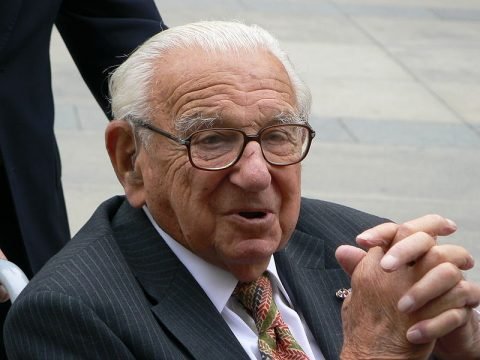
There are some stories that comfort us, others inform us, and others confront us. Sir Nicholas Winton’s life story does the job of confronting us. The reserved and quiet gentleman from England who rescued 664 children from the Nazis in 1939 has a life story that is truly remarkable—one that doesn’t allow the reader or casual observer to simply listen and move along. His story confronts and asks rather pointedly, if in a similar circumstance, what would you have done?
In 1939, Sir Winton was just 29 years old. He wasn’t a diplomat, nor a politician, nor a general nor anyone with a title. He was a stockbroker who happened to take a detour to Prague, where he saw families in makeshift camps. He saw families and children freezing and suffering. Most others would have felt badly, maybe donated a few dollars to ease the guilt, and moved on. Sir Winton didn’t. Sir Winton saw an injustice and went to work. He knew he had to do something dramatic, or these children would have no futures. He organized trains to transport hundreds of children out of Nazi-occupied Prague and into Britain. He fought the bureaucracy and worked around the clock as he knew every hour delay meant another child would be left behind. When the last train pulled away, mere hours before the border closed, 664 children were on their way to safety.
And now the stunning piece. Sir Winton didn’t brag. He didn’t hold a press conference. He didn’t write a memoir, he didn’t tell a soul about it, not even his wife. Sir Winton’s wife found out about it 50 years later when she found a scrapbook in their attic. In the 1980s, Sir Winton was invited to a BBC program for what he thought was a more general interview about war time stories. He sat quietly, hands folded, the way modest people do when they don’t want to attract attention. (I know—unrelatable to every elected official).
During the interview, which was conducted before a live audience, the host of the show asked a straightforward question: “Is there anyone in our audience tonight who owes their life to Nicholas Winton?” Nearly every person in the rows surrounding him stood up. One by one, the children Sir Winton saved nearly 50 years prior, now adults with grown children of their own, began to rise to their feet. Sir Winton looked around stunned and wiping away tears that rolled down his face as he realized the magnitude of what he had done.
It was one of those moments that live television captured something so good, so real—the ripple effect of sheer goodness. No paperwork, no logistics, just lives, saving lives, and making real futures for hundreds.
And here is the kicker, Sir Winton never saw himself as a hero. He said, “I just saw what needed to be done.” That is the line that matters and that is the line that should resonate within each of us. That is the line that we should embrace and emulate. We should try to live it every day.
We live in a time where many in our orbit are very good at explaining why something can’t be done. Why the problem is too big or why the system won’t let it happen. Or why someone else should handle the mess. Very few among us have the courage to lean in and say, “let’s do it because it needs to be done.”
Sir Winton didn’t ask for permission. He didn’t commission a poll. He didn’t run it up the flagpole or seek perfect conditions. Sir Winton didn’t wait for someone more suited to get it done. He acted because the children needed help. The children needed to be saved.
We don’t need to save 664 children to make a difference. We just need to stop looking away. We need to start looking to help in any way. Sir Winton’s story isn’t comfortable. It is a challenge. It is a dare. It is a reminder that heroic moments are necessary grand gestures. It is an example of a firm decision made quietly in a crucial moment without applause or attention.
Sir Nicholas Winton still stands out some 87 years after his monumental and magnificent achievement as a shining example of being the forceful but quiet hand that just makes the impossible possible.
As we close out today’s lesson on action, we are left with one question. Sitting where you are right now, with no more than the tools you currently have, what good can you do today? Sir Winton answered that question in 1939 and he saved lives. Now, you are on the clock. What’s your move?
I leave you with a YouTube clip of this amazing moment:



