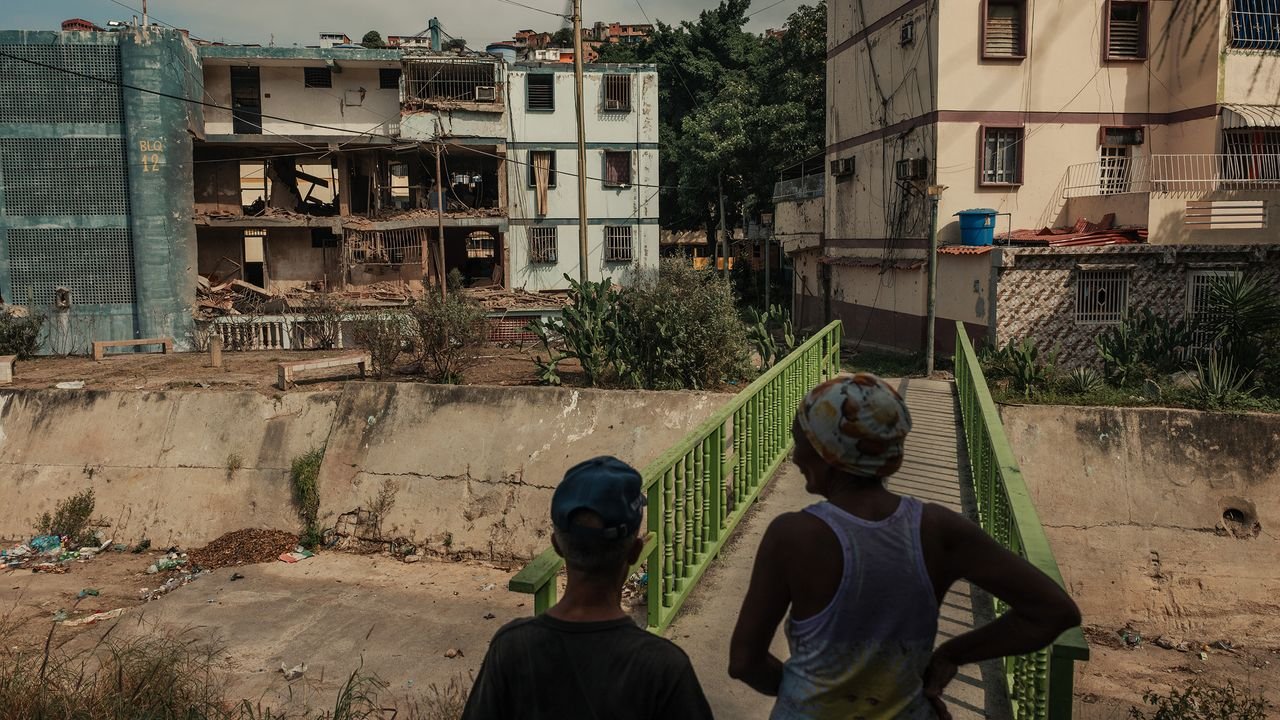
Other neighbors brought Tibisay to the clinic where Rosa was being treated, while Jesús and his family fled to a relative’s house, near a Venezuelan Navy base. Sitting in the dark, they were rattled by another wave of explosions. The base, less than a mile from the apartments, appears to have been the real target of the U.S. attacks in Catia La Mar. “What we wanted, more than anything, was for the sun to rise,” Jesús said.
Griselda and Jimmy, still in the parking lot, decided to seek refuge at the clinic. They had been there for less than half an hour when doctors came out to deliver the news: Rosa was dead.
Catia La Mar is separated from Caracas by mountains more than nine thousand feet tall, but residents of the capital had a similarly long night. American aircraft bombed multiple locations around the city, including airports, military bases, and transmission towers. After the last bomb dropped, the valley fell silent. Then, at 5:21 A.M., Donald Trump announced that President Nicolás Maduro had been captured, and some neighborhoods of Caracas broke out in cheers.
Later that day, I texted a friend in the city to ask about casualties. “I’m going to be very honest with you,” she said. “No one here is talking about the dead.” There were more pressing matters, such as fixing broken windows and stocking up on nonperishables. And though the evening had been frightening and the present was uncertain, many Venezuelans felt relieved: the person most responsible for the country’s descent into misery and despotism was gone, and would finally face justice; the regime that had governed the country for twenty-seven years was beginning to crack. If there were victims, they were probably complicit, and in any case, there was always a price to pay.
Hours after the attacks, the defense minister, Vladimir Padrino López, stated that the Venezuelan government was gathering information about the victims, but whatever it found did not become public. Trump ended up being the first leader to disclose casualties, telling reporters that Maduro had been guarded by Cuban agents, many of whom had been killed by U.S. forces. By that afternoon, reports had begun to circulate that there were dozens of new patients in Caracas’s military hospitals.
The following day, Padrino López conceded that much of Maduro’s defense team had died, without offering details. A government document listing fifteen fatalities in the battalion that guarded the President was leaked to local journalists, who also reported an additional ten deaths. Among them was one civilian victim, still unnamed.
By then, reports of Cuban officers killed in Caracas had begun to circulate on the island. On social media, residents of Río Cauto mourned Fernando Báez Hidalgo, a young lieutenant whose passing was described as “a pain that multiplies itself.” Unable to limit the spread of information, the Cuban President, Miguel Díaz-Canel, announced that thirty-two members of the country’s armed forces and its Interior Ministry had died during the U.S. attack. Later that night, Venezuela’s acting President, Delcy Rodríguez, shared her condolences.
Stephen Miller, the U.S. homeland-security adviser, boasted about the Cubans’ deaths during an interview with CNN’s Jake Tapper the next day. “What our Special Forces encountered when they did that daring midnight assault into Caracas were armed Cuban guards, and they sustained massive numbers of casualties,” he said. When Tapper asked about civilian deaths, Miller claimed that there had not been any: “Every single kill was an enemy kill.” A Pentagon official later told The New Yorker that the U.S. strikes had been “precisely planned to achieve operational objectives” and that civilians had not been “intentionally targeted.”
By the time Miller went on CNN, Venezuelan journalists had identified two civilian victims: Rosa González and Johana Rodríguez Sierra. Originally from a town near Cartagena, in neighboring Colombia, Johana had spent most of her life in Caracas. For decades, she had looked after a wealthy family’s estate in the mountains south of the city, where she lived with her daughter Ana Corina. Just up the hill was a group of telecommunication antennas, some of which are believed to belong to the Venezuelan military. Their caretaker, Carlos Bracho, lived in a small yellow house on site and had been there for even longer than Johana.