
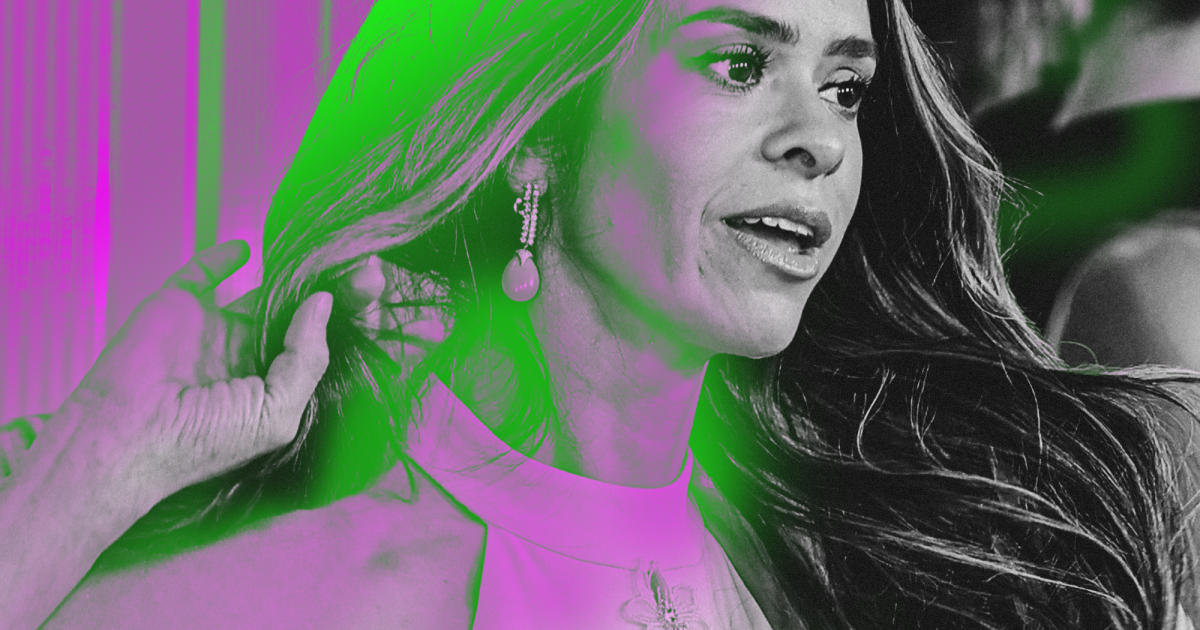
Mother Jones illustration; Mc Kiernan/ZUMA
“Did I ruin your life, or did I help your life?”
Taylor Frankie Paul first asked the question in the early days of The Secret Lives of Mormon Wives, the Hulu reality show that follows what is known as MomTok, a group of young Mormon influencers in Utah. At the time, when the show debuted in September 2024, Paul’s question was rhetorical, but the answer had already seemed obvious: None of the women would be on television had it not been for Paul’s public admission to “soft-swinging.” That, for better or worse, their nascent fame was directly tied to Paul’s chaos.
Four seasons later, the swinging scandal that catapulted MomTok to reality TV stardom feels small, even quaint, against new domestic violence allegations between Paul and her on-again, off-again partner, Dakota Mortensen. But they are only new in the sense that older ones exist; similar allegations between Paul and Mortensen played out in the show’s very first season and resulted in Paul’s arrest. (She later struck a deal and pleaded guilty to one count of aggravated assault.) On Thursday, TMZ published a video recording of that 2023 incident, which captured Paul throwing chairs at Mortensen with her young daughter in the room, quickly forcing the big decision: Shortly after the video, ABC announced that it was canceling Paul’s season as the next Bachelorette, just three days before it had been set to premiere.
It’s as if by broadcasting outrage, they believe they have done the moral work of untangling our addiction to reality TV toxicity.
The fallout has since churned out a mix of condemnation—ABC should have known better than to cast Paul, some say—and cheers for supposed accountability. Others have hurled labels like “ghetto” to characterize Paul. Even Laura Ingraham is disappointed.
Whatever the case, I take issue with how some of the admonishments appear to absolve viewers of the fact that we, too, have long known about Paul’s assault—again, the allegations were right there in the first season, albeit without video—and yet we continued to watch intently. Similarly, it’s been disorienting to watch friends take to Instagram to chastise ABC or rail against Paul as “trash”—only to privately screech with excitement about MomTok drama in group chats. It’s as if by broadcasting outrage, they have done the moral work of untangling our addiction to reality TV toxicity.
Any discourse that centers Paul is probably good for MomTok. The pain, trauma, and conflicts they share with the world are the trade of the larger reality TV ecosystem.
None of which is to suggest that I’m not personally conflicted. Should there be another SLOMW season, even with Paul included, I tend to believe that I’ll stay watching. After all, voyeuristic trips into someone else’s chaos are the bread and butter of the medium, and I’m a fan of the genre. But at some point, are we due for a reckoning? If so, when? Is it when a young child is seen in the margins of assault videos? When Snooki gets punched in the face? When cast members out their closeted housemates, and are then slapped in the face as they exit the show? When Housewife after Housewife openly struggles with substance abuse? Viewed against reality TV’s long record of platforming, sometimes exploiting, troubled characters and bad behavior, Paul is merely a new entry. Sometimes, as with America’s Next Top Model, the damage can take decades to assess. But the same throughline remains: We keep up with these traumas because of our own cravings for dark narratives; the concerns we express for toxic behavior get set aside when it’s time to be entertained.
As for the other Mormon wives, the shock they now profess has been strange to watch, considering the resurfaced clips strongly suggesting that they all knew about the specifics of the video long before the rest of us. I can’t help but wonder whether such collective silence would ever have been extended to Paul had she not been key to the group’s business opportunities—or if she weren’t white. Just look at how the heartwrenching admission this season by Layla Taylor, the only person of color on the show, that she has been taking GLP-1s and struggling with an eating disorder, has been treated like a minor detail. As she told The Cut:
It bummed me out to see how short it was. There were even more scenes that I had filmed talking about it that weren’t shown. It’s so hard. We have such a big cast. And we have a cast full of girls that have dealt with so much trauma. I was definitely sad to see that I only got a little bit, because this is something that I’ve been dealing with my whole entire life
So can MomTok survive all this? The uncomfortable truth is that any discourse that centers Paul is probably good for MomTok; the pain, trauma, and conflicts they share with the world are the trade of the larger reality TV ecosystem. Paul likely knows this too, having presciently asked the rhetorical question of whether her private drama hurts or benefits the group. But what’s good for MomTok might not be best for its leader—or us, for that matter.



