
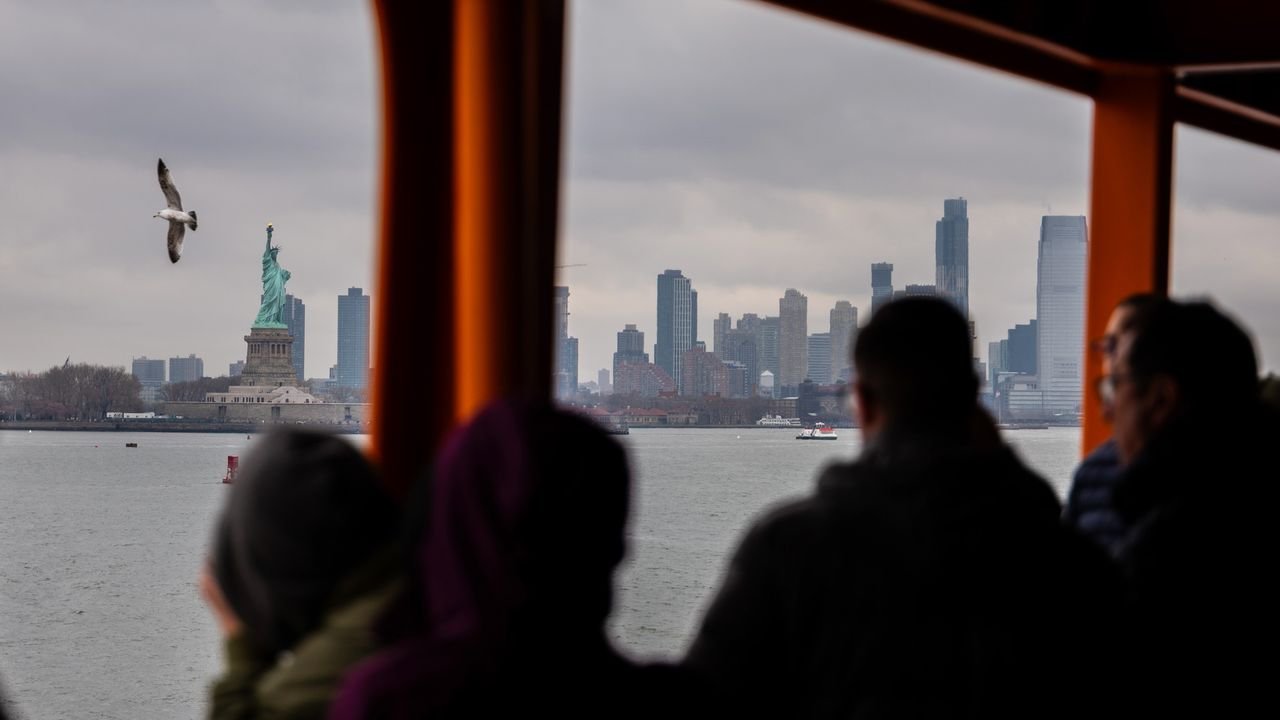
But what would actually happen? If the City of Staten Island were created tomorrow, it would immediately become the second-largest city in New York State. (Population: nearly half a million.) It would keep a lot of its bus routes, because the M.T.A. is managed by the state, and Staten Island still falls in the Metropolitan Transit District. (“They’re not seceding from that,” Husock said.) The ferry, though, is operated by New York City. It would probably still run, but it may not be free.
It’s possible that Staten Islanders would individually pay more taxes, but they might like that. The voters of an independent Staten, Husock said, could choose to pay more for the bundle of services that they want. A report from the Independent Budget Office, from 2024, estimated that secessionists would need to fill a budget gap of at least a hundred and seventy million dollars. It also warned that the island would lose out on New York’s economies of scale. Staten Island would, for example, have to renegotiate its deal with Spectrum and Verizon.
In addition to handling schools, Staten Island would have to run its own fire department, trash collection, hospitals, and snow removal. But so do other cities. “Buffalo is a city!” Fosella said. “It’s smaller than Staten Island. So clearly it can be done. It’s not like it’s the end of the world.”
Sam Pirozzolo, a New York State assemblyman for the Sixty-third District of Staten Island.Photograph by Charly Triballeau / AFP / Getty
The police would be a big sticking point. On an independent Staten Island, the politics of policing seem to flip. Paul Costello, a lifelong resident, who was one of the field leads for Staten Island for the Mamdani campaign, told me that the Republicans who are pushing to secede would miss the N.Y.P.D. “As a person who is hypercritical of the N.Y.P.D., it is the best-funded police force probably on the planet,” he said. The department’s annual budget last year was $5.8 billion. “For a pro-police person, they have everything they want right now,” he said. “They’re basically saying they want to kneecap them, which, hey, I’m all for. But it doesn’t really make sense.”
There’s a utopian model for what Staten Island could be, and it’s Yonkers. Yonkers, Husock explained, is a predominantly white, working-class community, of two hundred thousand people, connected to New York City by the Metro-North and buses, and governed by center-right Democrats. It runs its own police, fire, and schools. “I think they have Yonkers envy,” Husock said. “They’re not going to become Scarsdale, obviously, but they would become Yonkers.”
Not everybody agrees. “It’s not a good idea,” Costello told me. Being a part of New York City, he said, means that “we get literally the best services available to anyone in the country.” “It’s an old feeling,” he said, of secession, “but it’s not founded in financial literacy.”
Costello, who is thirty-one, grew up on Staten Island’s north shore, went to high school and college on the island, and now lives in St. George, near the ferry. “I love Staten Island with all my heart,” he said. But every time secession rolls around it can feel like living through the Civil War. “It’s like I’m a guy on the border between the Union and the Confederacy. And I’m like, ‘No, I’m part of the fringe that lives here that actually agrees with the North.’ ”



