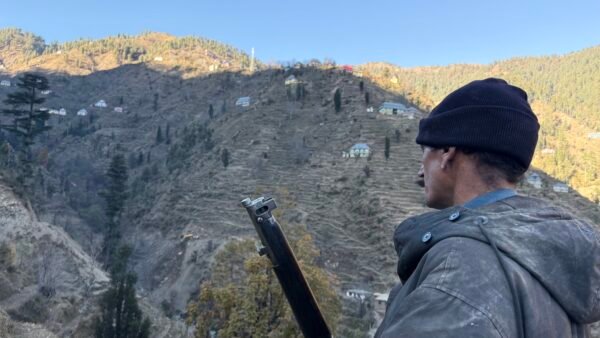
RAMBAN, INDIAN-RULED JAMMU & KASHMIR — Walking with a rifle dangling from his shoulder, Narinder Singh eyed the tops of hills, as though looking for a target. Singh, 50, has a routine: every morning when his village is asleep, he and several others tread carefully, hoping to keep their neighbors safe.
In the remote hills of Ramban, a dusty district in Indian-ruled Jammu and Kashmir, the sound of morning patrols has returned, but the men in motion aren’t soldiers. They are shopkeepers, daily wagers, and teachers, who have befriended old, rusty rifles.
Singh, a teacher at a primary school in Ramban’s Ganote village, is a member of the “Village Defense Group” (VDG) – a civilian militia. The model originated in the 1990s in Jammu and Kashmir, aiming to ensure the safety of the locals by arming them with weapons for self-defense as well as aiding the efforts of the security forces to curb insurgency and cross-border infiltration.
In this village nestled amid green hills, India has positioned Singh and at least 300 others as the first line of defense against anti-India insurgents. These civilian militias are meant to compensate for the state’s limited security presence in remote areas, effectively placing the burden of counterinsurgency on local residents where regular security forces have restricted access.
Ganote is made up of broken pathways and inaccessible routes. Photo by Tarushi Aswani.
Monitoring Mountains
Originally labelled as the Village Defense Committee (VDC), these groups were first created in Jammu division’s districts such as Doda, Kishtwar, Ramban, Rajouri, Reasi, Kathua and Poonch in 1995. The program set up armed civilian groups in the identified villages along the borders, as well as in forested areas of the Jammu division.
Singh himself was recruited to Gantoe’s VDG back in 1996. “I have been a VDG member for almost 30 years,” he explained. “I have seen anti-India rebels rush down from these hills that we call home.”
Singh believes that while Ganote’s locals are serving this civilian militia system, they are also exposing themselves to heightened risks in a conflict they have zero control over.
Ganote is a remote mountain village housing around 5,000 people, located in Ramban district of Jammu and Kashmir, situated along the Chenab Valley. The village can only be reached via narrow and broken roads. Surrounded by steep terrain and forested slopes, Ganote is part of a region that is geologically fragile and frequently marred by landslides. The area is strategically significant, while the rugged landscape contributes to its isolation and limits connectivity.
Ramban last saw anti-India insurgent activity back in 2011. Even so, Singh feels that manning hills to drive out insurgents is way beyond the civilians’ capacity. He told The Diplomat, “Have you seen our rifles? We carry British-era Lee–Enfield, .303 rifles. How can it aid us?” (The U.K. stopped producing the Lee-Enfield rifle in 1956, although production in India continued into the 1980s.)
Another VDG member, Shiv Nath, added, “We have no training, no new weaponry, we are just told to fire, if we see something suspicious. When soldiers undergo training for months, can’t we be trained? We are working towards guarding Mother India but we need training for our safety too.”
In Reasi, 150 kilometers from Ramban, 1,902 additional VDG members were recruited in December 2025. In January 2026, the Army started a training camp for the VDGs in Jammu’s Doda. Though the Army has now announced training, back in Ganote, members still feel ill-equipped to handle arms.

A VDG member showcases his .303 Lee-Enfield rifle, provided to him by the state. Photo by Tarushi Aswani.
Security Under Strain
On January 18, anti-India insurgents were reportedly spotted on the hilly tracts of Jammu’s Kishtwar district. The encounter with the insurgents led to at least seven soldiers being injured.
From the second week of January 2026, multiple drones were reported over Jammu and Poonch districts, marking at least three such sightings in a week and prompting the Indian Army to open fire in response. The repeated drone sightings and cross-border infiltrations this month alone underscored the ongoing security challenges along the Line of Control and adjacent international border between India and Pakistan.
These strains on security have severely alarmed the VDGs. “When the drones were sighted, we were alerted by the authorities and since then, we are on our toes, but we wish we were better trained and equipped. The situation in our region is very critical,” Singh and Nath explained to The Diplomat.
Over the past decade, Prime Minister Narendra Modi has projected national security as a settled achievement, using the 2016 and 2019 air operations against Pakistan to claim strength. Modi’s government promoted the cancellation of Jammu and Kashmir’s autonomy as a method that would surely root out anti-India insurgency and cross-border threats. India’s National Security Adviser Ajit Doval reinforced this narrative, most recently asserting that India has effectively countered terrorism, except in Jammu and Kashmir.
Yet the security landscape on the ground remains uneven.
Since 2014, Kashmir has witnessed recurring spikes in attacks. The 2019 Pulwama blast that killed 40 Indian Army soldiers punctured claims of deterrence. Targeted killings have risen since 2021, and drone incursions along the Jammu border have become increasingly routine. Newer militant groups are rising in the region; anti-India groups such as the People’s Anti-Fascist Front, The Resistance Front, Ghaznavi Force, Lashkar-e-Mustafa, and the Kashmir Tigers emerged after Modi’s revocation of Kashmir’s special status in 2019.
Meanwhile, the strategic consequences of the 2020 China-India clashes remain unclear. The April 2025 attack on civilians in Kashmir, followed by the May 2025 clash between India and Pakistan and the November 2025 blast in India’s capital, New Delhi, further highlight the gap between official projections and ground reality.
Back in Ganote, the VDGs realize this – including the implications for their own safety. “We have no choice,” Singh and Nath agreed. “If we stay unarmed, insurgents might kill us. If we pick up arms, we become dearer targets of insurgents. We are walking a tightrope.”

Ganote is a hilly village in Jammu division’s Ramban district. Photo by Tarushi Aswani.
Claims of Peace and Sustained Conflict
In 2005, India’s federal government founded a local militia, the Salwa Judum, to combat Maoist rebels in central India’s Chhattisgarh state. It was accused by rights groups of committing widespread atrocities and was disbanded in 2011, after the Supreme Court of India ruled against it, calling it “unconstitutional.”
Similarly, in Jammu and Kashmir, the civilian military model had been disbanded over concerns about misuse of weapons and a lack of accountability. However, in Jammu, the VDGs were reconstituted in August 2022. The policy to rearm civilians came three years after India stripped Kashmir of its semi-autonomous status in 2019, on the pretext that the move would counter insurgency and militancy in the region.
After the revival, there were a series of militant attacks in the Jammu region, including on VDG members, who were kidnapped and killed.
Firdous Tak, an advocate and former journalist from Jammu’s Kishtwar, argued that the decision to re-arm civilians punctures the Modi government’s long-standing claims of having delivered a “secure India.” Tak, who is also a spokesperson of the People’s Democratic Party, feels that far from reflecting stability, the reconstitution of VDGs only confirms the persistence of conflict conditions that official narratives have sought to downplay.
Tak shared problematic details about the VDGs, including that the latest VDG recruitments have been on the recommendation of the ruling Hindu supremacist Bharatiya Janata Party and the Rashtriya Swayamsevak Sangh (RSS), a right-wing Hindu organization.
“Arming right-wing people is extremely dangerous, it has backfired before,” Tak noted. “The VDGs have had a history of notoriety. Cases of extortion, vandalism and even abduction have been lodged against them.”
The Diplomat also spoke to a retired general of the Indian Army, who has served his tenure in J&K. “Armies can’t be everywhere. We follow a grid system which cannot work in the higher reaches, so consequently a lot of villages are left uncovered. So this VDG system makes sense,” he explained.
But the general noted several issues in the current set-up. “They [the VDGs] are poorly armed. Even the insurgents have better weaponry than them. While I support the idea, severe reforms are needed – from their training, to tactics, to their weaponry.”

Ramban district’s Ganote village has at least 300 VDG members at the moment. Photo by Tarushi Aswani.
The general also understood the point made by Tak, that arming Hindus who form the majority of Jammu’s population, threatens Muslims, who are in the minority in Jammu. But he reiterated that it is a good step, provided that the VDG members are properly trained. He recommended that Muslims in Jammu, who face threats as well, must also be armed.
The VDG system blurs the line between combatants and non-combatants. For men like Narinder Singh, patrols at dawn have become part of everyday life, even as classrooms, shops, and fields still demand their attention. In villages like Ganote, the VDG’s rifles don’t symbolize power; instead, they have become reminders of vulnerability, as civilians are expected to take on tasks they are ill-equipped to fulfill.
With little training and ageing weapons, Singh and his comrades stand watch over the mountains not because they seek conflict, but because they fear what might happen if they do nothing. In places like this, far from the political stage, the image of a secure India feels distant – and the burden of protection often falls on the shoulders of those least equipped to provide it.