
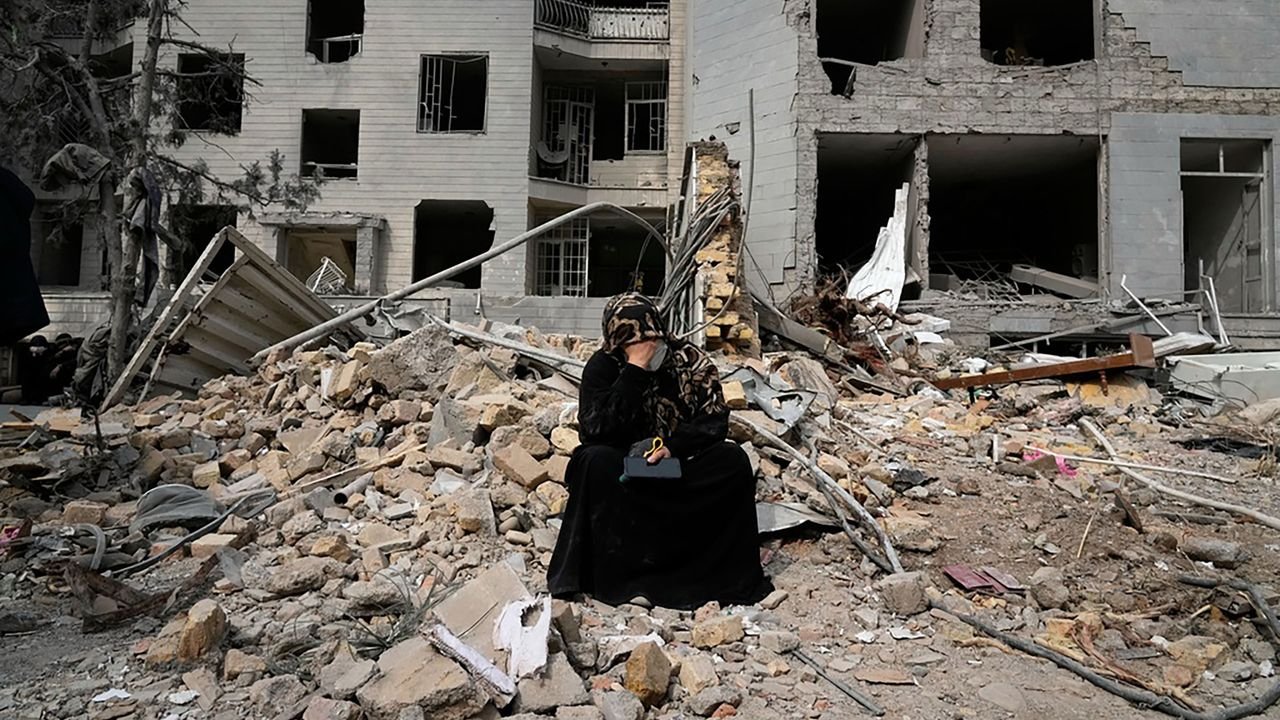
October 7th, and the decimation of Gaza, brought unshakeable images to screens around the world—of hang gliders, brutalized women in the backs of trucks, mangled children, flattened city blocks. The spectacle produced by the war in Iran has been, for distant viewers, comparatively familiar, almost generic. Similar images have appeared so many times that it’s become nearly impossible for many of us to know if we are looking at rubble in Gaza, southern Lebanon, Syria, Tel Aviv. The sameness of what we’re seeing has, in America, lowered the political stakes of war. Much of the public is still outraged about what’s happening, but I fear that two and a half years of images from Gaza may have built up a public immunity to the sight of smashed concrete and blown-up humans.
What happens when the spectacle of war no longer captivates the public? What happens when we can’t even muster the illusions of shared separation?
Strangely, as social media has moved from the text of status updates and tweets to short video, verbal commentary has actually grown more prominent and more viral. This is what led my friend and me to our idle accounting of new-media punditry. What’s shoved on our feeds is, increasingly, tight shots of people’s faces as they angrily decry one thing or another.
On this well-lit but warped stage, the act of politics changes, although not always perceptibly. Recently, Joe Kent, the former head of the National Counterterrorism Center, who resigned earlier this month in opposition to the war, went on Tucker Carlson’s show. Antiwar liberals, who might not agree with much of anything that Kent has said in the past, might still happen upon clips of that interview on social media and find themselves hoping that Kent acquits himself well, so that he might provide a convincing counternarrative to his fellow-travellers on the right to oppose further military action. This, in turn, one might imagine, could help pressure lawmakers to turn on Trump.
What’s striking about this train of thought, which is quite common among the terminally online—a population that is growing every day—is that it involves no actual agency on the part of the person tracking this Rube Goldberg political process. The viral talkers have become the measure and the expression of the public’s outrage, mediated through the algorithms of social media.
These are horrible conditions for meaningful dissent. Trump’s party controls all three branches of the government, but I suspect that another reason Trump and his Administration feel like they can do whatever they want without consulting popular opinion—or even really informing the public—is that they recognize, consciously or otherwise, that the American people, alienated and addicted to their phones, are currently incapable of organizing themselves toward significant political action. “The technology is based on isolation, and the technical process isolates in turn,” Debord wrote. “From the automobile to television, all the goods selected by the spectacular system are also its weapons for a constant reinforcement of the conditions of isolation of ‘lonely crowds.’ The spectacle constantly rediscovers its own assumptions more concretely.”
One could easily characterize the No Kings actions as simply more spectacle—drone shots of big crowds to feed the social-media machine. But I feel sure that most of the millions who marched this past weekend were not only looking for more capital within the viral economy; they were looking for other faces and voices that would remind them they’re not alone. This may be all that the protests can presently accomplish. But nothing is more important than remembering there’s life outside the spectacle. ♦



