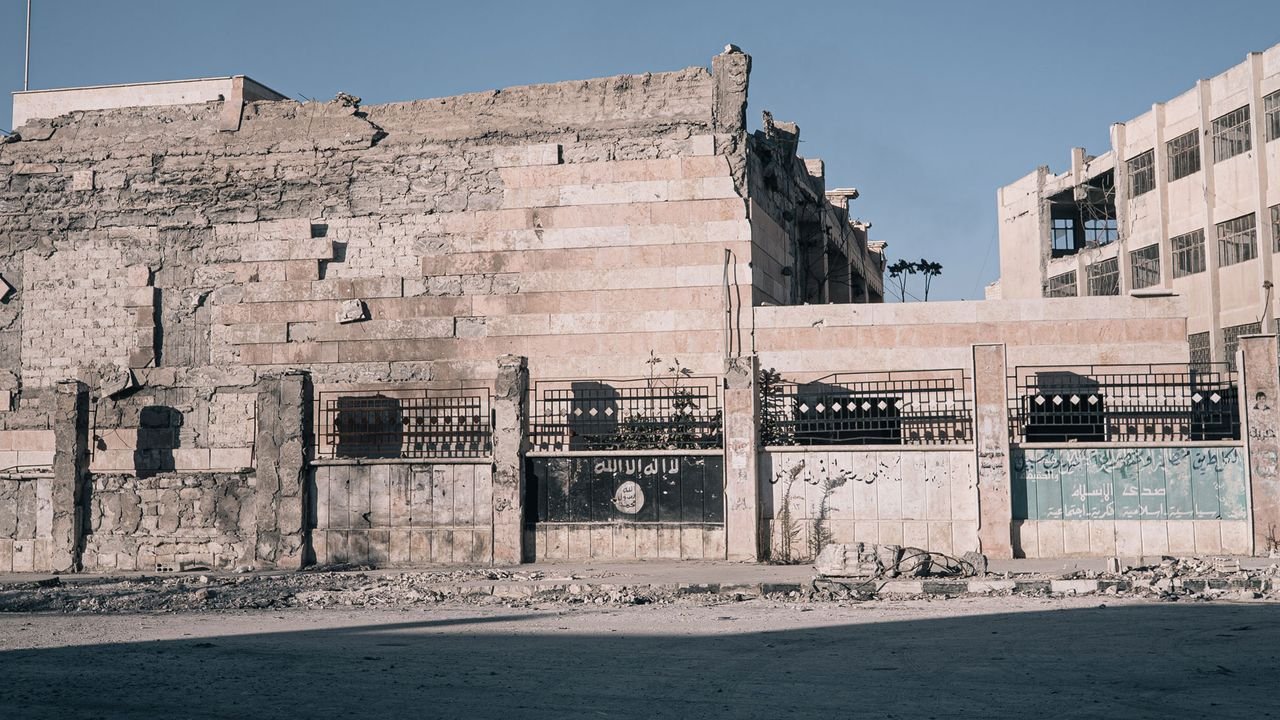
As the authorities dithered, people across the city grew restless. One activist decided to take matters into his own hands. Abdul Hadi Bisher was an energetic member of the Revolutionary Youth Movement, a pro-democracy organization that had organized protests against Assad. He’d been jailed after shouting “freedom” in the streets—and in detention he’d been sodomized and waterboarded. In the year since Manbij’s liberation, though, he’d grown disgusted with the city’s dysfunctional government, under which crime and inequality had become pervasive. He began to wonder if, in order to win justice for Musa, it was time to look for a more daring alternative.
Not long earlier, a hitherto unknown group called ISIS—the Islamic State of Iraq and Syria—had set up an office in town, unfurling a black banner that proclaimed “There is no god but God, and Muhammad is His Prophet.” ISIS members milling outside the building were heavily armed, but it wasn’t obvious to residents what their plans were for Manbij. Some of the members were foreigners from Egypt and Iraq, but others hailed from the countryside outside the city.
Abdul Hadi sought out an ISIS commander and explained the frustrations of Musa’s family. The commander listened patiently but replied that ISIS could not interfere with the judicial process in the city, because they were just one faction among many—that is, unless the people themselves demanded it. If the public lost faith in the judicial institutions of Manbij, then, and only then, could ISIS intervene.
On June 13th, under a blazing sun, Abdul Hadi gathered with some two hundred residents for a rally, with Musa’s relatives in tow. “The people want the execution of criminals!” they chanted, while marching toward the old cultural center. From within, ISIS guards watched the throngs. The door did not open.
Abdul Hadi led the procession toward Main Street. Protesters held banners decrying criminality and calling for law and order. Men and women stepped onto their balconies, watching the crowd stream past—not an unusual sight there since liberation, except that now there were no tri-star revolutionary flags, no banners calling for freedom. Instead, the word that the protesters shouted was “justice.” They wanted to be able to sleep soundly at night, to be able to send their children to school, to make a living, to simply live. As the mass moved down Main Street, it grew. Soon there were six hundred people. The procession passed the headquarters of various Free Syrian Army factions, at whom the protesters hurled bitter insults for failing to protect the city. By late afternoon, the crowd had reached the central courthouse, where the five suspects had been detained, and demanded swift justice.
Suddenly, three vehicles raced toward the crowd. Some ten ISIS members jumped out—perhaps the entire group then in Manbij—and stationed themselves around the courthouse. The ISIS commander with whom Abdul Hadi had spoken approached the building’s guards and demanded to enter. The policemen refused and ordered him back.
The commander opened his vest to reveal a bomb strapped to his chest. “I’ll use it!” he shouted. “I have no fear!”
The police backed away.
“The people of Manbij and the relatives of the deceased have asked for justice,” the commander declared. “The people have asked us to deal with this case, and we’re here to fulfill their wishes.” The stunned policemen opened the door. ISIS members gathered the suspects and stuffed them into their vehicles. As they drove off, a cheer went up from the crowd.
Later, Abdul Hadi met with several friends to discuss the astonishing episode. He hailed the commander’s follow-through—he had done exactly as he’d promised, waiting for residents to call for ISIS to intervene. These people aren’t afraid of anything, one of Abdul Hadi’s friends exclaimed. Perhaps they were exactly what the city needed.
Locked in a room at ISIS headquarters, the five suspects desperately tried to work out a plan. It turned out that only three of them, including Manhal and Karoom, had been present at the murder scene. One of the other two was Manhal’s brother, Ayman. He was just sixteen, and he had known nothing about the crime. Manhal was pacing the room, near tears. Ayman, moved by his brother’s plight, offered to confess to the crime. Because he was underage, he expected lenience.