
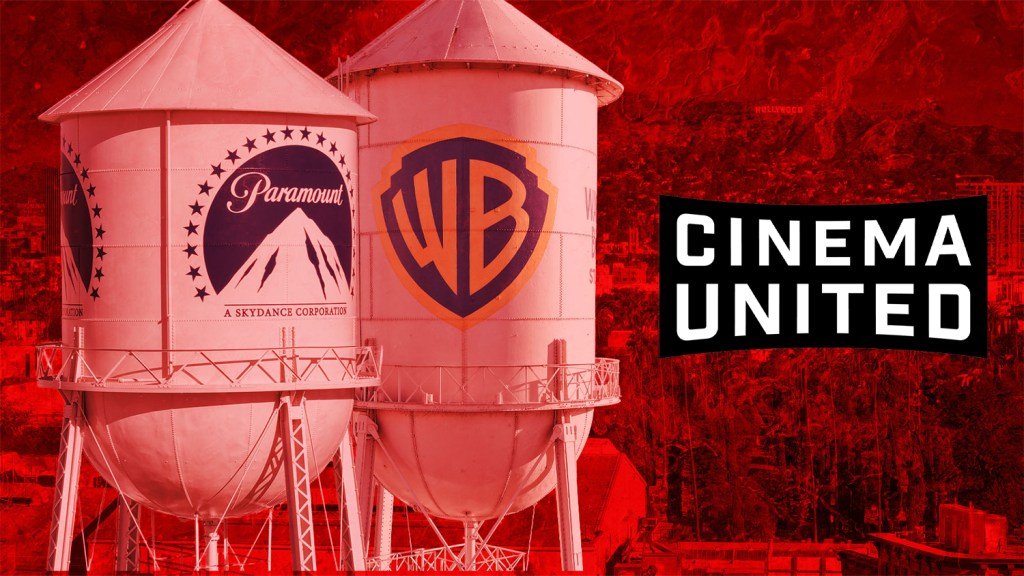
Nine days before Cinema United looks Paramount executives eye to eye at their Las Vegas confab, CinemaCon, the movie theater lobbyist org’s boss Michael O’Leary has fired off some letters this week. He wrote to the National Association of Attorneys General, the Democratic Attorneys General Association and the Republican Attorneys General Association about the Melrose Lot studio’s pending union with Warner Bros, declaring, “I strongly urge you to thoroughly investigate and move to block this proposed merger to ensure it does not harm competition or our local communities.”
Read the letter in full here.
Yes, a consolidation of the motion picture studios from five down to four would mean fewer jobs, less choices for moviegoers, higher tickets prices, increased leveraged rental terms on cinemas by studios, potential multiplex closings and depleting ticket sales. Just look at what happened with 20th Century Fox movies post Disney-Fox (a $1 billion less in 2025 versus 2016, a 70% drop).
“Based on our review of the proposed merger between Paramount and Warner Bros., we have no reason to believe the outcome of that combination would be any different,” writes O’Leary.
However, there’s a ripple effect, and that’s how the Paramount-Warner Bros Discovery merger will hurt Main Street America the most.
Writes O’Leary: “Our members’ theatres are Main Street businesses, not Hollywood businesses. They are vital cultural and economic engines for the communities they serve. A thriving theatre anchors foot traffic, supports nearby small businesses, and keeps local dollars in our local communities. Recent research shows that for each dollar spent in a local movie theatre, an additional $1.50 is spent in surrounding businesses in the community—including local restaurants, bars, shopping centers, transportation, and other local businesses.”
Minus the movie theater and foot traffic due to this merger, that ecosystem suffers, per Cinema United, “where dining and retail spending associated with movie visits nationwide adds up to billions of dollars for local restaurants and retail outlets.”
Paramount CEO David Ellison has promised that the new merger will maintain 30 theatrical releases a year. While that’s an organic slate increase that will be achieved upon absorption of Warner Bros (check out our chart here), the fear for many is about the future.
“We really believe that movies should be seen in theaters, and we still believe that’s one of the most significant places that you can really create long-term intellectual property,” Ellison said on a March 2 earnings call. “Television is a completely different business.”
O’Leary disagrees. Paramount will argue that their absorption of Warner Bros Discovery has been in an effort to scale up to streamer competitors like Netflix and Amazon. Cinema United’s note observes: “To the extent that Paramount continues to operate Warner Bros. as an independent, movie-making studio, it would be incentivized to mimic Netflix’s historic antipathy toward theatrical, sending its movies straight to premium video on demand (PVOD) or streaming video on demand (SVOD) and cutting out theatres altogether.”
Concludes O’Leary: “Most importantly, this merger threatens the economic and social well-being of our communities. While this transaction will impact theatre circuits of all sizes, it is Main Street America that will suffer the most. Smaller, mom-and-pop theatres will bear the disproportionate brunt of this latest attempt to scale Warner Bros.”



