
Two years ago, talk about how much if any cellphone access students should have in schools raged across Florida.
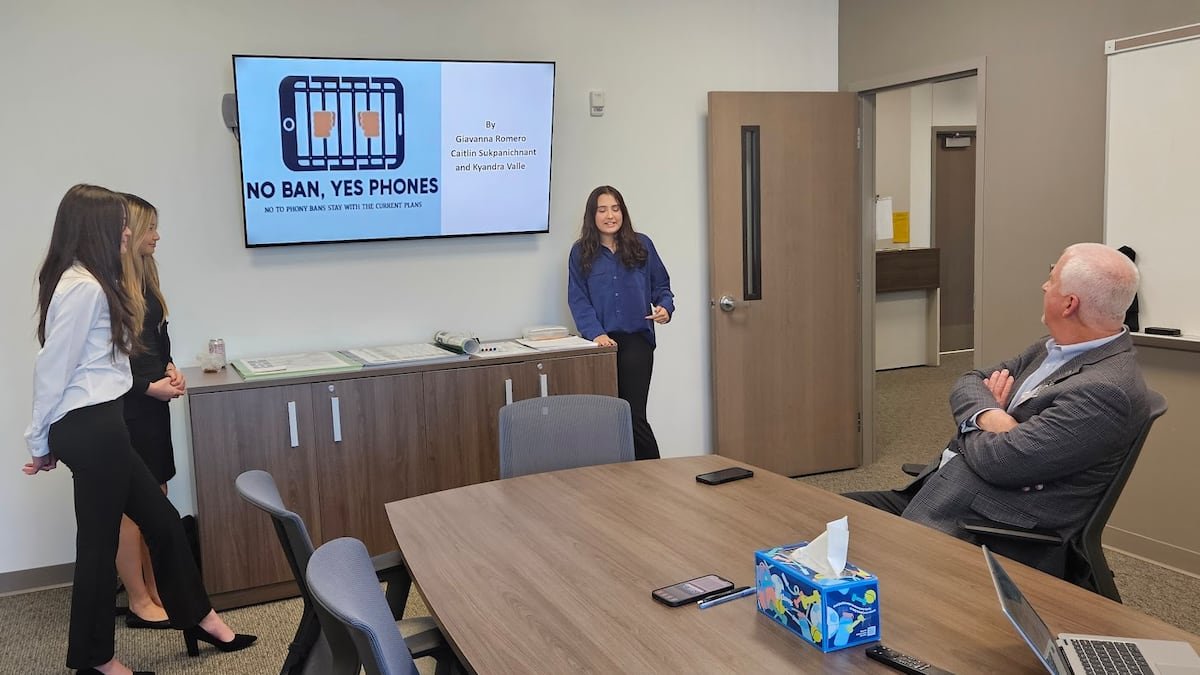
A group of teens at Pasco County’s Angeline Academy of Innovation so passionately wanted to prevent an all-out ban that they made it the topic of their entrepreneurship class project, culminating with an hourlong presentation aimed at convincing then-superintendent Kurt Browning not to stop their use.
They lost their argument. Soon after, Florida lawmakers imposed even stricter controls on schools, with other states following suit. And just as in those other states, views on the outcome have been mixed, with the adults who implement the rules generally more positive than the students who try to understand the ban while also dealing with their perceived loss of freedoms.
Pasco school board members said they haven’t heard any comments or concerns about the district’s cellphone rules in quite some time.
But looking back after two years, two of the Angeline students who argued against Pasco’s ban recently said the restrictions haven’t been as successful as proponents would like to believe.
Juniors Giavanna Romero, 16, and Caitlin Sukpanichnant, 17, said despite the best of intentions behind the ban, the rules lead to regular disruptions of instruction and other classroom activities. That’s because many students don’t stow their phones, and teachers have to deal with it.
They said it’s not infrequent.
“It causes more distractions than before the phones were banned,” Sukpanichant said.
Part of the problem, Romero, said, is that most kids have been brought up accustomed to having access to phones and the internet, whether to communicate with parents, check work schedules or scour TikTok. When they’re told to put them away, she suggested, they don’t all find it easy to comply.
“It’s definitely a big change,” she said, adding that the way teachers react can make it worse.
Some stop class to lecture the rule breakers, she said. Some implement punishments such imposing a silent classroom, telling students they can’t work together, making the learning less engaging.

“A lot of kids … feel like they have no control,” Romero said, noting that some feel discomfort at being disconnected from their parents.
Their observations reflect others from around the state.
The Orange County school district, for instance, won praise across the nation for its early adoption of a full day phone ban, with teachers and parents finding positive outcomes such as decreased discipline problems. At the same time, the Orlando Sentinel reported that many students didn’t care for the rules and often didn’t obey them.
Pinellas County district officials said they looked at Orange’s implementation when revising their policies, adapting to avoid some of the perceived problems. While the rollout was rocky, as students tested the limits, later reports suggested that resistance subsided.
Chad Mallo, Sukpanichant and Romero’s entrepreneurship teacher at Angeline, acknowledged that many children have struggled with the limitations.
“As kids go from a digital environment and we take it away, it’s almost like they need it,” Mallo said. “It’s a difficult transition. It’s almost like putting them in time out.”
He said some teachers have spent more time enforcing the requirement than it’s worth. It’s often boiled down to daily repetition, he said, at the expense of lessons.
On the plus side, though, many are figuring out how to avoid the discussion by making lessons interesting enough that students don’t want to use their phones.
“I feel less distracted when class is more hands-on and engaging,” Sukpanichant said, particularly with labs and other fun assignments. “I don’t feel the urge to go on my phone.”
If more teachers would take such steps, she said, students would be preoccupied with learning and not even think about texting and posting on social media.
At the same time, Romero said, in some instances phones and other devices can help with instruction. Many assignments and readings are online, she noted, and not all classrooms have access to school-issue computers, making phones a useful supplement for the work.
In her biomedical course, for instance, students use their phones to take pictures of dissections. Sometimes teachers use QR codes to link to extra materials. When the school lost its internet service in February, cellphones provided Wi-Fi hotspots for classroom connections.
“I think teachers should be able to decide if they want to use phones in their classrooms,” Sukpanichant said.
The rules also should take into account that high schoolers should be given the opportunity to learn how to use self-control, determining when it’s appropriate to use technology, rather than being dictated to, Romero added.
“In a year and a half, we’re going to be out on our own,” she noted.
JoAnne Glenn, the principal at Angeline Academy, preferred to see the changes in a positive light. While faculty members had concerns about their ability to enforce the rules, Glenn said, problems have not been too prevalent.
The school took steps to educate students and their parents about the expectations, she said, and the effort largely paid off in the form of increased social interactions among students who previously sat near each other but were glued to their small screens.
“In class the kids are more engaged because they don’t have the option to check out as easily,” Glenn said, noting that they can still use phones at lunch. “We’re also not seeing as much social media drama.”
The district continues to revise and refine its rules on how students can use phones and other personal wireless devices in school. A proposed amendment to the student code of conduct includes a definition that clarifies that earbuds, watches and other items that can connect to the internet are included.
Jeffrey S. Solochek is a reporter covering education as a member of the Tampa Bay Times Education Hub. You can contribute to the hub through our journalism fund by clicking here.



