
The first photos of Tropicana Field hours after Hurricane Milton made landfall crystalized the devastation wrought on St. Petersburg.
The Trop’s iconic dome was ripped apart that Oct. 9, 2024 night, its tatters illuminated by the exposed lights below. Shredded fiberglass littered the baseball diamond, filled with empty cots set up for emergency response workers. The infamous catwalks, that have long been a place towering pop-ups go to die, somehow remained.
“It reminded me of the ‘Walking Dead’,” said Mayor Ken Welch.
It was just the opening episode of this disaster. The Rays would go on to scuttle a long-sought deal to replace the Trop with a state-of-the-art ballpark. New owners set their sights on moving the team to Tampa. Yet St. Petersburg was legally obligated to fix the stadium and make it playable for the final three years of the Rays’ lease. Initial estimate: $55.7 million.
It seemed perhaps like a perfect time to walk away from the cursed dome. Four separate mayors had tried and failed for nearly two decades to broker a deal to keep the team in St. Petersburg. Even the Rays hesitated to greenlight the Trop’s repair.
Right after Milton, Beth Herendeen, the city’s point person on event facilities, walked through the damaged stadium. She had done so countless times before, going back to when it was called the ThunderDome in the 1990s.
Sure, the roof was gone. But the rest of the building was largely intact.
“My initial gut reaction was, we can fix this,” Herendeen said.
The city set an aggressive deadline: opening day 2026. Come Monday, against all odds given the team’s history, the Rays will play their home opener in the rebuilt Trop.
It took luck, quick decision-making and a dedicated team of city officials and building contractors with a soft spot for the maligned dome.
All they had to do was survive another hurricane season, the Rays’ indecision, tariffs — and a Russian volcano’s first eruption in 600 years.
The big focus: replacing the roof
The first step in repairing the Trop: spending $6 million to clean up the mess and waterproof it to prevent further damage.
Enter the contractors. The city leaned on its relationship with Hennessy Construction, which produced a report that showed the Trop was structurally sound. Stadium construction giant Aecom Hunt, which finished the former Florida Suncoast Dome in 1990 and outfitted it in advance of the 1998 Devil Rays opener, reached out to Hennessy less than 48 hours after the storm to offer its services, said Ken Johnson, Aecom Hunt‘s project and sports sector lead.
“To see this thing blown apart like it was, there’s a lot of memories that everyone had there,” said Johnson, who has worked on the Trop himself.
Hennessy and Aecom Hunt recommended Global Rope Access for the dangerous job of taking down the dangling remnants of the roof. The company flew in 20 technicians from all over the country.
It helped. Johnson noted that the concession areas, offices and mechanical and electrical systems that weren’t beneath the missing roof escaped serious harm.
“Had all that been damaged,” he said, “it would’ve been a whole different story.”
So the focus was replacing the roof before repairs to the interior could start.

‘You’re questioning our ability.’
Almost immediately after Milton passed, the Rays began signaling they wanted out of a $1.3 billion stadium deal they had spent almost two years negotiating. The St. Petersburg City Council didn’t know what to do with a damaged stadium that was supposed to be bulldozed in a few years.
The team’s 1995 agreement with St. Petersburg required the city to “diligently pursue” repairing the Trop until the contract ends in 2028.
But in November 2024 former Rays president Brian Auld said the team didn’t support repairing the Trop. Auld made the statement after the council had approved $24 million for fixes. He said that money would be better spent buying the team out of its lease.
“I would say that the challenge of being ready for 2026 is enormous,“ Auld said at the time. “If I was confident the Trop could be ready by 2026, I would be strongly in favor of improving it.”
City architect Raul Quintana, who retired in January, took Auld’s comments as a challenge. Many of the same city employees who had spent the past two years working nights and weekends to get a replacement stadium deal done now had to go into overdrive to repair a stadium the team wanted to cut as a loss.
“We felt strongly it could get done,” Quintana said. “You’re questioning our ability.”
Said Herendeen: “That may have provided a tinge more motivation.”
The Rays announced they would play the 2025 season across the bridge at Tampa’s George M. Steinbrenner Field, spring training home of the New York Yankees.
Then, just before New Year’s Eve 2024, the Rays issued a letter changing their position. The team expected the Trop to be ready for opening day 2026 to meet the city’s obligations. A representative from Major League Baseball would sit in on weekly meetings about repairs.
But the Rays’ hesitation had already delayed the city’s plans.
“It probably pushed us off a couple of weeks for sure,” Quintana said. “We were able to course correct immediately and get back on track, but it did affect the contract and it was something we were all very concerned about.”
Germany >> China >> Alaska >> Miami >> St. Pete
The Trop’s new roof is made of a Teflon-coated fiberglass fabric that was produced in Germany. Aecom Hunt placed deposits quickly to reserve production time. They were packaged in four bundles with the first shipping to China in June.
The city and the Rays felt comfortable using one layer. The previous roof had two. After Major League Baseball tested the fabric for lighting in Arizona, the parties agreed to one white layer, which would also brighten the Trop a bit more.
The raw material was flown from Germany to Shanghai, China, where it was manufactured into 24 panels. Enclose Tensile Structures of Dallas, Texas, which would assemble the roof, sent representatives to Germany and China to ensure the panels were made to exact specifications.
Each panel was folded like an accordion. The first 20 panels were flown from China to Alaska, then to Miami before getting driven to St. Pete. The last four panels were shipped by ocean freighter to Long Beach, California, and trucked to the Trop.
A huge earthquake in far east Russia is believed to have triggered the first eruption of the Krasheninnikov Volcano there in 600 years. That closed the airspace and delayed a flight with panels from China to Alaska. Meanwhile, as President Donald Trump announced ever-changing tariffs, the city set aside $100,000 and spent at least half that.
“For the first couple of months, it was like hand-to-mouth making sure the material got in,” said Enclose Tensile Structures President Tom Wuerch.
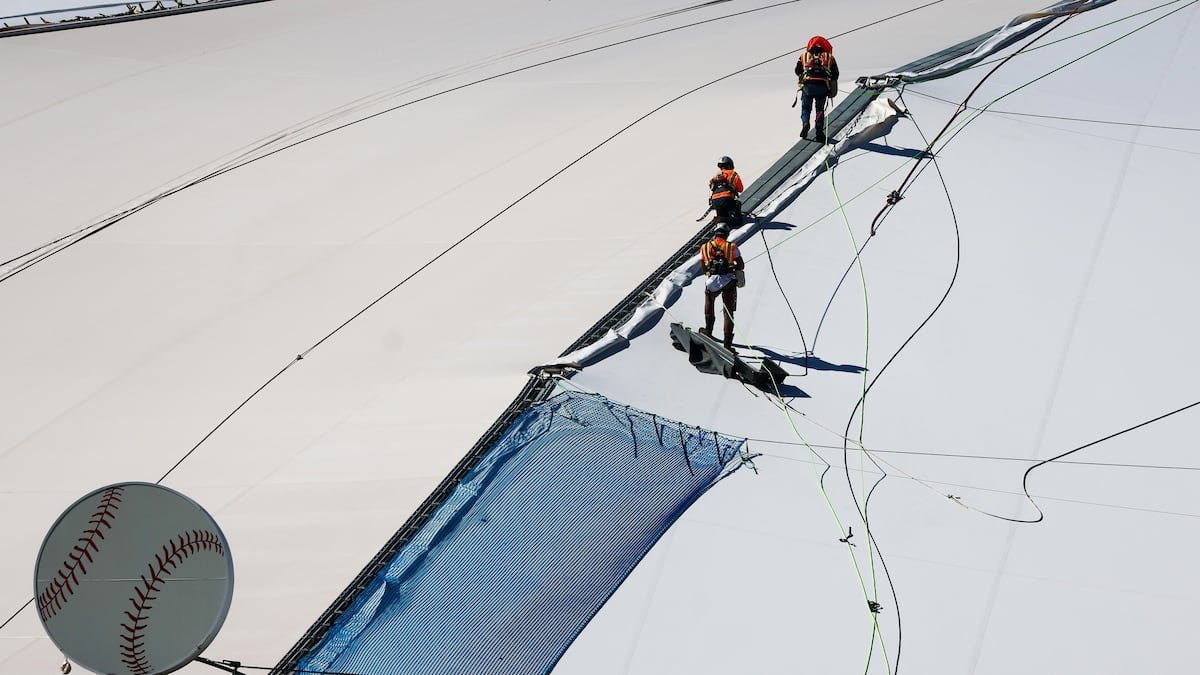
The first panels arrived in August during the peak of the 2025 hurricane season. That’s when 60 employees, many of whom were local union iron workers, began installation.
They used blue nets as work platforms to pull out and pinch each of the 24 panels. The workers had to stop numerous times when lightning was detected within a 10-mile radius or if wind whipped above 20 mph.
On Aug. 23, at least 4 inches of rain came down on the Trop. City landscape architect Cat Corcoran worked with Aecom Hunt and remediation team BMS Cat to create a dam around the field to collect and pump tens of thousands of gallons of rainwater to a retention pond. The Trop’s own never-before-used drainage system couldn’t keep up.
The workers on the roof averaged 10-hour days six days a week, Wuerch said. Some suffered from heat exhaustion, he said but there were no major incidents.
By November, the Trop’s roof had been rebuilt.
‘A symbol of what can be done’
John Curran kept tabs on everything that needed to be addressed under the slanted roof.
A local architect with ASD Sky, he detailed the areas where water had seeped in and what had to be repaired and replaced.
Curran worked on the dome back in the late ’90s and still had shop drawings he helped produce. Those drawings were used to make a three-dimensional model of the Trop to help guide the city’s building and permitting department.
“For me personally, it’s incredible how it’s come full circle,” Curran said. “It’s amazing to have worked on getting it originally set up for baseball and, in some respects, we’re doing it again, which is kind of special.”
The city’s contract required it to make the dome playable for baseball — but not to restore the team’s corporate offices. The city made clear early that it would not do so.
In September, a new ownership group led by Jacksonville home builder Patrick Zalupski purchased the Rays. The team also hired Aecom Hunt to oversee restoring the team’s corporate offices, concession stands and premium suites, including the new owner’s.
The group, Johnson said, invested “a lot of money to make this thing look the best since it opened.”
Tampa Bay Rays CEO Ken Babby said the club is grateful to the city and contractors for preparing the Trop for the team’s return to St. Petersburg.
“This was a complex, around-the-clock effort that required coordination, urgency, and problem-solving at every step,” he said. “Their dedication made it possible for our players, staff, and fans to safely return to Tropicana Field, and we could not be more appreciative of the work that brought us to this moment.”
Some of the contractors who worked to repair the Trop will be at Monday’s home opener. Others said they’ll be there in spirit.
Herendeen, in charge of it all, is taking the day off to enjoy the game with a friend. She bought her own ticket.
“Regardless of where the team ends up,” Herendeen said. “To have the team back, to rebuild, to open, it is a symbol of what can be done when we work together.”



