
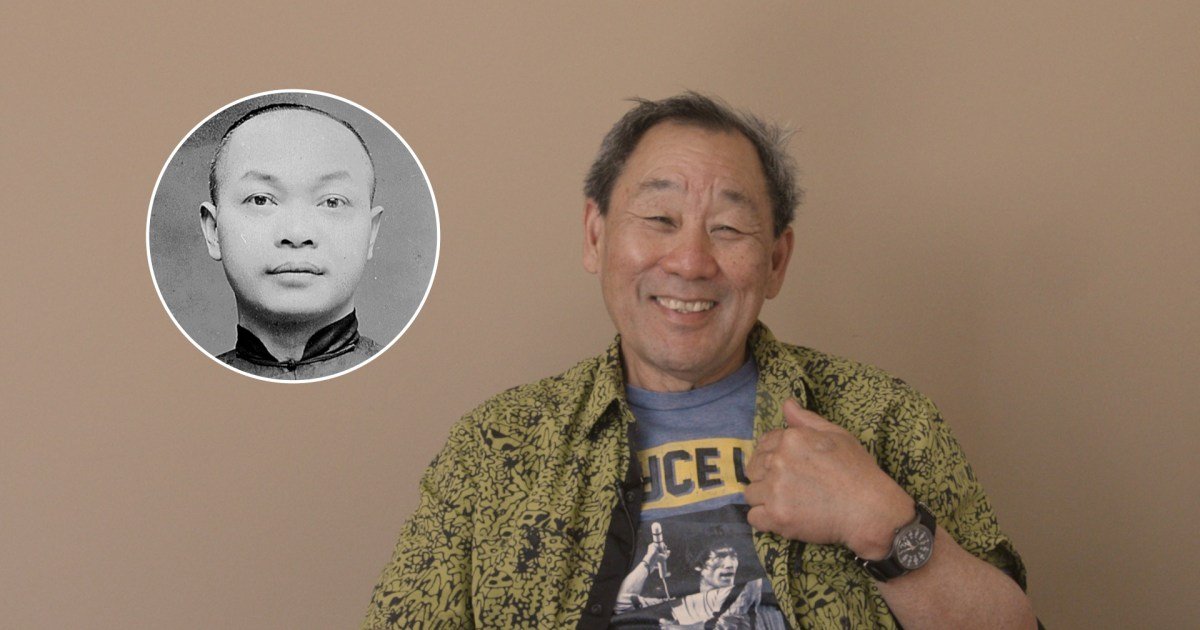
Norman Wong and his great grandfather, Wong Kim Ark.
Today, as the Supreme Court heard oral arguments over the future of birthright citizenship, the justices kept returning to one name: Wong Kim Ark.
Wong was born around 1870 in San Francisco’s Chinatown, the son of Chinese parents who had settled in the United States. As a young man, he traveled to China, and when he tried to come home, he was stopped at the Port of San Francisco. He was denied entry on the grounds that he wasn’t a US citizen because of his Chinese descent and his parents’ status as non-US citizens.
His community in Chinatown pooled resources and hired lawyers. Their argument was straightforward: Under the 14th Amendment, Wong was a citizen. His parents’ immigration status had nothing to do with it.
In 1898, the Supreme Court agreed. And for over a century since, Wong Kim Ark’s case has served as the definitive interpretation of the 14th Amendment: All children born in the United States are automatically US citizens.
That is, unless President Donald Trump gets his way.
Trump has been targeting birthright citizenship ever since his first term. On his first day back in office, Trump signed an executive order attempting to restrict it, limiting citizenship to children with at least one parent that is a US citizen or lawful permanent resident. Federal courts have blocked the order at every turn, but the Supreme Court agreed to take up the case, and today they did.
So we sat down with Wong’s great-grandson, Norman Wong, a 76-year-old retired carpenter living outside San Francisco. His family has not only fought for the constitutional right to citizenship, they’re painfully aware of what it looks like when that citizenship, once won, can be used against you.
Like his great-grandfather, Norman, 76, was born in San Francisco. He’s a retired carpenter and still lives in the Bay Area with his wife, Maureen. We met initially over Zoom, where he invited me to the monthly veterans meeting of Cathay Post 384 in San Francisco, the oldest Chinese American post in The American Legion.
He, Maureen, and his sister Sandra were invited by Alicia Ponzio, a Post member, former lieutenant in the United States’ Navy Nurse Corps, and professional figurative sculpture artist. Ponzio, upon learning about the story of Wong through a podcast, became inspired to sculpt a bust of Wong as a young man. At the meeting, she revealed the plaster model seen in the video.

This model she shared with us is one of many renderings made ahead of the final sculpture of Wong Kim Ark, which will be cast in bronze and proposed to stand at his birthplace of the original 751 Sacramento Street in San Francisco.



