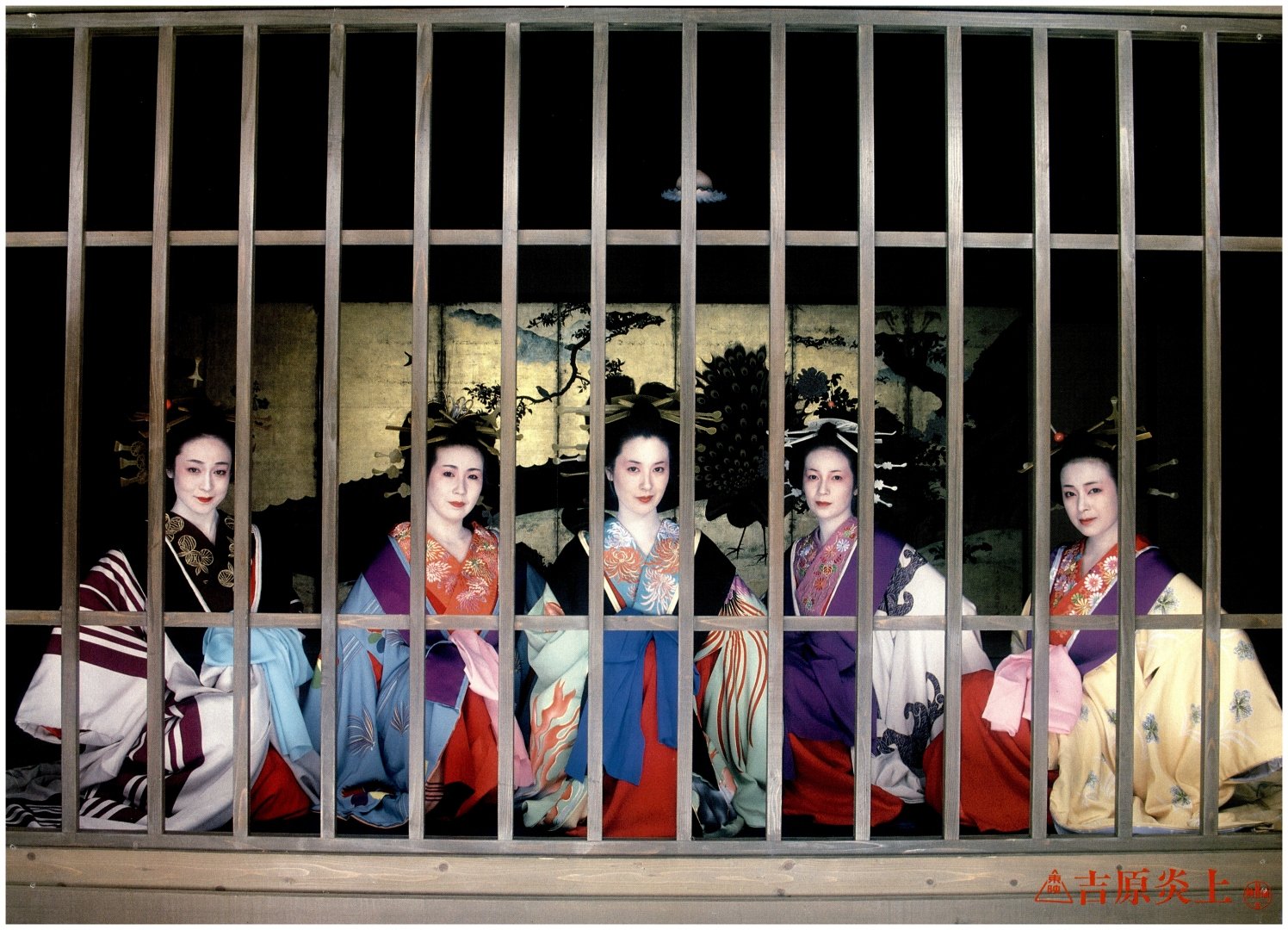
By the beginning of the 20th century, Yoshiwara, Tokyo’s officially licensed pleasure quarter, which was initially established in 1617, had more than 9,000 prostitutes, or oiran as they were called in Japan, many of whom suffered from syphilis. Despite the illusion it presented to its customers as a place where sexual dreams could come true, the area was in reality populated by sex workers who had been sold to the brothels because their impoverished families could not afford to raise them, with their lives unfolding according to contracts rather than free will. It is within this context that Hideo Gosha places “Tokyo Bordello”, a work that takes an unflinching look at the actual conditions of the district.
Buy This Title
by clicking on the image below
It is also within this setting that we first encounter Hisano, the daughter of a ruined ship owner, whose arrival is immediately marked by a doctor’s examination, during which she is ‘informed’ that she is not a virgin, followed by an encounter with the authorities, who have her sign a contract in what resembles a courtroom procedure. Soon after, she finds herself among a group of other courtesans, learning the trade from the three top oiran, Kokonoe, Yoshizato, and Kobana. Her training includes lessons on how to wear a kimono, apply makeup, walk, move, dance, and generally conduct herself according to the strict codes of the district. When the time finally comes to meet her first client, however, she is unable to proceed and attempts to run away. She is quickly apprehended, punished, and eventually introduced to the art of lovemaking by Kokonoe.
As the years pass, Hisano, now known by her oiran name Wakashio, becomes increasingly adept at her work, eventually aspiring to become the top courtesan in Yoshiwara and lead the annual parade. Meanwhile, a wealthy suitor from her past, Nobosuke, lingers around the district, frequently paying for her company without ever touching her. The narrative follows Hisano’s story over the course of several years, while also expanding to include the lives of other key members of the brothel, with Kiku, another courtesan, emerging as an equally important figure.
Hideo Gosha constructs a narrative that unfolds along two interconnected axes. One focuses on the lives of the women and men inhabiting Yoshiwara across time, while the other centers on the district itself, including the broader circumstances of those who work there or pay to enter its gates. Syphilis, as highlighted in the opening scenes, unwanted pregnancies, emotional attachment to patrons who eventually disappear, wealthy suitors who come and go, hysteria, and repeated sexual encounters with elderly and often unpleasant men combine to form a melodramatic portrait that nevertheless feels grounded in realism.
At the same time, the theatricality, beauty, illusion, and fantasy the oiran were required to project in order to entice their clients are sharply contrasted with their actual living conditions. These include resorting to homemade jelly to deceive customers into believing they had reached climax, dealing with physical exhaustion, and enduring the long-term effects of constant labor. Rivalries among the women, occasional expulsions due to poor performance or financial difficulties within the establishment, and a handful of rare happy endings contribute to a depiction that is both compelling and deeply tragic.
The individual character arcs are also particularly engaging, with Hisano’s journey remaining at the forefront. Her transformation from a young woman who attempted to flee her first customer into someone capable of manipulating men with ease, while harboring ambitions of becoming Yoshiwara’s leading oiran, is genuinely absorbing. Yuko Hisano captures this evolution with a performance that is consistently accomplished, especially through the chemistry she develops with nearly every actor she shares scenes with. Rino Katase, in the role of Kiku, presents a contrasting trajectory that proves just as fascinating, ultimately emerging as the standout performance of the cast.
Equally noteworthy is Gosha’s approach to eroticism, which, with only a few exceptions such as the lesbian sequence, is depicted primarily as labor rather than pleasure, further reinforcing the realism of the narrative. The underlying question of where lust ends and love begins adds an additional layer of thematic richness. Lastly, a documentary-like aspect, reinforced by the occasional presence of narration to explain the customs of the area, cements the narrative intricacy.
The art direction by Yoshinobu Nishioka is also exemplary, with the recreation of the period and the specific brothel environment proving both accurate and visually striking. The work on costumes, hair, and makeup, the color palette, the textured sound design by Koichi Ito, and the cinematography by Fujio Morita combine to create a striking audiovisual experience. Editor Isamu Ichida maintains a relatively brisk pace that suits the episodic structure of the story, although it is also here that the work’s most significant weakness emerges. The sheer number of episodes and characters eventually becomes overwhelming, giving the impression of narrative congestion over its 133-minute runtime.
Despite this flaw, “Tokyo Bordello” ultimately stands as a competent and compelling portrayal of life in Yoshiwara during the era, presenting its subject with realism, historical accuracy, and sufficient dramatic weight to render it a consistently engaging experience.