
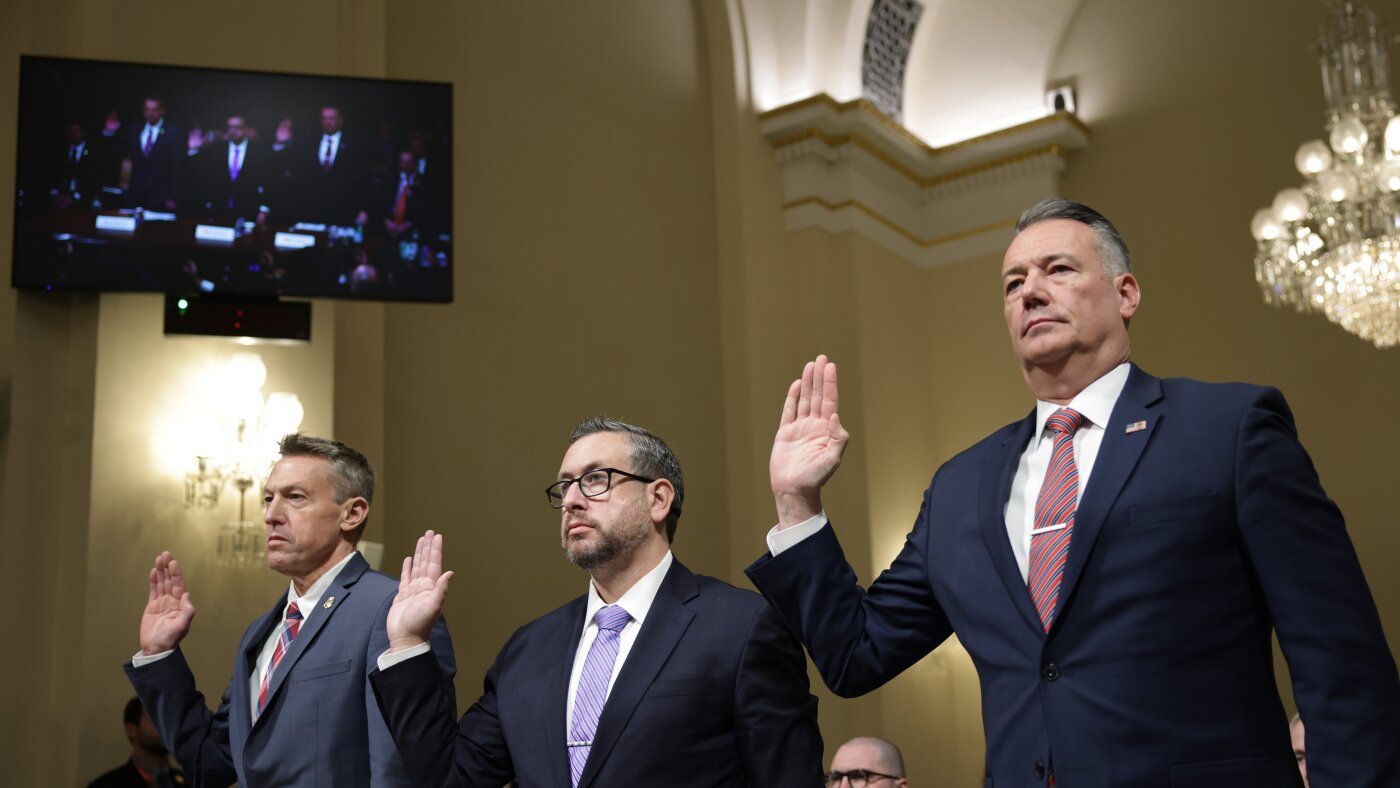
From left, U.S. Customs and Border Protection Commissioner Rodney Scott, director of U.S. Citizenship and Immigration Services Joseph Edlow, and Acting Director of U.S. Immigration and Customs Enforcement Todd Lyons are sworn in to testify during a House Homeland Security Committee hearing on Tuesday.
Samuel Corum/Getty Images
hide caption
toggle caption
Samuel Corum/Getty Images
The top officials of the three federal agencies that oversee immigration enforcement are slated to testify before the Senate Committee on Homeland Security today as their department is one day away from a potential shut down.
Immigration and Customs Enforcement acting Director Todd Lyons, Customs and Border Protection Commissioner Rodney Scott and U.S. Citizenship and Immigration Services Director Joseph Edlow are appearing before the panel. They also testified before the House Homeland Security Committee earlier this week.
Watch the hearing, set for 9 a.m. ET Thursday, live:
Thursday’s hearing was called for by the committee’s chairman, Rand Paul, following the killing of 37-year-old Alex Pretti, who was shot multiple times by federal immigration officers in Minneapolis.
During a town hall this week, the Kentucky Republican previewed the hearing, noting that he wanted to focus on the use of force by federal agents.
“I’m going to ask the head of ICE on Thursday, what is the appropriate use of force? Some of these are women being thrown to the ground where the woman probably is maybe saying something nasty, something bad, or protesting, but you shouldn’t throw somebody to the ground for being obnoxious,” he said, adding that he had concerns with the use of weapons. “Something’s got to be done better.”
Last month, the Senate stripped funding for the Department of Homeland Security from a broader federal spending package. With the agency’s baseline funding due to expire Friday at midnight, lawmakers are now considering potential changes to immigration enforcement at the behest of Democrats, who have refused to fund the agency without reforms.
Several Democrats on the committee were quick to call for DHS’s funding to be separated after two U.S. citizens, including Pretti, were killed in Minneapolis. They have laid out a list of demands that includes mandating the use of body cameras and judicial warrants, banning the use of masks and arrests in hospitals, schools and churches.
Republicans have shown scattered support for some proposals, such as body cameras. But the parties remain deeply divided around other potential reforms and negotiations have been faltering.
Democrats produced legislative text over the weekend encapsulating their key demands. The White House responded with a counteroffer that top Democrats have described as “incomplete and insufficient.”
Senate Majority Leader John Thune, R-S.D., has described the talks as making progress, though he has acknowledged that they are all but certain to not bear fruit before the Friday deadline, when funding runs out and members in both chambers are set to leave for a week-long recess.
But most Democrats, even a number of them who continued voting with Republicans last fall to end the government shutdown, say they will not support another short-term DHS funding measure even if it means a lapse in funding for the department.
“We are asking our colleagues and the White House to work with us,” Sen. Catherine Cortez Masto, D-Nev., told reporters on Tuesday. “Unfortunately we’re not seeing that.”
If lawmakers don’t reach a deal this week, another stopgap bill to fund DHS in the short term would be needed. A lapse in funding would affect agencies inside DHS, like the Transportation Security Administration and Federal Emergency Management Agency — potentially affecting air travel and disaster response.
During Tuesday’s hearing, all three agency leaders hedged in response to questions about whether their operations would be affected if DHS shuts down on Friday. Edlow of USCIS reminded lawmakers that his agency is funded primarily by the fees people pay when they submit various forms and applications, so his employees would still get paid.
ICE and CBP both got a huge infusion of cash from Congress in Republicans’ One Big Beautiful Bill Act last summer — making ICE the highest-funded U.S. law enforcement agency. That funding could allow the agencies to continue working with pay as they did during the last shutdown in the fall.



