No tears should flow for the supreme leader of Iran, Ayatollah Ali Khamenei, or for his associated butchers in the Islamic Revolutionary Guard Corps, the Basij militia, and the rest of the Iranian security apparatus. The obliteration—or perhaps one should say, re-obliteration—of the Iranian nuclear program is a good thing, as is the elimination or drastic reduction of its arsenal of drones and missiles, and the weakening of its proxy forces. The overthrow of the Iranian regime is a consummation devoutly to be wished, not only for the United States but above all for the Iranian people, most of whom hate a regime that has impoverished, oppressed, and murdered them.
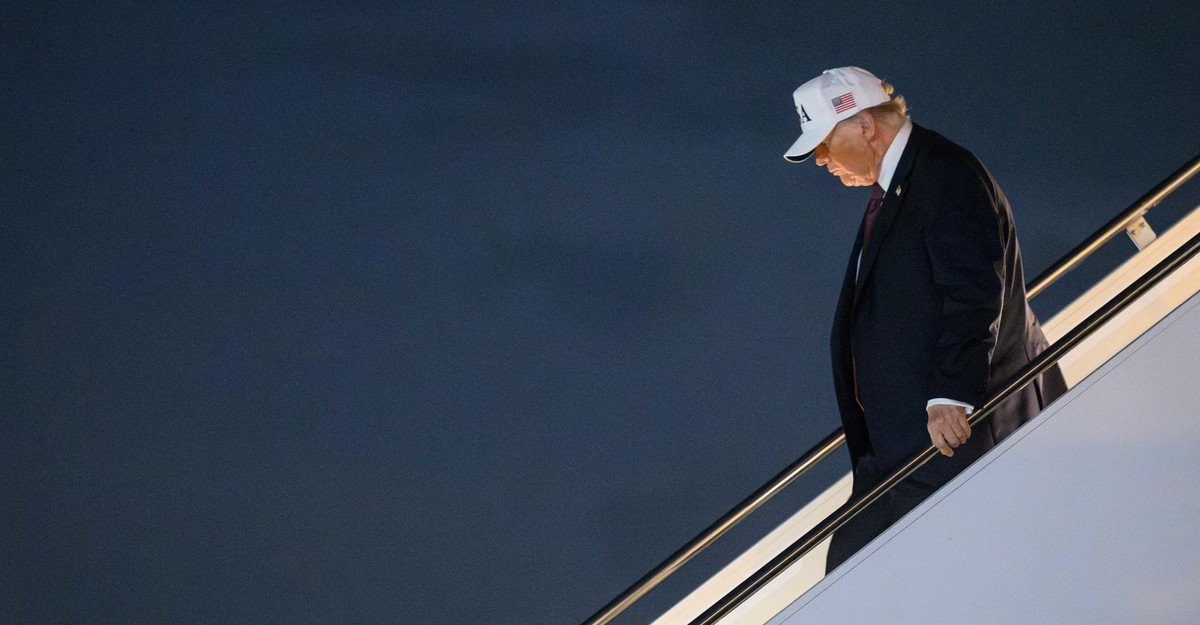
None of that, however, should diminish concern about the fecklessness of the way in which the United States has gone about launching this war. The mood was set by President Trump at Mar-a-Lago, tieless and wearing a goofy baseball hat, announcing the attacks and justifying them on mixed grounds. He accurately described the Islamic Republic’s implacable hostility to the United States and Israel since its inception, and itemized some of its many crimes. But he set the war aims very high:
We are going to destroy their missiles and raze their missile industry to the ground. It will be totally—again—obliterated. We are going to annihilate their navy. We’re going to ensure that the region’s terrorist proxies can no longer destabilize the region or the world and attack our forces, and no longer use their IEDs, or roadside bombs, as they are sometimes called, to so gravely wound and kill thousands and thousands of people, including many Americans. And we will ensure that Iran does not obtain a nuclear weapon.
And then he addressed those whose country he was attacking:
Finally, to the great, proud people of Iran, I say tonight that the hour of your freedom is at hand. Stay sheltered. Don’t leave your home. It’s very dangerous outside. Bombs will be dropping everywhere. When we are finished, take over your government. It will be yours to take. This will be, probably, your only chance for generations. For many years, you have asked for America’s help, but you never got it. No president was willing to do what I am willing to do tonight. Now you have a president who is giving you what you want. So let’s see how you respond. America is backing you with overwhelming strength and devastating force. Now is the time to seize control of your destiny and to unleash the prosperous and glorious future that is close within your reach. This is the moment for action. Do not let it pass.
The objectives, then, are total: the utter destruction not only of the Islamic Republic’s nuclear potential, not only of vital elements of its armed forces and its proxies, but of the regime itself.
Any normal president launching a war with such aims against a country of some 90 million people; with an area roughly that of France, Germany, Spain, and Italy combined; with a GDP (in nominal terms) of $400 billion; and that has close relationships with Russia and China would probably have doffed the baseball cap, put on a tie, and delivered a somber speech from behind the Resolute Desk in the Oval Office.
More important, a serious president would have prepared over months the ground for such a war—including by discussing the Iranian challenge at length during the State of the Union. He would have tried to explain to the American people why this, rather than their economic problems, was a matter of top urgency. He would have avoided unnecessarily antagonizing, let alone mocking and baiting, the opposition party, which is likely to control at least one house of Congress after the midterms. He would have worked on unifying support within his own base, which is internally divided among isolationists, Israel haters (who will react badly to this), and old-line Republicans who are queasy about wars launched without congressional sanction. Trump did none of these things.
It would be comic if it were not so serious that at the same time that the United States embarks on this kind of war, the secretary of defense is reveling in a vendetta that will pull senior U.S. officers out of educational fellowships at the country’s top universities and think tanks, and is musing about instead sending them to Liberty University and Hillsdale College—and, worse yet, picking an unnecessary fight to the death with the most effective artificial-intelligence company in the country, Anthropic.
How will the war unfold? Conceivably, it could work. The air attacks are probably coordinated with more sophisticated clandestine and special operations by both the U.S. and Israel. Perhaps an opportunity will indeed open up for the regime’s overthrow, either by a mass revolt or a coup by a hitherto-unknown insider or military figure willing to break with the regime’s past.
Or not. The regime has planned for this kind of event and, deeply unpopular though it is, has millions of adherents who are either complicit in its crimes or beneficiaries of its largesse. They, not the masses, are the ones with the guns.
Trump has created a substantial moral hazard for the United States of a kind not seen since the Hungarian Revolution, in 1956. By encouraging the Iranian people to rise up against a regime that was willing to openly massacre them in the thousands or tens of thousands, it has incurred a profound obligation to see them through this. If such uprisings are attempted and fail, the blood guilt will be American, incurring even more damage to America’s credibility, reputation, and honor than has already been suffered.
All wars have ripple effects beyond those who are engaging in them. For the moment, it appears that Iran’s proxies in Lebanon and Yemen are lying low—well and good if they continue to do so. If not, war will spread in the Middle East. Thus far, Russia and China have been impotent bystanders. Israel took apart Iran’s Russia-supplied air-defense system last year, and it is only recently that there has been talk of more advanced weapons from China going to Tehran. Something that looks like an American and Israeli success weakens them in the region as well.
The war will scramble politics in the Middle East as various players jockey for power in the vacuum resulting from the drastic weakening or collapse of the Iranian regime, and that process may not be particularly peaceful. Saudi Arabia, the United Arab Emirates, Turkey, and Israel, for starters, will all seek to carve out increasing influence. And all will look to the United States to deal with the smoldering fires that may be left by an Iranian regime that, even if drastically weakened, will continue to lash out.
Perhaps there is a master plan for the day after—not an American or an Israeli strong suit in recent times—in some vault in the Pentagon or the Kirya. Conceivably, Trump is prepared to stay the course and come to the aid of the Iranian people whom he has incited to rise up. One may hope (but should not expect) that there are enough precision missiles and interceptors in Israeli and U.S. arsenals to let this war roll on for weeks or longer, and that there are plans for refilling empty bins after some intense fighting. Maybe the American people will rally to support a war that a few days earlier barely one in five favored. With such uncertainties, however, a queasy doubt that Trump knows what he is doing is entirely in order.