
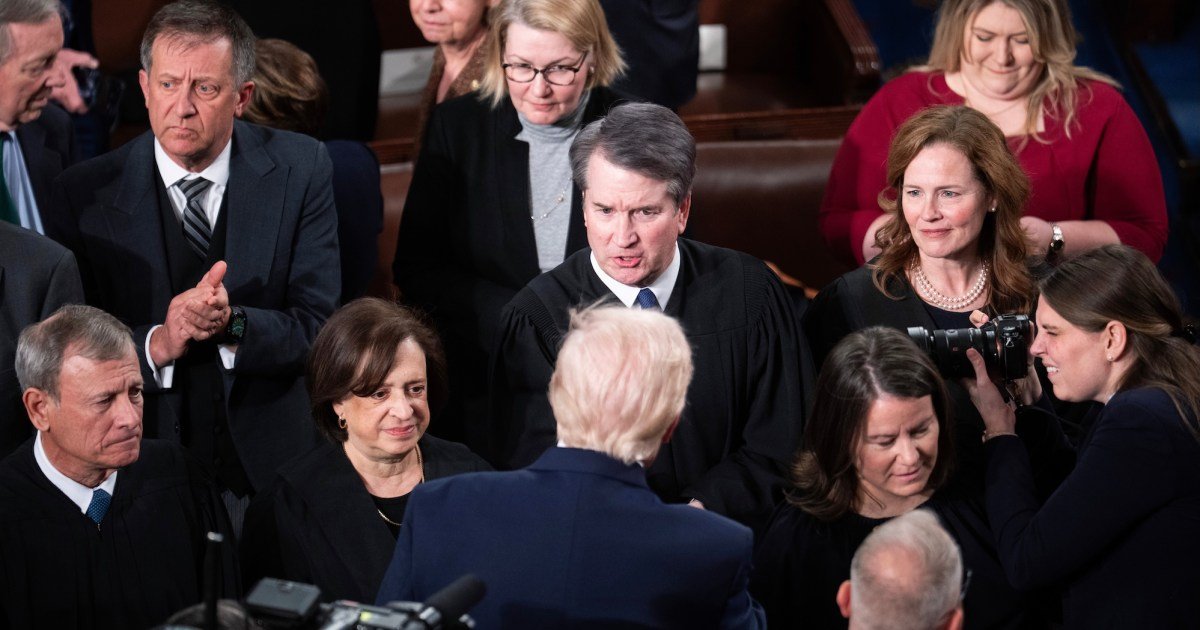
President Donald Trump talks with, from left, Supreme Court Chief Justice John Roberts, associate justices Elena Kagan, Brett Kavanaugh, and Amy Coney Barrett, before the State of the Union address in the House Chamber of the U.S. Capitol on February 24, 2026. (Tom Williams/CQ Roll Call via AP)
President Trump has claimed he is “going to lead a movement to get rid of MAIL-IN BALLOTS” and is currently lobbying the US Senate to effectively outlaw the practice as part of his push to pass the Save America Act.
The conservative justices on the US Supreme Court appear eager to assist with Trump’s crusade.
On Monday, the justices heard a challenge from the Republican National Committee and the Trump administration to a Mississippi law allowing mail-in ballots to be counted up to five days after Election Day as long as they are postmarked by the day of the election. Sixteen states have similar grace periods on the books, and 29 states accept ballots from overseas and military voters sent before or on Election Day but received after. The New York Times found that during the 2024 election “at least 725,000 ballots were postmarked by Election Day and arrived within the legally accepted post-election window.”
“Every time you try to state what your rule is, it seems to me it’s a rule that prevents early voting,” Justice Elena Kagan said.
The Fifth Circuit Court of Appeals, the most right-wing appellate court in the country, struck down Mississippi’s law in the run-up to the 2024 election in what UCLA law professor Rick Hasen called a “bonkers opinion.”
But at least several Republican-appointed Supreme Court justices want to turn that bonkers decision into settled law—at the very moment that Trump is trying to eliminate mail ballots nationwide and “take over” elections.
During the two-and-a-half-hour oral argument in Watson v. Republican National Committee, several of the conservative justices spread conspiracy theories and crazy hypotheticals about mail-in ballot deadlines and the use of the practice more broadly.
Justices Clarence Thomas and Neil Gorsuch suggested that mail-in ballots could be given to a neighbor or a notary, then submitted after Election Day but still be counted if they arrived within five days of the election.
Justice Brett Kavanaugh, echoing Trump’s complaints about “vote dumps” during the 2020 election, claimed that if ballots arriving after Election Day changed the outcome of a race it would undermine voter confidence in the result.
Mississippi Solicitor General Scott Stewart, who defended the law for the state, replied that his opponents “haven’t cited a single example of fraud from post-Election Day ballot receipts.” He argued that “states have broad powers over elections” and that allowing mail-in ballots to arrive during a brief grace period did not change the meaning of Election Day since ballots were still cast by or before that day.
But Justice Samuel Alito bemoaned that “we don’t have Election Day anymore. We have election month.”
The complaints from Alito, Thomas, Gorsuch, and Kavanaugh suggested that at least four of the court’s conservative justices were hostile to Mississippi’s mail-in ballot law and shared Trump’s broader goal of limiting access to mail-in ballots.
The liberal justices noted that if ballots must be cast and counted on Election Day, that would also imperil early voting, which 47 states currently use.
“Every time you try to state what your rule is, it seems to me it’s a rule that prevents early voting,” Justice Elena Kagan said to conservative lawyer Paul Clement, who represented the RNC.
Clement and Trump administration solicitor general John Sauer claimed that early voting would not be impacted by a decision in their favor, since voting happened in advance of the election. But Trump himself, along with top officials in his administration, have called for all voting to take place on a single day, which would end both mail-in and early voting.
The Supreme Court has repeatedly ruled that states should not change voting laws in the middle of an election. Kavanaugh asked Clement if that would be an issue in this case if the court ruled in his favor by June. Clement said states would have “plenty of time” to prepare for the general election.
In reality, however, changing mail-in ballot deadlines months before the general election could disenfranchise hundreds of thousands of voters who could be unaware of the stricter rules or have their ballots thrown out because of postal delays or because they live in remote, rural locations. And any decision narrowing voting access would embolden Republicans to go even further in their attempts to restrict voting rights. The Supreme Court is also weighing another case that could kill the remaining protections of Voting Rights Act and turbocharge Republican gerrymandering efforts. These two cases have the potential to throw the midterms into chaos.
Many court experts expected the RNC and Trump administration to lose the Watson case given how far-fetched their arguments were. Justices John Roberts and Amy Coney Barrett did not tip their hand as much as the other conservative justices, so it’s possible that Mississippi will still prevail. But the fact that a majority of justices or close to it appeared sympathetic to the arguments against mail-in voting is a reminder that the Republican Party’s war on voting isn’t confined to Trump and that even if the Save America Act appears doomed in the Senate, the GOP’s push to limit access to the franchise will continue full steam ahead.



