
This is an edition of The Atlantic Daily, a newsletter that guides you through the biggest stories of the day, helps you discover new ideas, and recommends the best in culture. Sign up for it here.
According to President Trump, Iran has undergone not one, but two regime changes already this year—and the new government is far more “reasonable” than its predecessors. “The one regime was decimated, destroyed, they’re all dead. The next regime is mostly dead,” he told reporters on Air Force One this weekend. “And the third regime, we’re dealing with different people than anybody’s dealt with before.”
Trump and his Cabinet have been warming to the phrase regime change since the start of his second term. It’s a marked shift from what he campaigned on. As far back as his acceptance speech at the Republican National Convention in 2016, he was calling for the country to “abandon the failed policy of nation building and regime change,” and he reiterated those views in his most recent bid for reelection. Last year, around the time Trump decided to bomb Iran’s nuclear facilities, he called those two words “not politically correct,” seeming to understand their rhetorical link to America’s failed “forever wars” during the 2000s and 2010s. Yet in the same Truth Social post, he started coming around to the phrase: “But if the current Iranian Regime is unable to MAKE IRAN GREAT AGAIN, why wouldn’t there be a Regime change??? MIGA!!!” In the weeks leading up to last month’s attack on Iran, Trump said that regime change would be “the best thing that could happen” to the country.
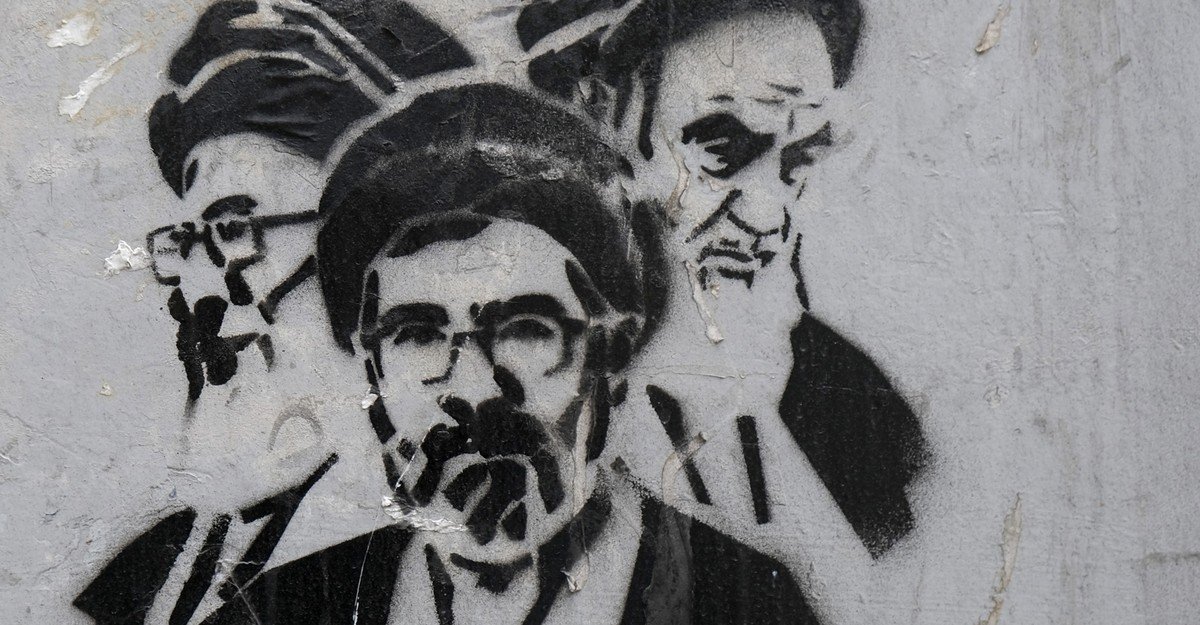
With his comments this weekend, Trump is casting regime change as a mark of progress in the war. He is signaling—perhaps in the hope of calming down oil markets—that the United States has already achieved an important victory. At the same time, he’s dramatically escalating the conflict in other ways, threatening the complete destruction of some of Iran’s most crucial energy infrastructure as the Pentagon prepares for weeks of ground operations. But regime change hasn’t actually happened. Although American and Israeli attacks have taken out key Iranian leaders, their replacements are still very much part of the existing system.
Iran’s supreme leader is now the cleric Mojtaba Khamenei, a son of former Supreme Leader Ali Khamenei, who was assassinated late last month. Other officials who have been killed, such as the heads of the Supreme National Security Council and the Islamic Revolutionary Guard Corps, have been replaced via the typical governmental channels—that is, by the Iranian president and his associates. (Trump has claimed that Mojtaba is seriously wounded, but on Sunday, the Iranian government transmitted a defiant message, purportedly written by him, through state media.) Iran’s government is the same theocracy it has been since the revolution of 1979 and the overthrow of the shah. That any of these new appointees have meaningfully different attitudes toward the U.S. than past leaders did is, despite Trump’s assurances, far from certain.
People often use regime to refer to the government of a single political leader—particularly one they dislike, or who was not elected democratically—but as my colleague David Graham helpfully explained last week, regime actually refers to a system of governance that doesn’t always change when the head of state does. “One could argue,” he wrote, “that the U.S. has had the same ‘regime’ since 1789, when the Constitution entered into force and George Washington became president.” Arash Azizi, a scholar of Iranian history and a contributing writer at The Atlantic, told me that “the war and decapitations have affected the internal factional balance, but they haven’t changed the regime. There is arguably even more regime cohesion now than there was before the war.”
As for what an actual regime change in Iran might look like, Azizi said that it “would include either an unraveling of the Islamic Republic’s core structures or, at the very least, abandonment of its key policies. I think this is likely in the medium term (and it would have been even without the war)”—the regime’s signature policies are both unpopular in Iran and strategically untenable, Azizi explained—“but nothing of the sort has happened yet.” In other words, Trump is misusing the phrase to project an image of success in this historically unpopular war.
The Trump administration has offered an abundance of conflicting explanations for its goals in Iran—10 rationales in the first six days of the war alone, my colleagues Marie-Rose Sheinerman and Isabel Ruehl have noted. But the president’s recent actions have underscored his rejection of the anti-interventionist values he campaigned on. In addition to escalating the conflict in Iran, he has sought to destabilize other foreign governments over the past few months: After the January capture of former Venezuelan President Nicolás Maduro (and the subsequent installation of a Trump-approved interim leader), the White House established its first effective oil blockade against Cuba since the Cuban missile crisis. Despite slightly softening the blockade in recent days, there’s no indication that Trump has backed down from his stated goal of ousting Cuban leadership and ushering in a more pro-American government.
Perhaps Trump really will carry out regime change in Iran. As my colleague Nancy Youssef wrote earlier today, there are still many paths this war could take—and no military strategist would ever advise determining the outcome of a war just a few weeks in. But in the meantime, there’s plenty of reason to be skeptical about Trump’s assessment of how things are going.
Related:
Here are three new stories from The Atlantic:
Today’s News
- The Supreme Court ruled 8–1 that Colorado’s ban on conversion therapy for minors violates free-speech rights, a decision that could affect similar laws in more than 20 states.
- The U.S. military has begun flying B-52 bombers over Iran for the first time in the war. The move signals that Iranian air defenses may be weakened after weeks of strikes, but Defense Secretary Pete Hegseth said Iran can still retaliate with missiles.
- Israel’s defense minister said that its military plans to occupy much of southern Lebanon up to the Litani River after its ground invasion ends, and that displaced residents will be barred from returning for the time being.
Evening Read
What Maxxing Reveals About Life Online
By Ian Bogost
Perhaps you’ve heard of looksmaxxing, the online trend in which young men strive to become supposedly attractive, often through self-harm. Thanks to Clavicular, a young, fringe manosphere influencer, this term—and others modeled after it—has proliferated. You can be a looksmaxxer by soft maxxing (skin care or exercise) or by hard maxxing (plastic surgery or self-mutilation). Looksmaxxers often find themselves jester-maxxing, that is, using humor to gain the attention of women.
Maxxing can be specialized, too, and even modest, maximally speaking. A dude might be personality-maxxing instead of jester-maxxing. Less incel-maxxing versions might entail health-maxxing—what people called wellness approximately 10 minutes ago. Want your gut to be more regular? That’s fiber-maxxing. Want to build bulk? You’re protein-maxxing. Some so-called tradfem women want to bear more children through fertility-maxxing—a process our culture once understood as getting pregnant again. Maxxing goes the other way too, maximizing harm instead of benefit: Maybe you’ve got a drug habit, in which case you might be pill-maxxing. Anorexia, for some, is now starve-maxxing.
Read the full article.
More From The Atlantic
Culture Break

Explore. Electronics are getting more expensive and worse, Hana Kiros writes. Blame the AI boom.
Think. Some research suggests that many diagnostic errors in medicine stem from failures in thinking. Alexandra Sifferlin set out to learn if diagnostic excellence is a skill that any clinician can achieve.
Play our daily crossword.
Explore all of our newsletters here.
Rafaela Jinich contributed to this newsletter.
When you buy a book using a link in this newsletter, we receive a commission. Thank you for supporting The Atlantic.



