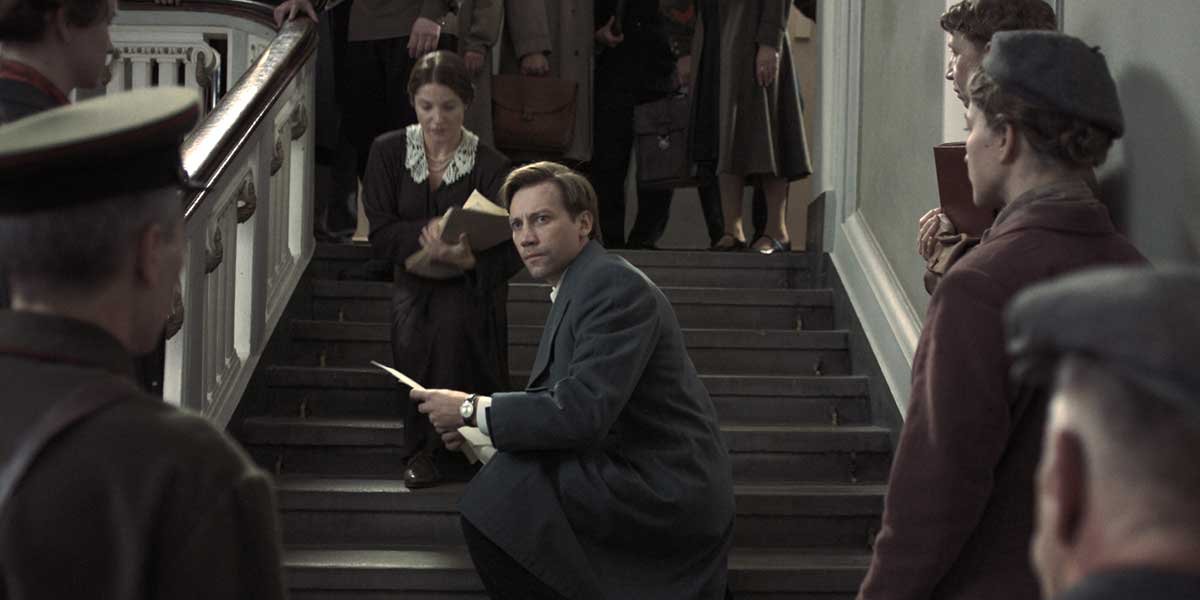
Set in the Soviet Union of 1937, at the height of Stalin’s Great Purge, “Two Prosecutors” unfolds within the suffocating machinery of a state built on fear, denunciation, and forced confessions. In a men’s prison in Bryansk, thousands of letters written by political prisoners—each protesting their innocence and detailing brutal interrogations by the NKVD—are systematically burned, as one of the opening scenes eloquently highlights.
Against all odds, one letter, written in blood by Stepiak, an aging Old Bolshevik who helped build the very regime that has now condemned him, escapes destruction and reaches the desk of Kornyev, a young and fervently idealistic prosecutor devoted to the Soviet cause. Troubled by its contents, Kornyev insists on meeting the prisoner, convinced that a grave injustice has taken place. What begins as a seemingly straightforward investigation soon turns into a Kafkaesque journey through the bureaucratic labyrinth of Soviet power. As Kornyev pushes his case all the way to the Attorney General’s office in Moscow, his faith in the system is gradually tested, eroded, and ultimately weaponized against him.
The metaphor for justice, represented by Kornyev, the issues citizens face within a setting that constantly works against them, represented by Stepiak, and the system itself with all its inherent flaws, embodied by everyone from the lowest prison guard to high-ranking public officials, is quite palpable here, essentially dictating the narrative. At the same time, as the problems USSR faced at the time and the way Stalin chose to deal with them come to the fore, a clear parallel with what is happening in the country today is eloquently drawn, with Loznitsa’s commentary resonating particularly strongly.
Apart from the historical context, which is frequently conveyed through monologues and still demands some knowledge of the period, all other cinematic aspects are equally accomplished. From the moment Kornyev arrives at the prison, the atmosphere of anxiety and constant danger is firmly established, with the suspicious looks he receives, the heavy silences, and the succession of doors he must pass through to reach the prisoner lending the narrative a claustrophobic quality that further reinforces this oppressive mood.
At the same time, an intense theatricality permeates almost every frame, all of which are meticulously constructed. In this regard, the production design by Yuriy Grigorovich and Aldis Meinerts, combined with the way cinematographer Oleg Mutu captures these spaces, is truly striking. This theatricality extends to the performances, which are characterized by a deliberate artificiality, as most characters behave like automatons or mechanisms, at least when they are not pretending to be something entirely different from what they actually are.
Aleksandr Kuznetsov, as Kornyev, breaks away from this approach, emoting far more than those around him in a standout performance that underlines the character’s difference and foreshadows where it ultimately leads him. Aleksandr Filippenko, as Stepiak, the Old Bolshevik falsely imprisoned in Bryansk, and Pegleg, a World War I veteran of the Battle of Kowel, delivers two particularly impactful monologues that essentially vocalize Loznitsa’s commentary. While the approach is admittedly on the nose, the strength of the performances and the weight of what is being said make these moments memorable rather than intrusive.
Lastly, Danielius Kokanauskis’s editing further amplifies the theatricality, with transitions that are almost entirely absent, an approach that once again proves highly fitting for the material.
“Two Prosecutors” is a masterful film, both in terms of context and cinematic values, once more highlighting Lonznitsa’s prowess as both director and script writer.