
The Ukrainian Navy may have conducted its first confirmed combat use of the RBS 15 anti-ship missile during a strike against the Russian-controlled Sivash offshore platform in the Black Sea.
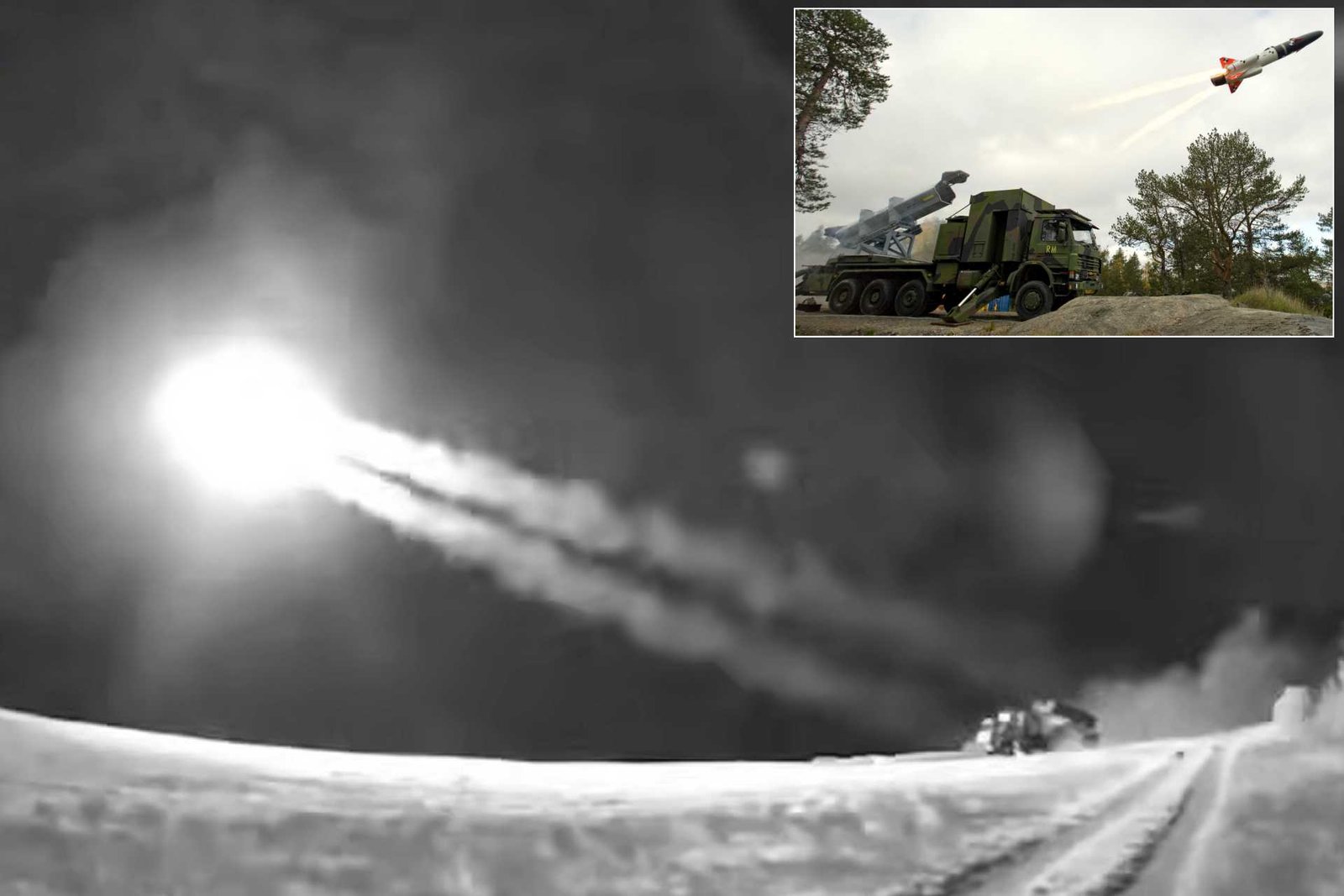
Footage released on April 6, 2026, shows a truck-mounted coastal launcher firing the missile, confirming Ukraine’s growing ability to conduct precision maritime strikes alongside the Neptune system, strengthening its ability to disrupt Russian surveillance and logistics nodes while increasing coastal denial operations in the Black Sea theater. The RBS 15 missile, developed by Saab, also demonstrated its precision strike capability against maritime infrastructure, complementing its traditional anti-ship capability.
The launcher observed in the footage corresponds to known RBS 15 mobile launchers, particularly in the design of the transport-launch containers, which are rectangular and mounted in pairs on a truck chassis. (Picture source: Ukrainian Navy and Saab)
On April 6, 2026, the Ukrainian Navy released footage showing the launch of what is assessed to be a Swedish Saab RBS 15 anti-ship missile during a strike against the Russian Sivash offshore platform, with the video itself bearing a timestamp of March 12, 2026, indicating that the engagement occurred earlier and was intentionally disclosed with a delay. The sequence shows a truck-mounted coastal launcher firing a subsonic cruise missile toward a fixed maritime structure located in the northern Black Sea area. The RBS 15 had previously been announced as part of Swedish military assistance in 2022, but no prior operational use had been visually confirmed.
The release, therefore, might constitute the first observable employment of this missile type by Ukrainian forces. The target selection is consistent with known Russian use of offshore platforms for surveillance and communications relay functions, while the strike expands Ukraine’s anti-ship inventory beyond the R-360 Neptune system, which had already been used in previous engagements. The launcher visible in the footage corresponds to known RBS 15 coastal configurations, with two rectangular transport-launch containers mounted on a truck chassis and oriented at an elevation angle consistent with cruise missile launch profiles. The cabin placement, equipment compartment location, and overall vehicle layout align with Swedish-designed mobile coastal defense systems.
The missile itself shows a propulsion layout with air intakes positioned on both sides of the fuselage, indicating a turbojet-powered design rather than a solid-fuel rocket. The exhaust plume and launch behavior are consistent with this propulsion type. Comparative analysis of container dimensions and mounting structure matches previously documented RBS 15 configurations. No other system currently known to be in Ukrainian service combines these specific physical characteristics. The identification for this article is therefore based on a combination of OSINT, launcher architecture, and missile configuration rather than a single feature. These elements together support the attribution to the RBS 15 system.
The timing gap between the March 12 recording and the April 6 publication indicates that the release was not intended to provide real-time operational information, but rather to demonstrate capability under controlled conditions. The Sivash platform is located in a semi-enclosed maritime environment where radar coverage and logistics support are critical, making it a relevant target within a denial framework. The use of an anti-ship missile against such a target suggests that coordinates were pre-programmed rather than relying on real-time tracking, which is consistent with fixed-object targeting. The launch profile indicates a standard coastal battery firing sequence, implying integration with external targeting inputs, potentially including aerial or satellite reconnaissance.
The absence of official follow-on footage limits assessment of the impact effects on the paper, but the engagement itself confirms the operational deployment of the RBS 15 by Ukraine. The disclosure pattern suggests that Ukraine intends to signal capability without revealing deployment density or geographic distribution, introducing an additional variable for the Russian Navy’s planning in the Black Sea. Anti-ship missiles such as the RBS 15 are designed to engage surface vessels but are structurally classified as cruise missiles with autonomous navigation once launched. After receiving targeting data, these missiles follow a programmed route using inertial navigation, typically corrected by satellite positioning systems.
During the terminal phase, an active radar seeker acquires the target, allowing final trajectory adjustments. The sea-skimming flight profile, often between 2 and 10 meters above the water surface, reduces detection range and limits reaction time for enemy defenses. These missiles are deployable from multiple vectors, including ships, aircraft, submarines, and land-based mobile launchers. In addition to maritime targets, modern anti-ship missiles can engage fixed land or offshore infrastructure, particularly within coastal regions, to deny access to maritime areas rather than to maintain continuous control at sea. In the Black Sea context, this translates into restricting Russian movement and increasing operational risk for naval units operating within Ukraine’s range.
The RBS 15 missile was developed by Saab Bofors Dynamics, a subsidiary of Saab, in the late 1970s and entered service in the mid-1980s as a long-range anti-ship cruise missile. The missile measures approximately 4.35 meters in length, with a diameter of 50 cm and a wingspan of about 1.4 meters. Its launch mass ranges from 650 kg in-flight to about 800 kg, including boosters. It carries a 200 kg high-explosive warhead designed for blast and fragmentation, with detonation triggered by impact or proximity. Propulsion is provided by a turbojet engine, enabling a sustained speed of about Mach 0.9, equivalent to roughly 1111 km/h. Guidance combines inertial navigation with GPS correction during mid-course flight and active radar homing in the terminal phase.
The missile maintains a low-altitude flight profile over water to reduce detection probability. The variant most likely transferred to Ukraine is the RBS 15 Mk2, based on its known export history and the absence of indicators associated with later versions. The Mk2 retains the same general dimensions and propulsion system as earlier variants but incorporates improved guidance and resistance to electronic countermeasures. Its range of more than 70 km allows coverage of coastal waters and offshore installations within that radius. The Mk3 variant, which exceeds 200 km in range and includes enhanced GPS integration and targeting logic, is not assessed to have been supplied.
The Mk4, with a range above 300 km and updated seeker technology, represents a more recent development and is, to date, unlikely to have been transferred. However, nothing definitively rules out these last two versions, in the absence of clear images of the variant transferred to the Ukrainians. The Mk2 nonetheless provides a significant increase in capability compared to the RBS-17, which has a shorter range of only 8 km and a smaller warhead of just 48 kg. This allows Ukraine to engage targets at medium distances with a heavier payload, filling a gap between short-range coastal systems and longer-range strategic missiles.
The use of the RBS 15 against the Sivash platform indicates a deliberate expansion of target categories beyond naval vessels to include fixed offshore infrastructure. Such platforms are used for radar coverage, communications relay, and logistical support, making them integral to maritime operations. The RBS 15’s ability to follow pre-programmed waypoints allows it to approach targets from optimized angles, including overland routes if necessary. This reduces reliance on continuous target tracking and enables strikes against static objectives with known coordinates. The selection of an offshore platform by Ukraine rather than a ship, such as the frigate Admiral Makarov, suggests a focus on reducing Russia’s ability to maintain situational awareness and sustain maritime activity in the Black Sea.
It also demonstrates the adaptability of anti-ship missiles beyond ships to include support nodes. This has implications for operational planning, as it affects not only naval units but also the systems that enable them to operate. The Swedish transfer of anti-ship missiles to Ukraine was publicly announced in 2022, but until this event, there had been no observable deployment of the RBS 15 system in combat. The delivery complements existing Ukrainian systems, particularly the R-360 Neptune, which has a longer range and has been used in previous engagements. The combination of these systems creates a layered strike capability, with the Neptune covering extended distances and the RBS 15 providing medium-range engagement options. This allows for more frequent use of missiles in scenarios where long-range assets may not be required, further complicating defensive planning for Russian forces.
Written by Jérôme Brahy
Jérôme Brahy is a defense analyst and documentalist at Army Recognition. He specializes in naval modernization, aviation, drones, armored vehicles, and artillery, with a focus on strategic developments in the United States, China, Ukraine, Russia, Türkiye, and Belgium. His analyses go beyond the facts, providing context, identifying key actors, and explaining why defense news matters on a global scale.



