
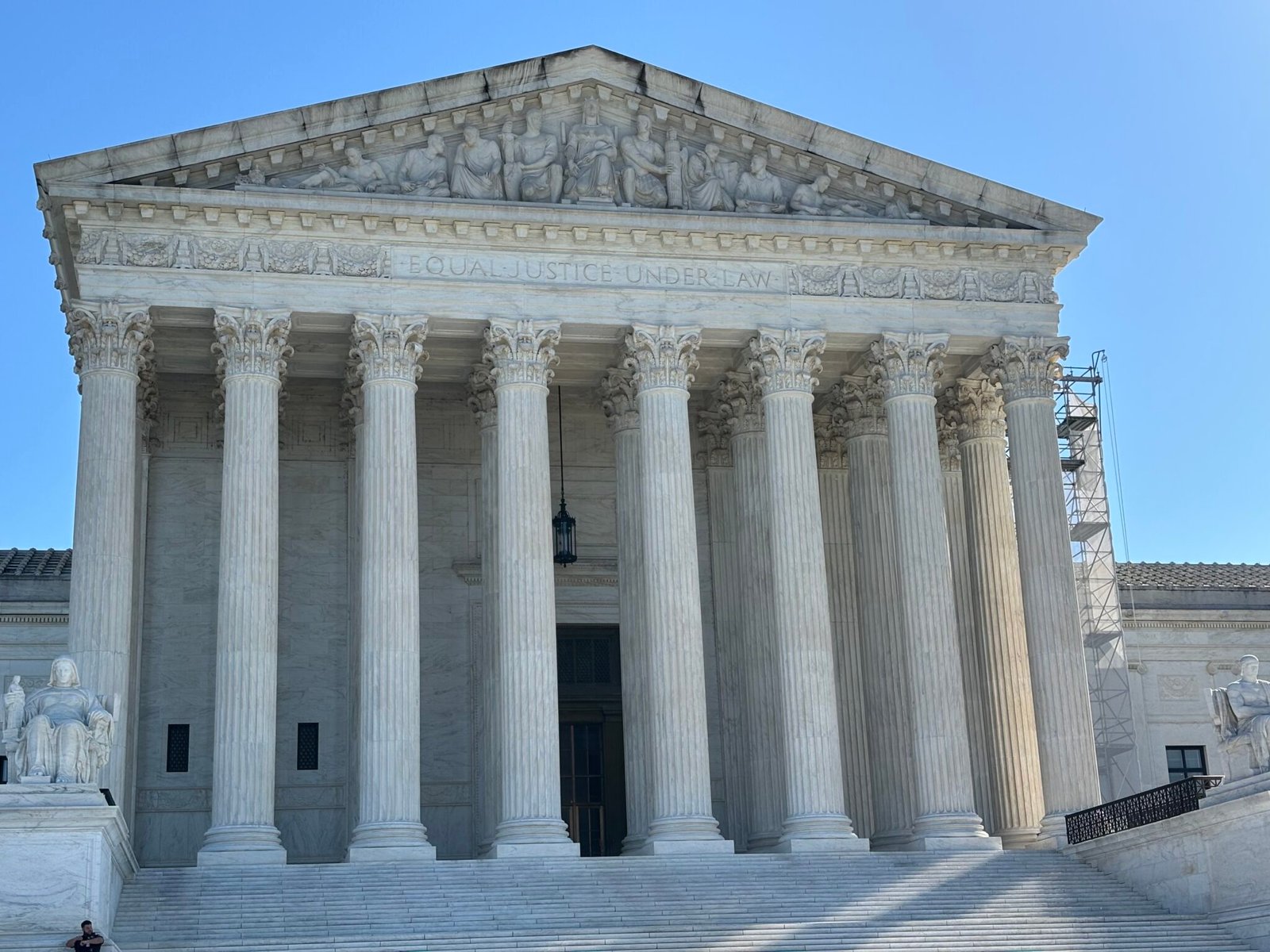
WASHINGTON — The U.S. Supreme Court dealt a major blow to President Donald Trump’s trade agenda Friday, ruling the tariffs he issued under the International Economic Emergency Powers Act are illegal.
In a 6-3 decision authored by Chief Justice John Roberts, the court said Congress alone holds the power to tax in almost all circumstances. The Trump administration’s argument that trade deficits and illegal drug imports granted it emergency power to levy tariffs was not justified, the court said. Tariffs are taxes on imported goods.
The Trump administration had argued that a provision in the law, known as IEEPA, that said the executive branch could “regulate” imports empowered the president to levy tariffs.
“Based on two words separated by 16 others (in the law)—‘regulate’ and ‘importation’—the President asserts the independent power to impose tariffs on imports from any country, of any product, at any rate, for any amount of time,” Roberts wrote. “Those words cannot bear such weight.”
Justices Sonia Sotomayor, Elena Kagan, Neil Gorsuch, Amy Coney Barrett and Ketanji Brown Jackson joined Roberts’ opinion.
Justices Clarence Thomas and Brett Kavanaugh filed dissenting opinions. Thomas and Justice Samuel Alito joined Kavanaugh’s.
Kavanaugh’s dissent accepted the administration’s reading of the law and said it was not the justices’ role to decide a policy matter that has “generated vigorous” debate.
“The sole legal question here is whether, under IEEPA, tariffs are a means to ‘regulate . . . importation,’” he wrote. “Statutory text, history, and precedent demonstrate that the answer is clearly yes: Like quotas and embargoes, tariffs are a traditional and common tool to regulate importation.”
White House press secretary Karoline Leavitt said Trump would hold an early afternoon press conference to respond to the ruling.
‘Unchecked’ presidential authority
In the opinion of the court, Roberts wrote that Trump’s expansive use of the emergency tariff powers would upend the balance of powers between branches of government.
The administration’s position would empower the president “to unilaterally impose unbounded tariffs,” simply by declaring an economic emergency, Roberts wrote. Further, that declaration would be unreviewable and could be overturned only by a veto-proof majority in both houses of Congress.
That view “would replace the longstanding executive-legislative collaboration over trade policy with unchecked Presidential policymaking,” he wrote.
When Congress intends to convey that kind of power to the executive branch, it generally does so in uncertain terms, Roberts said.
“In light of the breadth, history, and constitutional context of that asserted authority, he must identify clear congressional authorization to exercise it,” he wrote.
The government’s argument that IEEPA authorized that power, “falls short,” the opinion said.
The chief justice added that it was telling that in the nearly 50 years since the IEEPA became law, no other president has read such broad powers into it.
What to do about the taxes that were collected?
The ruling opens a new debate about how to handle tariff revenue that the government has already collected since Trump first imposed the IEEPA tariffs a year ago.
Kavanaugh noted the likely confusion the issue would cause.
“The Court says nothing today about whether, and if so how, the Government should go about returning the billions of dollars that it has collected from importers,” he wrote. “But that process is likely to be a ‘mess,’ as was acknowledged at oral argument.”
U.S. Sen. Elizabeth Warren, a Massachusetts Democrat and prominent economic liberal, said that revenue should be sent to small businesses that were harmed by the imposition of tariffs.
“Any refunds from the federal government should end up in the pockets of the millions of Americans and small businesses that were illegally cheated out of their hard-earned money by Donald Trump,” she wrote in a statement.
Main Street Alliance, a national trade group representing small businesses, called for the revenue collected under the tariffs to be returned to small businesses.
“If the authority was unlawful, the collections were unlawful,” Executive Director Richard Trent said in a statement. “Every penny taken from small businesses under this framework should be returned.”
Attention turns to Congress
With the court ruling that taxing power lies with Congress, efforts to codify the tariffs Trump had applied could become a priority for Republican lawmakers.
“No one can deny that the President’s use of tariffs has brought in billions of dollars and created immense leverage for America’s trade strategy and for securing strong, reciprocal America-first trade agreements with countries that had been taking advantage of American workers for decades,” House Speaker Mike Johnson, a Louisiana Republican, wrote on social media. “Congress and the Administration will determine the best path forward in the coming weeks.”
Adrian Smith, a Nebraska Republican who chairs the House Ways and Means Committee’s subpanel on trade, said Congress should work with the president to legislate tariffs.
“Nebraska’s farmers, ranchers, and manufacturers create world-leading products and deserve reliable access to global markets,” he said. “I am committed to working with the administration to deliver long-term certainty through comprehensive and enforceable trade agreements. The President has made clear his intention to use every available tool to secure strong deals, but only Congress can ensure that these agreements provide lasting stability beyond any single administration.”
Ohio Republican Sen. Bernie Moreno, though, said in a social media post that the ruling would severely hamper efforts to rebalance trade, and called for Congress to codify the tariffs.
“SCOTUS’s outrageous ruling handcuffs our fight against unfair trade that has devastated American workers for decades,” he wrote. “These tariffs protected jobs, revived manufacturing, and forced cheaters like China to pay up. Now globalists win, factories (sic) investments may reverse, and American workers lose again. This betrayal must be reversed and Republicans must get to work immediately on a reconciliation bill to codify the tariffs that had made our country the hottest country on earth!”
Democratic lawmakers praised the court’s decision, while blasting the tariffs as a matter of policy.
“This is a win for the wallets of every American consumer,” Senate Minority Leader Chuck Schumer, D-N.Y., said. “Trump’s chaotic and illegal tariff tax made life more expensive and our economy more unstable. Families paid more. Small businesses and farmers got squeezed. Markets swung wildly. We’ve said from day one: a president cannot ignore Congress and unilaterally slap tariffs on Americans. That overreach failed.”
Sen. Jeff Merkley, the ranking Democrat on the Senate Budget Committee, called the decision “a win for farmers, small businesses, and hardworking, middle-class families across the country,” he said in a statement.
“Trump’s illegal and chaotic tariffs have harmed American consumers and businesses, leaving them to foot the bill for rising prices due to Trumpflation,” the Oregon Democrat added. “While Trump continues his ‘families lose, billionaires win’ agenda, we’re using every tool at our disposal to fight back against his reckless policies and build an economy where families thrive, and billionaires pay their fair share.”
Arguments were heard in November
The justices heard arguments in early November in what was the first major case of the second Trump term to move beyond the court’s emergency docket and be heard on the merits of the case.
Small businesses and Democratic state attorneys general led the legal challenges against Trump’s tariffs in the two separate cases, consolidated before the Supreme Court. They alleged Trump usurped taxing power, which belongs to Congress as outlined in Article I of the Constitution.
Victor Schwartz, founder and president of the family-owned, New York-based wine and spirits importer VOS Selections led the small business plaintiffs, which included a Utah-based plastics producer, a Virginia-based children’s electricity learning kit maker, a Pennsylvania-based fishing gear company and a Vermont-based women’s cycling apparel company.
State attorneys general who sued included those from Arizona, Colorado, Maine, Minnesota, Nevada, New Mexico and Oregon.
Two Illinois-based toy makers that primarily manufacture products in Asia filed a separate challenge.
For nearly three hours on Nov. 5, the justices dissected the language of IEEPA, a 1970s-era sanctions law that Trump invoked during the first year of his term in a series of emergency declarations and proclamations triggering import taxes on goods from nearly every country.
The high-profile case drew Cabinet officials to the court, including Treasury Secretary Scott Bessent, who sat shoulder-to-shoulder with Commerce Secretary Howard Lutnick and U.S. Trade Representative Jamieson Greer.
Members of Congress also attended. Among the crowded rows were U.S. House Ways and Means Chairman Jason Smith, R-Mo., Sen. Mike Lee, R-Utah, and Democratic Sens. Amy Klobuchar of Minnesota and Ed Markey of Massachusetts.
‘Liberation day’
Trump began imposing tariffs under IEEPA via executive order in February and March on products from China, Canada and Mexico, declaring the countries responsible for illegal fentanyl smuggled into the United States.
The president escalated the emergency tariffs April 2, which he dubbed “liberation day,” when he declared trade imbalances a national emergency. In addition to a new baseline 10% global tariff, Trump announced hefty additional duties on products from countries that export more goods to the U.S. than they import from U.S. suppliers.
The White House calculations baffled economists, as the administration proposed steep duties on close trading partners — including 20% on products from the European Union, 25% on South Korea, 32% on Taiwan and 46% on Vietnam.
Inexplicably he also announced a 50% tariffs on goods from the landlocked, 11,000-square-mile African nation of Lesotho, and 10% on the Heard and McDonald Islands, only inhabited by penguins and seals.
Trump’s announcement crashed markets, wiping trillions of dollars away in just a matter of days. He relented and delayed most of the tariffs, but escalated a trade war with China — shooting up the levy to 125%, and eventually to 145%.
The administration’s trade war with China cooled a bit in May, but left the rate on some products at an effective 55%.
Trump maintains his tariffs have forced the hand of other governments to invest in the U.S. in exchange for lower tariffs. For example, Trump officials claimed victory in a framework deal with Japan that lowered duties on Japanese products to 15%, from 25%, with a promise from Japan to invest $550 billion in the U.S.
As recently as late August, Trump imposed an extra 25% tariff on goods imported from India, bringing the total tariffs on Indian products to 50%, because of the country’s usage of Russian oil.
In early August, Trump slapped a 40% tax on all Brazilian goods after he disagreed with the country’s prosecution of its former right-wing President Jair Bolsonaro for plotting a coup to remain in power in 2022.



