
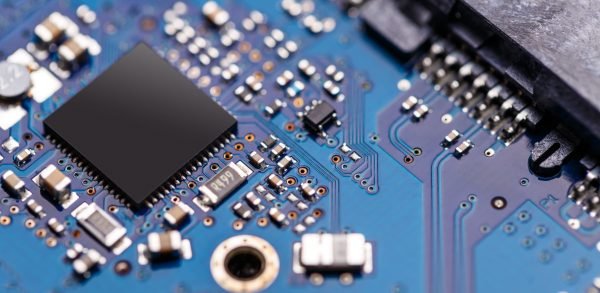
Modern electronics depend on semiconductors. A semiconductor is a type of material, typically silicon, used to build integrated circuits like computer chips. Because they are essential for the production of modern electronics, the design and manufacture of semiconductors have become a highly competitive technological frontier, with countries around the world competing for a favorable position.
The production of semiconductors and the integrated circuits they make can be broken down into three phases: design, fabrication, and assembly. Because these chips are so small and complex, packed with huge amounts of tiny transistors and other components, they have to be designed using specialized software. After the design is complete, the chips go into production in a fabrication plant. Most of the value is added during these first two phases of the process.
There are only a handful of facilities capable of designing and producing the most advanced chips in the world, and they require expensive and advanced lithography machines that are only made (for now) in the Netherlands. Finally, the process ends with assembly, which is the lowest value added link in the chain. Design and fabrication are highly concentrated, but many countries have some role in assembly, where chips are packaged, tested and shipped to customers.
The goal, of course, is to move up higher in the value chain from assembly to design and production. Doing so requires investing not just to build physical infrastructure, but also in acquiring the necessary skills and knowledge to design and fabricate chips. Vietnam, which just broke ground on the country’s first integrated chip plant, is attempting to do just that. The goal is to capture more of the value in global semiconductor supply chains.
Hoa Lac Hi-Tech Park is an industrial zone in Hanoi where state-owned technology and defence company Viettel recently broke ground on the country’s first integrated semiconductor production facility. The goal is to master end-to-end production of integrated circuits and semiconductors from design to fabrication to assembly. Currently, most of Vietnam’s output is in the assembly phase, though there are some local design firms. Viettel’s new plant will be the first indigenous production facility. The goal is to start trials by 2027 and be fully operational by 2030.
The plan is to initially design and produce 32-nanometer chips. The most advanced chips being produced by TSMC and others are 2 and 3 nanometers, so Vietnam’s facility will not be on the cutting edge of the global chip wars. But if it sticks to the envisioned timeline, it will represent a very significant leap forward for indigenous production capabilities in a critical frontier technology. Under this plan, Vietnam will train 50,000 design engineers by 2030 and support more than 100,000 workers by 2040.
Vietnam has certain structural advantages that give it a competitive edge in semiconductors. One, much of Vietnam’s recent explosive growth has been led by foreign investment and exports, particularly in electronics. Foreign firms, like South Korea’s LG, invest in production facilities in Vietnam, which then make electronics and export them. This simple formula has turbo-charged economic growth in the country.
Vietnam’s exports are dominated by electronics. Electronics accounted for $165 billion in exports in 2023, about 41 percent of all exports. This is a higher concentration than other big regional exporters, like Thailand. It indicates that Vietnam has already developed an extensive techno-industrial base for the production of electronics, including assembly of integrated circuits and semiconductors. Moving into fabrication represents a logical and ambitious next step.
The other thing Vietnam is doing is developing the long-term skills and knowledge to support this vision. Aside from a physical plant, you need engineers and other experts to design and build chips and semiconductors. Currently, about 30 percent of students in Vietnam are enrolled in science, technology, engineering and math degrees. The Ministry of Education and Training is offering incentives, including scholarships, to shift more students into these fields. The target is 35 percent by 2030.
We don’t know how all of this will play out. But if Vietnam is able to achieve its goal, led by a state-owned defense and technology company and supported by complementary investment in science and engineering, it will provide a useful roadmap and interesting insights into what works and what doesn’t for emerging markets intent on moving up global value chains. Given that other countries in the region are racing to move up the same global value chains, sometimes using quite different approaches, the next few years will be nothing if not interesting.



