
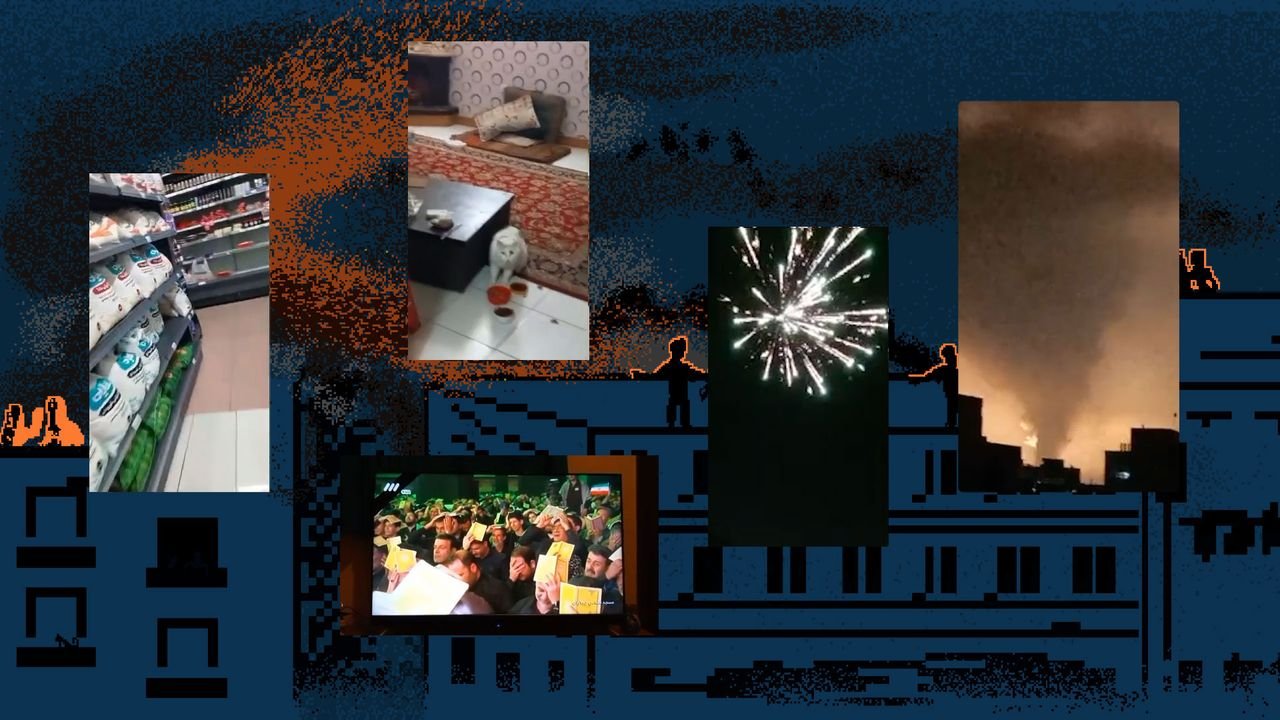
One night in early March, an Iranian writer and dissident climbed to the roof of his apartment building, in Tehran, to marvel at a towering inferno that had blanketed the sky in smoke. The blaze was from a series of oil depots that had been hit by air strikes—the latest target in the United States and Israel’s joint operation against Iran. Since the conflict began, the writer, whom I will call Hadi, was among dozens of neighbors who emerged on rooftops or balconies every night to cheer at the constellation of missiles razing their city. But this night felt different. “You feel a mix of amazement and terror,” he told me. “Like watching a meteor shower from the end of days.” Overnight, the smoke coiled upward and gave way to acid rain that stained the city black.
After the U.S. and Israel killed the Supreme Leader, Ayatollah Ali Khamenei, on the first day of the operation, President Trump called on Iran’s ninety-two million people to rise up and establish a new order. But an uprising seems unlikely, at least for now. As of this week, more than fourteen hundred Iranians have been killed. Thousands have fled Tehran, the epicenter of the attacks. One father told me that he left in less than an hour, after celebrating his son’s fourth birthday. “We blew out candles, said farewells to friends, and got into our car,” he said. “My son hates loud noises. I had told him Superman was coming to save Iran, and that we would be back soon.”
Not everyone can afford to leave the city, though. Booking a hotel room or renting a house elsewhere is prohibitively expensive for some Iranians. There are also residents, like Hadi and a number of his friends, who have made a deliberate decision to remain in Tehran. Many of them are dissidents who have participated in nearly every political uprising since 2009. They are accustomed to self-imposed invisibility. And they feel an obligation to stay and witness the turmoil.
Hadi and I first connected in January, after thousands of Iranians were massacred by security forces, as part of a nationwide crackdown on protesters. Hadi, who is in his forties, had previously been imprisoned by the regime for his involvement in student protests. The brutality he saw in January—which was accompanied by an internet blackout, imposed by the regime—inspired him to document what he was seeing. “In a forced darkness, misinformation spreads easily, and people are left with fragments,” he wrote. “There were things happening that I could not allow to disappear into the void.”
I reached out to Hadi the morning the war broke out. He began sending me voice notes and videos chronicling his days in a besieged city. As people deserted rubble-strewn streets, shops closed. So did gas stations and A.T.M.s, owing to shortages in fuel and cash. Hospitals ran out of blood, and started turning away patients. Many Iranians who had cheered on the offensive as an opportunity to oust the regime felt betrayed. They feared the war would end with more repression and punishing sanctions.
Hadi shared his dispatches with me at great risk. Authorities sent Iranians daily text messages warning that any protester would be severely punished for helping the enemy.



