
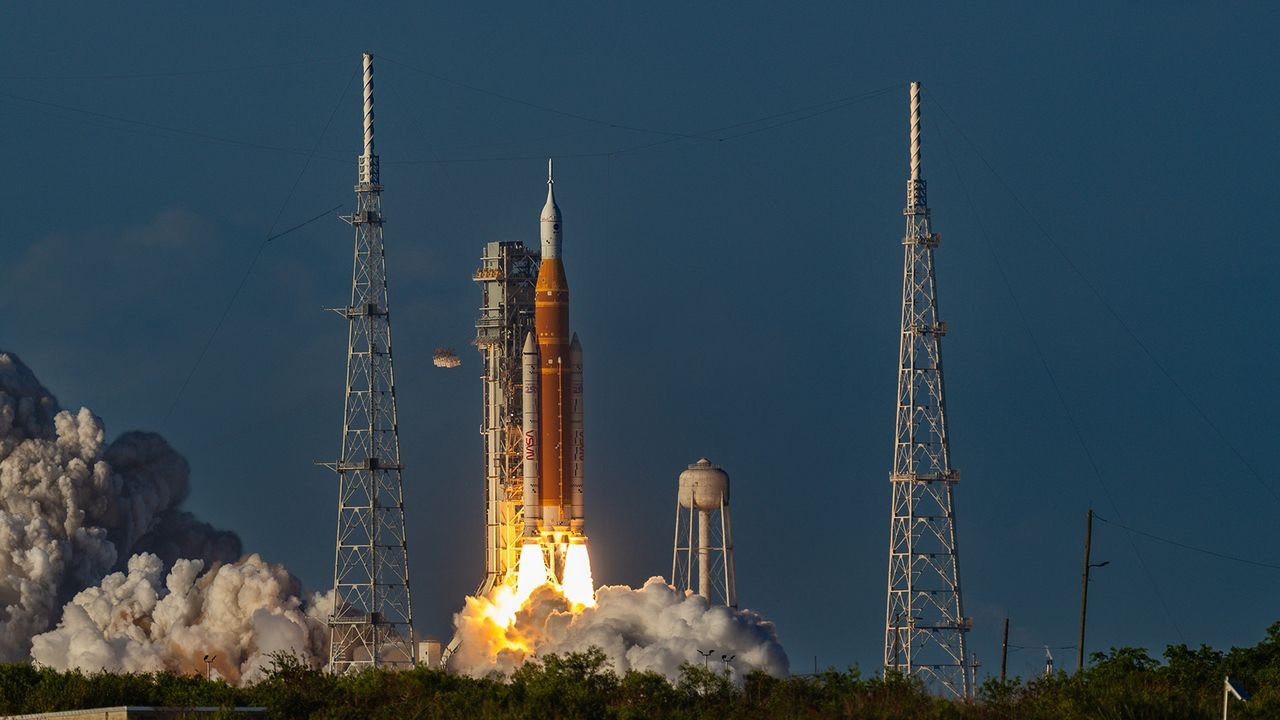
Some issues demanded attention soon after takeoff. Just before maneuvers that would move the spacecraft out of Earth’s orbit and into a lunar trajectory, the capsule flashed an emergency message: a suspected cabin leak. Jeremy Hansen, a Canadian astronaut on the mission, mentally prepared to don a spacesuit and figure out how to get the crew home. The message turned out to be a false alarm. Other difficulties have been more down to Earth. “I also see that I have two Microsoft Outlooks, and neither one of those are working,” Reid Wiseman, the mission commander, told Mission Control. The crew has learned to navigate shipboard life, too. Victor Glover, the pilot, reported that the spacecraft was uncomfortably cold, and donned a knit cap. Then there was the question of where one sleeps while weightless. Koch took to hanging from the ceiling, like a bat.
NASA has hailed the mission’s many firsts. Most notably, its diverse crew was travelling farther from Earth than anyone ever has. Key moments in the mission were memorialized with charmingly clunky scripted remarks. “When the engine ignites, you embark on humanity’s lunar homecoming arc and set the course to return Integrity and her crew safely home,” Chris Birch, the capsule communicator in Mission Control, told the crew. Koch replied, “With this burn to the moon, we do not leave Earth—we choose it.” This is NASA’s most important crewed effort in a generation, and so far it has been textbook. Close observers of the space program are not only celebrating milestones but feeling a wave of relief. Artemis II follows thirty years of false starts.
This week’s mission represents a beginning and an end. It gives NASA a new focus beyond the moribund I.S.S., and it sets the stage for a revived space race. This time, the main rival is China, which has a disciplined and effective program, called Chang’e, to land humans on the lunar surface by 2030. (Like Artemis, Chang’e is named after a goddess of the moon.) Artemis also represents the end of something essential. Artemis II is arguably a product of Old NASA, and it would still be recognizable to the architects of the Apollo missions. Although it features cutting-edge alloys, carbon-fibre composites, and digital avionics, the mission is managed by the same NASA centers. Many of the same contractors that built Apollo hardware were responsible for building Artemis II, often in the same buildings.
Beginning with Artemis III, in the name of efficiency, NASA will start handing major elements of the lunar program over to private companies, including SpaceX and Blue Origin. NASA will neither build nor own the next generation of lunar landers. It will basically hire a rideshare service to bring its astronauts from lunar orbit to the surface, and it will even rent its spacesuits from a contractor called Axiom Space. In the Trump Administration’s budget for the fiscal year 2026, it sought to cancel the Artemis rocket, known as the Space Launch System, in favor of commercial alternatives still in development, such as SpaceX’s Starship. The NASA of old was spread across the country so that many communities would benefit from its investments; the new space program will be increasingly privatized and concentrated in Texas and Florida. One wonders if it can live up to NASA’s longstanding motto: “For the benefit of all.”
To land the first two men on the moon, in 1969, NASA depended on about four hundred thousand workers. Only three years later, the Apollo program ended, and the technical capacity to build, assemble, and operate millions of parts quickly degraded. By the time President George H. W. Bush laid out systematic goals for NASA, in the late eighties, it was no longer feasible to repeat what had worked before. Bush envisioned multiple advances: a space station, a return to the moon, and a Mars landing. But setting foot on the moon again would require starting largely from scratch, technically and psychologically. “NASA programs require sustained political support and financial support over many years,” Emily A. Margolis, the curator of contemporary spaceflight at the Smithsonian’s National Air and Space Museum, told me. “During that time, the multiple Presidential Administrations and Congresses valued spaceflight differently. NASA had to work against that challenging backdrop.”



