
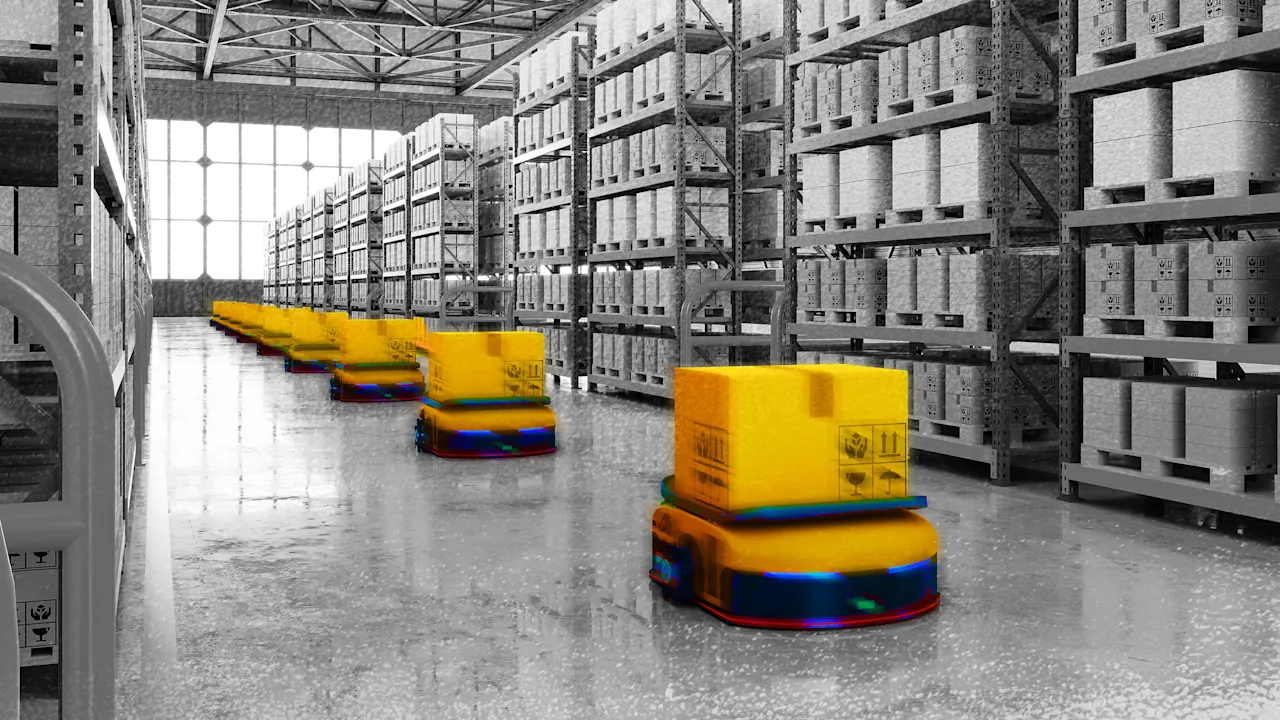
Across the top floors of an Amazon warehouse in Garner, North Carolina, about 10 miles south of Raleigh, the robots are already crowding out human workers.
A sprawling robotic system in the middle of one floor specializes in stowing items, which involves picking up a pack of paper towels or a Stanley tumbler and making space for it in a storage bin—a complex task for a robot. The humans who work among them are left to mill about the perimeter of the floor. Few human workers are welcome on another floor populated by robots, aside from the technicians who maintain them.
At this warehouse, known as RDU1, the workers have grown accustomed to robots buzzing around them. There are hallways designated for robots, usually marked by red tape. If there is green tape—known by the workers as the “green mile”—humans are free to roam the halls.
“People joke around and talk to them,” says Italo Medelius, an Amazon worker and organizer with Carolina Amazonians United for Solidarity and Empowerment. “They’re like our coworkers. A lot of people describe it as ‘We’re literally working in the future.’”
For years, technologists and futurists have warned that robots will come for our jobs, and it seems that time might actually be here—or at least rapidly approaching. Generative AI is upending white-collar jobs as we speak, chipping away at entry-level jobs, and changing the way we work. A similar transformation has been underway in Amazon warehouses across the country.
In 2025, Amazon disclosed that there were a million robots operating at its warehouses—which meant the company was employing nearly as many robots as human workers. (Amazon’s human head count has crossed 1.5 million, with the vast majority of people working in warehouses.) A Wall Street Journal analysis last year found that the average number of human workers per facility—about 670—was the lowest it had been in 16 years, even as the number of packages shipped per employee had increased exponentially.
Recent reports have indicated that robots will take over Amazon warehouses in the years to come: Last fall, The New York Times reported that the company had plans to effectively replace more than half a million jobs with robots. According to the report, which drew on interviews and internal documents, robots and automation would enable Amazon to avoid hiring 160,000-plus people by 2027; over the next several years, the company would be able to cut back on a total of about 600,000 hires. (In a statement to Fast Company, Amazon spokesperson Brad Glasser described the Times story as “misleading” and said it “didn’t accurately reflect our hiring plans. Instead, it reflected one team’s perspective, which misrepresents where we see our business heading.”)
This shift comes after the company has spent years hiring at an astonishing pace, growing its ranks significantly amid the pandemic and nearly doubling its head count since 2019—much of which was in warehouse jobs. In 2022, Amazon claimed that its warehouses were actually overstaffed.
All the while, however, Amazon has laid the groundwork for robots to eventually take the place of many of its human workers—and its competitors are scrambling to do the same.
Walmart has been adopting automation across its warehouses, according to its latest earnings report: About 60% of Walmart stores now receive their supply from automated distribution centers, and more than half of its volume across fulfillment centers moves through automated systems, from autonomous forklifts to sensors that enable real-time inventory management.
UPS is investing $9 billion in its automation plan, with $120 million earmarked for robots that will help unload trucks; the company has also made significant cuts to its human workforce over the past year, slashing tens of thousands of jobs. But as the second-largest employer in the country and a pioneer in its industry, Amazon is leading the charge—and its big bet on robots will radically reshape warehouse jobs.
“This is a major cratering or hollowing out of a large chunk of jobs, by any stretch of the imagination,” says Mark Muro, a senior fellow at think tank Brookings Metro who studies the effects of AI and automation on the workforce. “This will likely spread. [Amazon] has been extremely aggressive and sophisticated over a long period of time on logistics—so I think they are likely going to be setting a bar for many other organizations.”
Can robots actually replace workers?
In 2012, Amazon made a rather prescient acquisition: spending $775 million to purchase the robotics company Kiva, whose robots resembled Roombas that helped transport inventory across long distances in Amazon warehouses. The robots cut back on the amount of time workers spent traversing warehouses and moving products. In the years since, Amazon has invested in robotic arms that can sort and pick items, alongside more advanced robots that can shuttle towering shelves of products and packed orders (which are fittingly named after figures in Greek mythology: Hercules and Pegasus).
In a statement to Fast Company, Glasser disputed the characterization that Amazon’s investment in robotics would significantly impact warehouse jobs. “The premise of this story is wrong and ignores important facts. The reality is that we’ve been rolling out robotics in our facilities since we acquired Kiva in 2012 and, at the same time, we’ve created more direct and indirect jobs than any company in America—well over 2 million. We also offer more opportunities than ever for career advancement into higher-paying technical jobs, and more and more employees are participating in those programs and finding new roles across our network, joining the more than 700,000 employees we’ve already upskilled.”
At some of the company’s most automated warehouses—which include RDU1 and a facility in Shreveport, Louisiana—robots already handle much of the fulfillment process, especially once an order is packed. But experts and industry observers are skeptical that Amazon can make as drastic a change to its workforce as forecasted within the next few years. “I think it’s wrong to minimize what is happening, but at the same time there are going to be speed limits for transition,” Muro says. “Adoption of this stuff is not easy.”
Robots still struggle with some skills that are second nature to humans, like picking up a glass or folding laundry, which leaves Amazon’s vision of a fully automated warehouse just out of reach, even now. Ken Goldberg—a robotics professor at the University of California, Berkeley, and the cofounder of Ambi Robotics—says Amazon’s reported plans seem “exaggerated.”
“The picture of robots coming in and just sort of removing all the workers is a science fiction fantasy that’s been around for a long time, but has not been borne out by statistics,” he says.
One reason for that is that robots still lack dexterity and struggle to carry out tasks that might seem simple to humans, like rummaging through a shelf or drawer to find a specific item. “If you reach into your purse and pull out your keys, you know how to do that; you just feel around and you grab them,” Goldberg says. “No robot can do that. We’re not even close. We don’t have the tactile sensors. We don’t have the dexterity to be able to do that, to sense or manipulate.”
Even the way humans replace a garbage bag—shaking it out and wrapping it over the rim—is something robots cannot easily replicate.
Those hurdles explain why certain aspects of warehouse jobs have remained very human-centric, even at facilities that are heavily automated. It’s also why robots can alter how humans do their jobs, but not outright replace them—at least not yet.
“A robot doesn’t come in and take over a job; it takes over a task,” Goldberg says. “A job is usually lots of different tasks. So what it does is relieves a worker of that task but opens them up to do other tasks.” Still, Goldberg says it’s just a matter of time before robots progress to the degree that they can more wholly replace human workers in certain jobs.
“I’m not saying this will never happen,” he adds. “It will happen, but I don’t know when. I think that’s the big question.”
Warehouse jobs are already transforming
Even if Amazon is unlikely to replace workers en masse just yet, a seismic change is already playing out across its warehouses. Bianca Agustin, co-executive director of the worker advocacy nonprofit United for Respect, has observed how robots are changing jobs on the ground in Georgia, where a heavily automated Amazon facility—dubbed ATL2—is just miles from three other warehouses that have yet to undergo the same transformation.
The nature of jobs in the more automated warehouses is “pretty distinct” when compared against what workers are doing in older facilities, Agustin says. “There’s a lot of automation in Amazon facilities, but the difference is the degree to which robots are actually taking on functions that were previously performed by humans.” Even so, the robots are very much working alongside humans and being trained by them.
“The robots are there,” Agustin says. “But humans are working alongside them to help work out kinks.” (As it does with its human workforce, Amazon also reportedly collects productivity metrics for robots.)
There can be all sorts of pain points as people learn to work with robots. Some have told Agustin that increased automation has made their job feel even more menial and downright boring. “You’re literally sitting there watching a robot do a job, and your only role is to unstick that thing if it stops working,” she recounts.
Medelius, the Amazon employee and organizer in North Carolina, has found that the presence of robots “changes the work culture a little bit” and requires workers to be more aware of their surroundings. “You kind of have to watch where you’re going,” he says. “They might run you over. That’s why the color-coded hallways are necessary to keep people safe.”
The robots may beep or play music to alert workers when they’re on the move. “It’s definitely weird,” Medelius says. “You definitely see how we as humans interact with things that are, in a way, almost anthropomorphic.”
A warehouse worker at an Amazon sortation center in Southern California who asked to remain anonymous told Fast Company that dealing with robots can “be a pain,” and that there is minimal training for the average worker. (The employee describes the training materials as slideshows with AI-generated voice-overs.)
The robots may need maintenance or come in too fast; sometimes they’re responsible for tracking productivity metrics like “time off task,” which Amazon famously uses to monitor workers on the job. When you’re working with a robot, it is “effectively your partner,” he says, but you are responsible for whether the robot executes its job.
“When that robot takes [too] long, then it’s usually on you,” he says.
As someone who used to manage dock doors at Amazon facilities, this worker has also seen firsthand how tasks like that have been automated during his four years at the company, leading to less human oversight. “Now a lot of the process is automated, so you have one person cover multiple dock doors,” he says. “I haven’t done that position in a while because they just cut down on that need.”
More broadly, he worries that this shift will put many warehouse workers at a disadvantage, displacing the average employee and favoring those who have more specialized robotics training. “A lot of new warehouses have minimal human input. I feel very concerned because not only is that replacing jobs, but it also threatens people who want to fight for better working conditions,” he says.
Amazon already has a reputation for offering limited opportunities for career growth to people in warehouse roles, and many warehouse workers are hired on a seasonal or temporary basis without benefits. As the company relies more heavily on robots, there may be even fewer opportunities for full-time positions, particularly for employees who don’t upskill and gain robotics proficiency.
Many of the workers Medelius hears from are primarily concerned with displacement. Amazon does provide pathways for those who want to maintain and repair robots (which requires AI and robotics courses). Whether those career choice offerings actually lead to clear promotion opportunities and career growth for employees, however, is an open question.
“If you start off as a warehouse associate, it’s very unlikely that you’re going to move up,” Medelius says. “That’s one of the main complaints about Amazon, that they kind of want you out the door. So that doesn’t bode well, with the robots coming in and [Amazon] saying, ‘Oh, you can take all these classes, and we’ll pay for them, and you can then become a robotics technician.’”
What the future holds for warehouse workers
For a company like Amazon, automation could be a potential solution for some of the intractable labor challenges that persist across its warehouses. Many of these jobs are physically taxing and present numerous safety concerns.
“It’s very hard to get workers for these jobs,” Goldberg says. “They often don’t like the job for all kinds of reasons. It’s high pressure, but also very unrewarding and prone to injuries, so there’s a lot of turnover.”
As employees have sought to improve some of their working conditions through high-profile union efforts across the country, Amazon has pushed back aggressively. In a sense, for organizers like Medelius, the company seems to just be biding its time until many warehouse workers can be supplanted with robots.
Automation has become a leading concern for organizers over the past couple of years. “We really want to be able to come to the table and hear Amazon’s side on automation,” Medelius says. “Automation is never going to be stopped. It’s coming. The robots are coming. But the whole idea of being able to negotiate with Amazon is that we want to have a seat at the table.”
Amazon has argued that adopting robots more widely will free up workers for better jobs with higher pay. (The company specifically pointed to its Mechatronic and Robotics Apprenticeship and Amazon Future Ready upskilling programs that enable workers to move into roles like robotics maintenance and software development.) While advocates like Agustin say that’s true to some extent, there are also simply going to be fewer jobs—and without a more concerted effort to upskill workers, many of them may not be eligible for the new jobs that emerge as robots absorb more tasks.
The training program for employees who want to become robotics technicians does actually provide a “high level of technical knowledge to take on new positions where they are sort of overseeing the robots,” Agustin says, noting that such roles also promise more money and stability. “I just think the challenge with that is you’re never going to absorb millions of workers into those positions—because they simply aren’t needed.”
In many parts of the country, Amazon warehouses have fueled job creation and economic growth, often with the blessing of state officials who dangled tax breaks to bring the company in. But as more and more warehouses become automated—at Amazon and beyond—there may be few alternatives for the workers who are left behind. Lateral moves will prove more difficult as other companies take a cue from Amazon and rush to adopt automation in their own facilities.
The Southern California employee Fast Company spoke to fears people may be driven out of the region as Amazon leans more heavily on its robot workforce. “Young folks are already incentivized to leave because there’s not a lot of job opportunities,” he says. “There’s not a lot of good, stable career growth.”
It’s a concern that United for Respect is raising in conversations with local and state governments. “What we’re saying to county and state officials is, ‘This train has left the station,’” Agustin says. “‘This is the future of warehousing.’ But [Amazon] came in making commitments to get tax breaks. You should either start to claw some of that back, or ask them to do something to mitigate against the worst of the layoffs.”
In Georgia, Amazon is quietly downsizing to make room for robots, according to Agustin. One site is slated to shut down altogether because it can’t be upgraded into a robotics facility in its current form, and workers in the region are already being asked to leave or forced to accept fewer hours. (Amazon denied these claims and said the company had not announced future plans for the site, noting that any decisions would not be influenced by robotics adoption. The spokesperson also said Amazon regularly adjusts schedules following the holiday peak season, and that any staffing changes at ATL6 were not related to robotics.)
While Augustin is witnessing job losses in real time, she believes they are not yet happening on a large scale—and that companies like Amazon and Walmart could still find a way to soften the blow as they scale automation, if they care to do so.
“The question is: Can the two largest employers in the country help shape the labor market in a positive way? I think the answer is yes,” she says. “I do think they could create a much bigger number of very good jobs.”



