
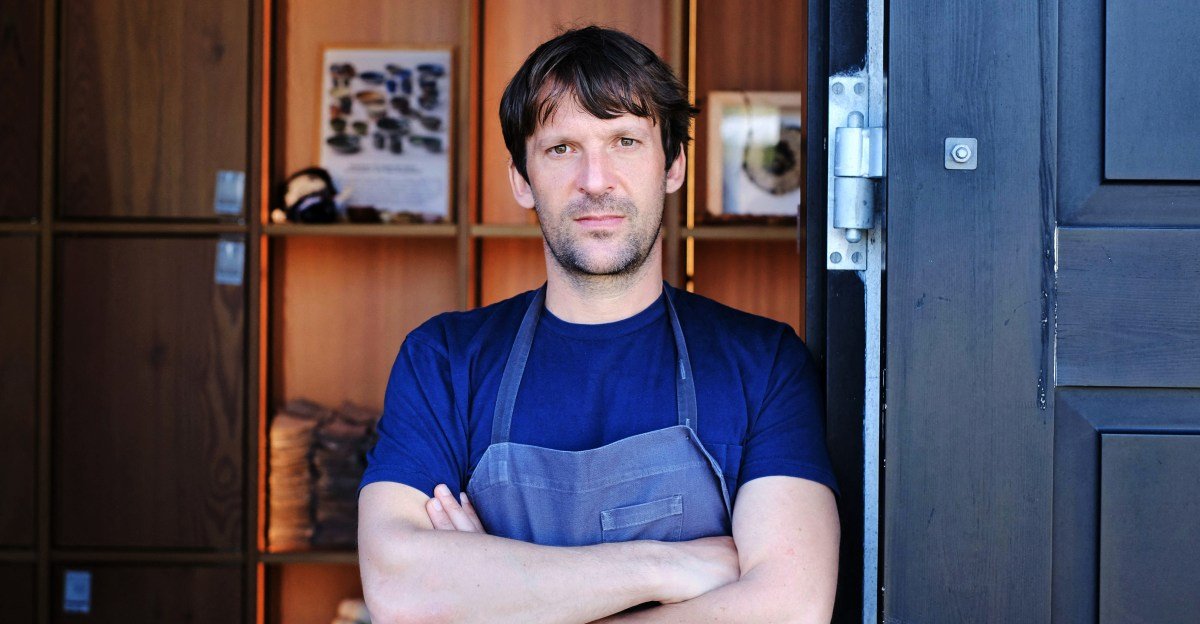
One of the most acclaimed restaurants in the world, Noma, opened a pop-up in Los Angeles on March 11.
It was supposed to be a joyous occasion for Noma head chef and co-founder René Redzepi and the staff, who relocated from Copenhagen, Denmark, for the sold-out 16-week stint.
But Noma LA’s opening has been mired in controversy — not only because it costs $1,500 for a meal, but because of new allegations that Redzepi physically and psychologically abused staff members and interns for years.
The accusations were first posted on Instagram in February by Jason Ignacio White, a former head of Noma’s fermentation lab. Further reporting by the New York Times’s Julia Moskin included accounts by 35 former Noma staffers of Redzepi punching, jabbing, and berating employees between 2009 and 2017.
Some of these accounts have been known for years, with clips from the 2008 documentary Noma at Boiling Point circulating on social media that show Redzepi screaming and cursing at employees.
Redzepi himself acknowledged his bad behavior in a 2015 column in Lucky Peach magazine. He says that the culture at the restaurant has changed since these alleged abuses took place.
But the latest charges are prompting another round of soul-searching in the fine dining world, and raise questions of what it will take to dismantle the toxic culture that has permeated so many kitchens.
To understand what might come out of this reckoning, Today, Explained co-host Sean Rameswaram spoke with Helen Rosner. She’s a staff writer and restaurant critic at the New Yorker and author of their weekly column The Food Scene.
Below is an excerpt of their conversation, edited for length and clarity. There’s much more in the full podcast, so listen to Today, Explained wherever you get podcasts, including Apple Podcasts, Pandora, and Spotify.
Why do you think this story about René Redzepi is getting such a big reaction? We know that chefs like him, and even him, have been accused of very bad behavior before.
Noma is quite simply the most important restaurant in the world, which sounds like a big hyperbolic thing to say, but it is the truth. I think that there is no single restaurant on the planet that is as influential for the fine dining scene, that is as contributive to this sort of trickle-down of trend and philosophy and the way of thinking and the way of doing business.
René Redzepi is the face and avatar of this restaurant that any chef and any cook in the entire world is aware of and almost certainly is in some way modeling themselves on.
Can you just explain why it’s so important?
Noma is, to maybe oversimplify it, a restaurant in Copenhagen, Denmark, that was opened in the early 2000s by chef René Redzepi with Klaus Meyer, who’s no longer affiliated with it. [It] took a couple years to find its footing, but when it really burst onto the international fine dining scene, what Noma was doing was a type of cooking that was really rooted in a phrase that they used that has now become kind of a cliche in the culinary world: “sense of place.” What Redzepi was doing was a lot of foraging, a lot of going out and finding ingredients, plants, animals, fungus, insects. What Noma did was actually quite revolutionary and like a lot of silly-seeming descriptions of art, when you were actually experiencing it in its execution, it was pretty extraordinary and transportive.
And this is why people would pay like $1,500 to go to this LA pop-up.
It’s the kind of thing where I think from the outside you might think of it as pretentious, but I genuinely think, and I’ve eaten at Noma twice, that I wouldn’t call it pretentious because I don’t think it was pretense. I think that Redzepi and the team that he cultivated believed quite passionately in the innovation and the creation and exploration that they were doing. They communicated it to diners with extraordinary clarity. It was, I think, by any metric of art, successful art.
“The idea of a restaurant kitchen as a particularly toxic workplace predates Noma, and is certainly not exclusive to Noma.”
A lot of chefs, as you well know, spent their time at Noma as interns or kitchen staff. When those chefs left Noma, did they take its toxic culture with them?
That’s hard to say. I think that the idea of a restaurant kitchen as a particularly toxic workplace predates Noma, and is certainly not exclusive to Noma. We see The Bear exploring the really sort of darker, more painful side of it. We see a sort of semi-glorification of it in the work of Anthony Bourdain, where he had a very conflicted relationship to it. He reveled in the kind of pirate ship-ness of cooking, and he also, later in his career as he achieved more and more fame, looked on it with a lot of skepticism and was like, we don’t have to make being an abusive dick an essential part of our professional identities as cooks.
The model of fine dining is rooted in what’s called the brigade system, which comes out of French fine dining and is modeled on military hierarchy. You have people who are each in charge of their own stations. The chef de cuisine is the head of the kitchen; the sous chef is the assistant to that. And then you have chefs who are in charge of different stations: The garde manger is the person who’s in charge of salads and raw vegetables, the saucier is in charge of sauces, and things like that.
As a system, it’s something that is not in universal adoption across fine dining, but it is kind of the substrate on which fine dining is built. And the whole idea of everybody saying, “Yes, chef,” in unison sounds like military call-and-response because it is.
And historically — this is certainly very much less the case in the last couple of decades — but historically, restaurant work was not something you went into if you were upper-class. It wasn’t something you went into aspirationally. It was an industry that took all comers and that didn’t do background checks. If you could just walk into a room and if you could scrub a dish, you’d have a job. So discipline, compliance, not talking back, not pushing back, not making any ripples, became the way that these restaurants would function.
And they were multimodal beasts with dozens of people running around trying to execute tons of dishes all the time for a demanding clientele. That kind of rigidity in structure certainly can produce a certain kind of product, but it also creates and enforces a certain kind of mindset, both in the people who are receiving the orders and the people who are giving them.
If I’m not mistaken, there was supposed to have been a huge reckoning in the restaurant industry — some other chefs who were accused of being toxic or harassers or whatever it might’ve been. Did we learn anything from it?
I think that the restaurant industry is sort of in a perpetual state of reckoning, and is also trying to figure out what it is and if it is even a coherent industry at all or just kind of a loose consortium of individual businesses.
I think that the Me Too movement and that era of workers feeling empowered to speak out was pretty extraordinary, and if it didn’t massively, dramatically shift the way that business is done in the restaurants, it certainly moved the needle a little bit. And so what we have seen over the last few years is a much stronger, much more focused culture of workers standing up for themselves.
I think part of what makes this Noma story really interesting and really complicated is that the abuses that were outlined in this blockbuster New York Times report took place between 2009 and 2017, nearly a decade ago. And that doesn’t minimize their horror. That doesn’t minimize the nature of the abuse.
But it does, I think, tell us something that this took place in a slightly different social environment where people who were coming to Noma, who were seeking out proximity to the creativity, the innovation, the excitement, the prestige, might not have felt as confident as people now might be to push back, or to say no, or to intervene, or to leave and say something immediately in public.
The way that the landscape has shifted, I think, is also that consumers are more receptive to hearing these stories. I saw this in the comments on my own article that I wrote about this for the New Yorker are overrun with people who are defending the actions that Redzepi is accused of. Not just saying it didn’t happen, but saying that, like, that’s just the cost of being in a kitchen.
This is something I want to ask you about because my favorite episodes of The Bear are the ones where people are screaming at each other and, like, on the cusp of killing each other. And then you look at this Noma pop-up in Los Angeles, even after all this controversy, and we heard that you can’t make a reservation there because it’s fully booked at $1,500 a person. Is this something that we’re okay with to some degree?
I think it’s impossible to overestimate people’s capacity for cognitive dissonance. There are lots of people who think that this kind of accountability culture has gone too far. Honestly, I don’t actually see meaningful consequences for virtually anybody who gets in the crossfire or this sort of thing. You brought up Mario Batali. When he stepped away from his restaurants, for a lot of people, several of those restaurants remained open, even though Batali wasn’t involved in [them] anymore. For a lot of people, those restaurants became toxic. I didn’t go back to Babbo, which was his flagship, but there also is a not-insignificant portion of people who went to those restaurants even harder just to stick it to the folks who had the audacity to speak up.
I don’t think that being an asshole to your employees makes the food taste better. You don’t need to be an art monster to make art. You don’t need to be a jerk in order to be successful. You don’t need to have people fear you in order to have them follow you.
I don’t think it’s possible to come up with one universal law that tells us what’s going to make a restaurant good and what’s going to make a restaurant bad — with the exception of the fact that being an abusive workplace does not mean your food is going to be good.



