
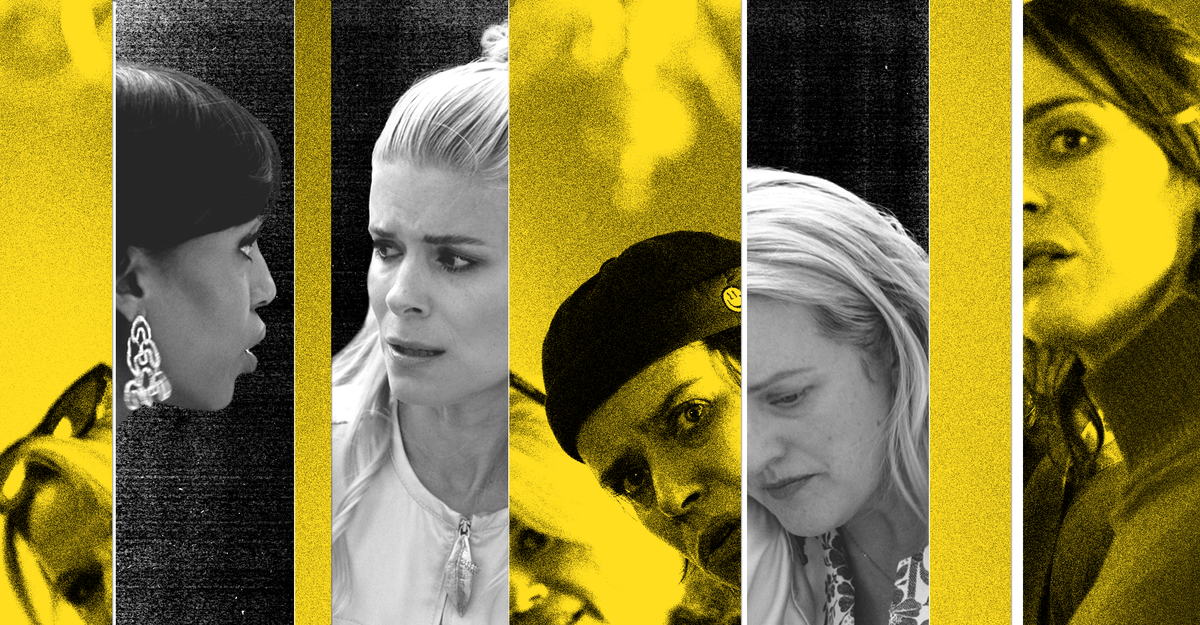
If the new Apple TV show Imperfect Women had premiered in the 2010s, it would probably have commanded the zeitgeist. The thriller, about a group of old friends whose cushy suburban lives unravel after one of them is murdered, has all the makings of an addictive watch. The whodunit comes riddled with beguiling red herrings and sordid twists. The cast is stacked with Emmy winners and hey-it’s-that-guy! actors. It’s the kind of glossy, elevated soap opera that would have fit neatly alongside Scandal and the rest of ABC’s melodrama-heavy programming a decade ago—and not just because Kerry Washington is one of the show’s stars. Middle-aged women caught up in wildly dramatic and morally gray predicaments once spelled easy success in ratings and critical acclaim. Just look at Desperate Housewives. Or How to Get Away With Murder. Or Big Little Lies.
As it stands, Imperfect Women isn’t likely to join their ranks in popularity. Although the series has risen to second place on Apple TV’s viewership charts, it hasn’t cracked the top-10 most-watched streaming titles overall in the United States. The overcrowded television landscape makes it harder than ever for any program to stand out, but other shows that mash up the character of the typically wealthy, often bored housewife with the intrigue of a crime thriller haven’t been clicking with viewers either: NBC canceled Grosse Pointe Garden Society, a drama about gardening-club members trying to cover up a murder, after a single season last summer. Prime Video’s The Better Sister, which follows estranged siblings who reconcile after one of them finds her husband dead, also came and went with little fanfare. Recent multi-season series about middle-aged women getting their hands dirty amid their seemingly mundane lives—Yellowjackets, Palm Royale—have ended or will end this year, further thinning out the genre.
Imperfect Women, then, is the latest evidence of the slow decline of what could be called “the messy-mom thriller”—in which violence and mystery pierce the suburban ennui felt by female protagonists of a certain age. Viewers who also belong to that demographic may find these stories more than just entertaining; they’re provocative, told with a level of gravitas rarely afforded to mature experiences of marriage, motherhood, and female friendships. After so many seasons of the troubled likes of Good Girls and Bad Sisters, however, the conceit has begun to feel stale. Many tales of fictional women getting caught up in crime pale in comparison with the real-life scandals that now flood social-media feeds, podcasts, and what feels like every piece of unscripted media. (Even in the already dramatic realm of reality TV, headlines can be too overwhelming for fans and creators alike to ignore.) Watching female characters break free of their perceived status quo by indulging in chaos used to be a guilty pleasure. These days, it’s just noise.
One recent exception cuts through the banality by going beyond showing women break bad. How to Get to Heaven From Belfast, a Netflix series that began streaming in February, follows the broad strokes of the messy-mom thriller: Three dissatisfied women find their routines upended when they become entangled in a suspicious situation. Their journey isn’t exclusively about the mystery, however; the show places equal importance on observing how these former best girlfriends navigate their adult relationship, perhaps grasping that its viewers have had more than their fair share of whodunits. When what was once novel and shocking has become ordinary, familiar comforts offer a more surprising place to find actual thrills.
Shows about crime-solving older women tend to be more concerned with the crimes than with the women themselves. But How to Get to Heaven From Belfast is created by the Derry Girls showrunner Lisa McGee, which explains the show’s exuberant Irish-isms, rat-a-tat dialogue, and characters whose friendship is instantly believable. The three central characters resemble the genre’s typical protagonists—and likely viewers—in that each one is somewhat worn down from the compromises that come with aging. Saoirse (played by Roisin Gallagher), a onetime aspiring playwright, oversees a hit police-procedural series but questions whether she’s wasting her time. Dara (Caoilfhionn Dunne), the group’s nervous Nellie and de facto rule follower, is trapped at home taking care of her nightmarish mother and pining for the girlfriend who got away. Robyn (Sinéad Keenan), the chattiest of the bunch, has been run ragged trying to mother her three children, all of whom seem intent on splitting her eardrums and driving her mad.
The three reunite under bleak circumstances: Greta (Natasha O’Keeffe), their childhood friend, has died. At the funeral, Saoirse, Dara, and Robyn discover that the body in the casket belongs to a different woman, yet the show rejects the impulse to let the mystery drive the plot. Instead, the group’s evolving dynamics—the way the women absorb, bicker over, and make peace with how they have and haven’t changed—become as important to their story as the conspiracy they’re trying to unravel.
Take, for instance, a moment in an early episode when Dara’s ex-girlfriend spots them planning a boneheaded mission to retrieve the body in Greta’s casket. The interaction leaves Dara deflated, so Robyn and Saoirse immediately work to boost their friend’s confidence, coordinating their barrage of compliments with incredible precision. It’s a heartwarming beat despite not advancing their amateur sleuthing, one that treats the women’s intimacy with the same seriousness afforded to Greta’s disappearance.
Belfast, in this way, doubles as a poignant portrait of how women build and maintain their bonds. The show’s flashbacks fill in background details explaining why Greta vanished, while also exploring why Saoirse, Dara, and Robyn can still rely on one another after years of drifting apart. The characters are motivated to continue spending time away from their usual obligations not just because the investigation shakes them loose of their doldrums but also because they enjoy one another’s company. Having a friend go missing isn’t a typical midlife crisis. Feeling like your social life has become nonexistent is.
That resonance has been missing from the wider realm of messy-mom thrillers lately. Friendships are often treated as convenient opportunities for protagonists to deliver exposition dumps. Aging tends to play like a grim impediment to joy that can be dispelled only via lawlessness, extramarital affairs, and, in some cases, death.
Imperfect Women may be the most egregious entry yet: By my count, the show packs in three infidelity subplots, two instances of domestic violence, and one viral video that nearly derails a character’s career—all in the span of eight episodes. It also turns its heroines into wine-guzzling loners, rarely allowing the solid lead cast (Washington, Elisabeth Moss, and Kate Mara) to share the screen. That’s by design; the series shifts among their perspectives every few episodes, generating intrigue out of having multiple unreliable narrators divulge their secrets. As a result, though, the women’s connection ends up ill-defined, robbing the audience of the chance to empathize with them. If anything, I found it hard to buy that these characters ever truly liked one another.
Not every messy-mom thriller can avoid the genre’s overreliance on long-buried secrets and seemingly uncharacteristic rebellions to suggest depth. Even Belfast, in its later episodes, spends too much time untangling what’s going on with Greta, pushing the show into formulaic territory. Yet what keeps it from veering into blandness is its refusal to depend on the kinds of outrageous stakes that play like echoes of news stories. The show understands that older women at home may so badly need a break that they’ll fantasize about appalling impulses (that fictional characters can actually act on). But Belfast also grasps that the greatest pleasure—guilty or otherwise, on-screen and off—may be as simple as finding quality time with a couple of best friends.



