
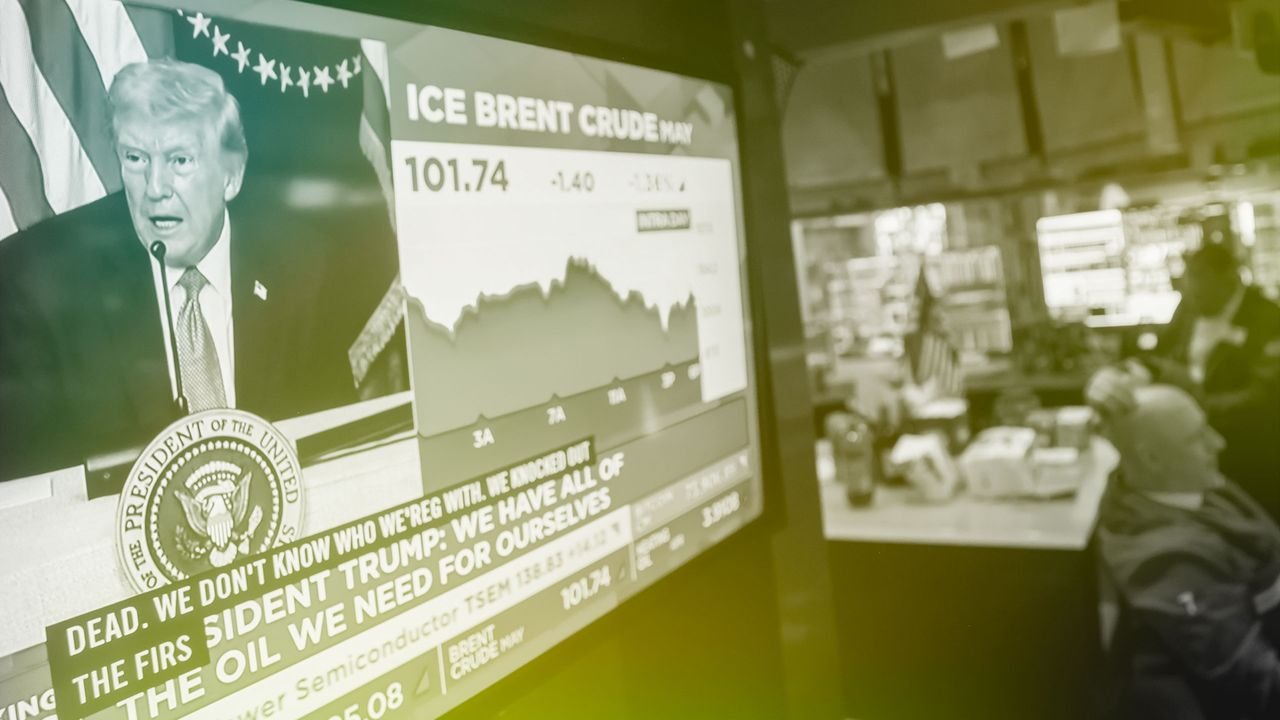
Since the war began, trading in the futures markets has been heavy and, sometimes, frenetic. In terms of their absolute size, the trades that took place immediately before Trump’s announcement last Monday weren’t off the charts. But the volume of trading was unusually large for the time of day: according to data collected and analyzed by Bloomberg, it was roughly nine times the average volume at the same time during the previous five days. The sudden surge in trading of stock futures was also unusual: until Trump’s post, there had been no big news. “The timing and the fact that the two trades were placed at the same time, it kind of smells like something was off,” Mike Khouw, a veteran futures trader and portfolio manager who used to run a derivatives desk at Cantor Fitzgerald, a Wall Street investment bank, told me.
In futures markets, trades are often placed on margin through a brokerage account. Some of these trades were so large, Khouw said, that whoever placed them would have needed tens of millions of dollars in margin reserves, indicating a considerable level of financial sophistication and wealth. “You are not dealing with a rube,” Khouw said. “You are not dealing with someone whose other occupation is working at Starbucks.” The wagers could also have been placed by an institutional trader with ample financial reserves. It’s at least conceivable that a hedge fund read the publicly available runes, concluded that Trump would back down before his forty-eight-hour deadline expired, and decided to establish a short position in oil and a long position in stocks before U.S. markets opened for the new week. Computer-driven algorithmic trading is also common in the futures markets, and it could have played a role here. The fact that the trades came so close to Trump’s announcement may have been mere happenstance, Khouw pointed out. But, given that coincidence of timing and the corruption endemic to the Trump Administration, it also seems conceivable that someone, or some entity, got tipped off and cashed in.
It wouldn’t be the first time in recent history that anonymous traders have made bank based on their uncanny ability to predict Presidential announcements or actions. The day before the war began, six accounts on Polymarket, the online prediction site, wagered that the U.S. would strike Iran within forty-eight hours, netting profits of more than a million dollars. In January, another Polymarket account won big by betting that Nicolás Maduro, the President of Venezuela, would soon be out of power. (On January 3rd, a U.S. raid captured him and his wife.) But it would be tough to identify who made these wagers: it takes a lot of people to launch a military raid, so the circle of advance knowledge was surely large, and bets on Polymarket are funded by anonymous cryptocurrency accounts, which are difficult to penetrate.
In this instance, finding out who placed the well-timed trades should be easier—at least in theory. It seems reasonable to assume that the number of people who received prior notice of Trump’s decision to postpone the strikes on power plants was relatively small, and the trades were placed on regulated exchanges. The regulatory agency that has primary responsibility for enforcing the laws in the futures markets is the Commodity Futures Trading Commission (C.F.T.C.). “The thing that should be happening is that the C.F.T.C. should be investigating these trades,” Schiffrin, who is now with Better Markets, a Washington-based public-interest group, said. “They have the authority to subpoena trading records and find the identity of the people who placed the trades. Insider-trading investigations happen all the time, and that’s how they work.”
The C.F.T.C. didn’t respond to a question about whether it had launched an investigation. Despite recent staff cuts, the agency’s enforcement division still has some dedicated professionals. But the C.F.T.C.’s leadership doesn’t inspire much confidence. Its current head, Mike Selig, is a thirty-six-year-old lawyer and crypto booster. Last week, Selig announced the creation of an “innovation task force” centered on three industries in which the Trump family now has business interests. “The C.F.T.C. seems to be more focussed on promoting crypto, prediction markets, and A.I. than its core function: investigating and preventing manipulation in the futures markets,” Schiffrin said.



