
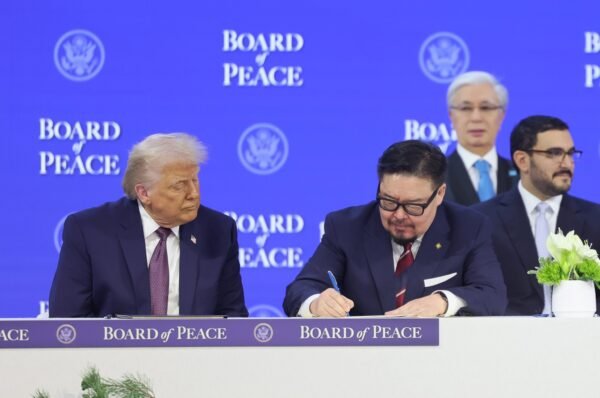
Mongolia’s Prime Minister Zandanshatar Gombojav attended the 2026 World Economic Forum in Davos, Switzerland. While there, Mongolia officially joined the U.S.-initiated Board of Peace as one of the founding members. Mongolia’s swift move to join the newly forming international organization is drawing some criticism, but the government emphasizes that the membership aligns with Ulaanbaatar’s flexible, multi-pillared foreign policy, and protects its national interest.
On January 22, on the margins of Davos, the U.S. President Donald J. Trump launched the Board of Peace. The board was initially designed to oversee the U.N.-approved 20-point Gaza Peace Plan and reconstruction of Gaza; it has now turned into an early stage of an international cooperative body that aims to resolve other, as-yet-unspecified global conflicts.
U.S. Ambassador to Mongolia Richard Buangan offered his congratulations to Zandanshatar. “We express our gratitude to Mongolia for becoming a founding member of the Peace Council,” Buangan said in a statement. “This historic initiative, being implemented under President Trump’s leadership, will finally bring peace to Gaza.”
Mongolia became a Founding Member alongside 19 other countries represented at the charter signing ceremony, including fellow Asia-Pacific countries Indonesia, Kazakhstan, Pakistan, and Uzbekistan. Notably, none of the United States’ democratic allies, whether in Western Europe or East Asia, accepted Trump’s invitation to join.
Afterward, the Zandanshatar administration defended its participation.
“The Board of Peace is not a military alliance but a voluntary cooperation platform based on respect for national sovereignty, fully consistent with Mongolia’s independent, peace-centered and multi-pillared foreign policy,” it said in a statement.
The Office of the Prime Minister told The Diplomat that “Mongolia’s joining to the Board of Peace also demonstrates its independent foreign policy mechanism.”
Zandanshatar government’s official press release highlighted three key points for Mongolia’s decision to join the Board of Peace. First, it said that “Mongolia’s support for a new, flexible, and result-oriented peace mechanism will strengthen Mongolia’s international position and provide an opportunity to make its voice heard more clearly.”
Second, the administration pointed to Mongolia’s long experience in international peacekeeping operations through the United Nations. The statement said that the Board of Peace “is not a military alliance, but rather based on voluntary cooperation and respect for the sovereignty of states, which is fully consistent with Mongolia’s peace-promoting, independent, and multi-pillared foreign policy.”
Finally, the the Zandanshatar administration sought to head off potential criticism about the cost, given that Trump had demanded a payment of $1 billion for permanent seats on the Board of Peace. That payment does not apply to states that are content with a temporary, three-year membership, the Mongolian government statement said. “It is not a mandatory condition… Mongolia does not have to make financial commitments to this extent and is fully able to participate as an ordinary member for a period of 3 years, on a voluntary basis, in a manner that suits its capabilities and interests.”
Ulaanbaatar might be jumping the gun. Other states are still reviewing the newly forming Board of Peace. Mongolia’s strategic partners such as Japan, South Korea, Poland, and many of its European partners are assessing the Charter and the way that the Board of Peace will operate.
From the standpoint of Mongolia-U.S. bilateral relations, Mongolia’s membership on the Board of Peace is a continuation of the strategic partnership that was established during Trump’s first term in 2019.
“Joining this initiative at its initial stage as a founding member would provide Mongolia with a strategic advantage,” the deputy chief of Mission to the Mongolian Embassy in the United States, Battushig Zanabazar, told The Diplomat. “Since the Board represents one of the key initiatives of the Trump administration to promote peace and stability, Mongolia’s early support and participation would send a tangible positive signal to the U.S. administration.”
Battushig emphasized that “this would tangibly strengthen Mongolia’s Strategic Third Neighbor partnership with the United States and play a key role in deepening political trust.”
From a broader historical standpoint, Mongolia’s presence and contributions on the international stage have been globally accepted and continued to grow since it achieved membership to the United Nations in 1961. However, diplomats from that era remember the struggle Mongolia faced to gain U.N. membership – its bid was rejected several times.
Hence, Mongolia’s decision to join the Board of Peace carries the collective memory of steps the country took during the historical turning point at the end of World War II, when a new international order was being established. Today, the world is experiencing a similar inflection point, and Mongolia’s decision to join the new Board of Peace might prove to be one of those historical moments.
Mongolian leaders want to choose a path that ultimately protects its independence and sovereignty, while also expanding economic opportunities to the maximum extent. With that in mind, Mongolia has signed on to various international bodies in recent years, including observer state status in the Shanghai Cooperation Organization and a temporary free trade agreement with the Eurasian Economic Union (EAEU). To the Zandanshatar administration joining the Board of Peace may be just another entry on this list. Mongolia has also been strengthening bilateral relations with the Gulf states such as the United Arab Emirates, Bahrain, and Saudi Arabia. These endeavors and strategic goals should not be neglected in addressing what benefit could Mongolia get from being on the Board of Peace.
That being said, it is imperative for policymakers to conduct Mongolia’s foreign policy in conjunction with its other international obligations. Assuming that Mongolia’s membership on the Board of Peace will not conflict with its United Nations commitments and agreements, the U.N. will still remain a significant channel for diplomatic bargaining between nations.
Mongolia’s decision to join the Board of Peace, although it may seem premature, is not a recalibration of Mongolia’s foreign policy framework. But any additional agreements and cooperation mechanisms will need to be discussed at the legislative level to make sure that each step aligns with Mongolia’s democratic principles and longstanding support for peace and security in the region and the globe.



