
Last week, tensions escalated in Minneapolis following two fatal shootings by federal immigration agents. President Trump has spoken about invoking the Insurrection Act and MAGA architect Steven Bannon recently called on him to do so in response to the situation in Minnesota. This act, a combination of laws passed largely in the 19th century, would allow the president to send military forces into the cities and override the Posse Comitatus Act of 1878, which generally prohibits federal troops from being involved in domestic law enforcement operations.
Under the law, the Insurrection Act can be invoked in a number of circumstances. According to a report from the Brennan Center, Section 251 allows the president to send in troops if the state legislature or governor requests federal assistance during an insurrection. Sections 252 and 253 empower the president to act regardless of the wishes of state officials. In particular, Section 253 allows the president to use troops to suppress “any insurrection, domestic violence, unlawful combination, or conspiracy” that obstructs the enforcement of laws or when state authorities can’t or won’t protect constitutional rights.
When asked about this authority, Trump often notes that half of U.S. presidents have used it. “Fifty percent of the presidents, almost, have used (the Insurrection Act). And that’s unquestioned power,” Trump said in an interview on Oct. 19, 2025.
That is not true. Most presidents have not used the Insurrection Act. In fact, most have been extraordinarily reluctant to do so, even in circumstances far more dire than what is occurring in places such as Minneapolis, Chicago, and Portland, Maine. During the 1950s and 1960s, presidents invoked the Insurrection Act only in a handful of critical civil rights confrontations, most notably to enforce court-ordered school desegregation in Little Rock, Arkansas, in 1957; at the University of Mississippi in 1962; and in Detroit, Michigan, in 1967 during a period of severe urban unrest. For much of this era, however, and to the frustration of civil rights activists, the executive branch avoided deploying federal protection in the Deep South even as white terrorism ran rampant. In a 1964 memo to President Lyndon Johnson, Deputy Attorney General Nicholas Katzenbach concluded: “The practical problem is whether their presence [federal forces] serves to aggravate the emotions of the populace or alienate local law enforcement officials.” In the cases that resulted in the memo, Katzenbach was talking about a situation where local police were hostile to federal and state law, often part of or acting together with the Ku Klux Klan.
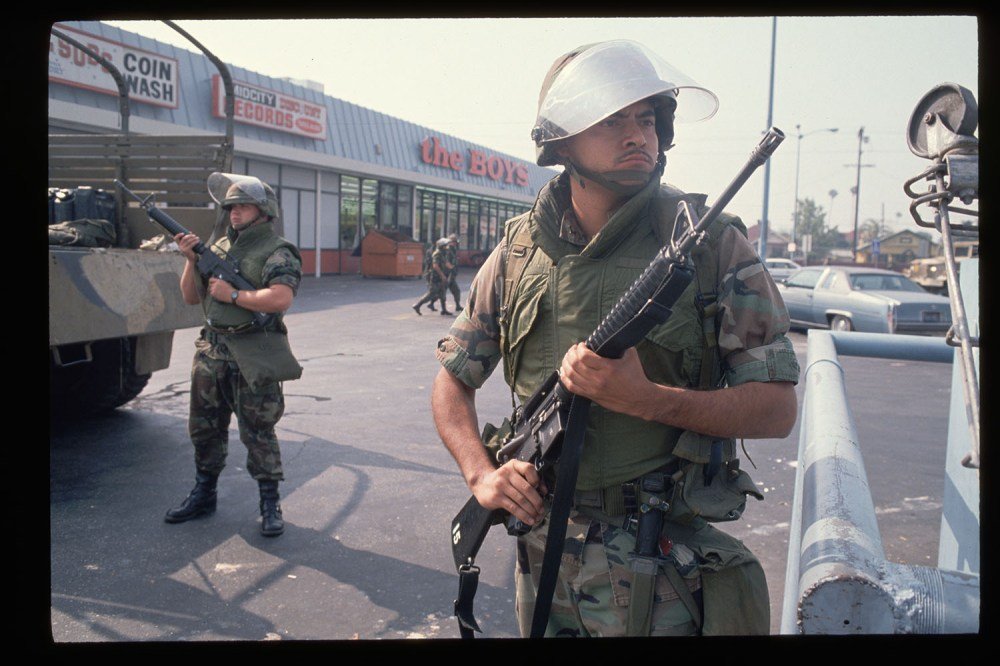
Indeed, how much it typically took for presidents before Trump to move in this direction can be seen the last time an American president invoked the Insurrection Act. In 1992, George H.W. Bush did so amid violence in Los Angeles sparked by the outrage over four police officers who avoided punishment after being caught beating an unarmed Black American man, Rodney King, following a traffic stop. Bush’s decision does not support Trump’s expansive interpretation of this authority. In fact, it illustrates the opposite: how extreme the circumstances have usually had to be for such executive action to occur.
In March 1991, a plumber using his Sony camcorder, the latest technology of the period that allowed people to record events without any expertise, captured a gruesome scene: several Los Angeles police officers violently assaulting King. George Holliday sold the footage to a local news station, and it was soon picked up by the national cable networks, becoming one of the first videos to go “viral.” What many Americans saw shocked them.
For decades, civil rights leaders had argued that police routinely mistreated Black communities, and Johnson’s Kerner Commission confirmed in 1968 that police abuse was the spark for almost all of the urban unrest of the previous year. But until the King video, most Americans outside of the most affected communities had never actually seen this kind of violence occur. They heard about it, read accounts of it, or encountered it through fiction. With King, they witnessed it with their own eyes.
Yet on April 29, 1992, the officers were acquitted by a jury in California’s then-conservative Simi Valley, where the trial had been moved in ways that favored the police. Fury erupted across the country about the decision. The verdict struck many people as a profound injustice given what they had seen. Massive unrest broke out in South Central Los Angeles, plunging the city into chaos. Buildings were burned, people were attacked, and dangerous confrontations unfolded hour by hour. Many Black and Latino residents had scant trust in the police, who under the direction of Police Chief Daryl Gates had systematically engaged in racist and nativist practices and grossly violated constitutional rights—as Danny Goldberg recounts in his recent book, Liberals with Attitude.
The mayor of Los Angeles, Tom Bradley, and Gov. Pete Wilson both sought support from Washington. Bradley—a Democrat, the city’s first Black mayor, who issued sharp criticism of the verdict—and Wilson, a conservative Republican who had risen to power by appealing to growing anti-immigrant sentiment in the state, could agree on the need for federal assistance. Looting, arson, and rioting were spreading, all broadcast live on television.
On the day of the verdict, Bradley declared a state of emergency. Wilson sent in 2,000 National Guard troops later that evening to help restore order. There were delays in mobilizing the Guard members, and as a result it was almost 24 hours before their presence could have an effect. As the situation grew more dire, the governor vastly expanded the number of National Guard troops deployed and imposed a curfew on April 30. None of these steps, however, succeeded in stabilizing the situation. King gave a statement to reporters, tears streaming down his face: “People, I just want to say, can we all get along? … Can we stop making it horrible for the older people and the kids?”
By the third day, Bradley and Wilson had called on Bush to provide assistance, including invoking the Insurrection Act. Bush was running for reelection. By the spring of 1992, much of the bounce that he had received from the swift success of Operation Desert Storm, when the U.S. and allies forced Saddam Hussein’s Iraq out of Kuwait, had been drowned out by the poor state of the economy. Democratic candidate and Arkansas Gov. Bill Clinton blamed the Republicans for failing to deal with the underlying problems facing the Black community in Los Angeles and other American cities. Bush wanted to demonstrate that he could be effective on the domestic front, without fueling further chaos. Nor did he want to further aggravate racial tensions, as many Black Americans were already distrustful of the GOP.
On the morning of May 1, Bush met with a range of advisors to finalize a plan. He also met with civil rights leaders who criticized him for saying more about the violence in the city than the criminal justice issues at the heart of the story. They supported sending federal troops but wanted a full investigation into the police and reforms to address the hardships in Los Angeles.
After calling for calm, the president signed Executive Order 12804, authorizing the deployment of federal troops to the city in response to the governor’s request and the inability of local law enforcement to uphold the law. The order federalized the National Guard and directed the secretary of defense to deploy over 4,000 active-duty forces from the Army and the Marines to restore order. He also issued Presidential Proclamation 6427, explaining that Wilson had requested the troops because of the severe challenges facing law enforcement in the state.
The president spoke to the nation on May 1 at 9 p.m. to explain what he was doing and why. In the speech, he condemned the disorder while also expressing sympathy for those who were angry about the verdict. “What we saw last night and the night before in Los Angeles,” the president said, “is not about civil rights. It’s not about the great cause of equality that all Americans must uphold. It’s not a message of protest. It’s been the brutality of a mob, pure and simple. … What is going on in L.A. must and will stop.” At the same time, as civil rights leaders had urged, he made sure to address the anger beneath the unrest.
Speaking about King, and the need for justice, after having absorbed what the civil rights leaders told him, the president said: “What you saw and what I saw on the TV video was revolting. I felt anger. I felt pain. I thought: How can I explain this to my grandchildren? Civil rights leaders and just plain citizens fearful of and sometimes victimized by police brutality were deeply hurt. … Viewed from outside the trial, it was hard to understand how the verdict could possibly square with the video.” He announced that the Department of Justice was looking into the case through a grand jury investigation of possible civil rights violations by the police.
As the operation unfolded, between 3,000 and 4,000 Army soldiers and Marines were deployed to the city to support local law enforcement. Federal troops assisted in the most destabilized areas to help restore stability but did not engage in routine policing. They operated under strict rules of engagement, with clear limits on the use of firearms, which were permitted only if they were under direct threat and as a last resort. They did not arrest anyone. Their primary roles were to establish a visible presence through checkpoints and to help local firefighters, police, and hospital staff carry out their work. The Attorney General and Chairman of the Joint Chiefs of Staff, Colin Powell, helped to coordinate the efforts.
Violence had subsided by May 3, two days after Bush announced his decision, and by May 9 the federal troops had left the city. Although the executive order allowed the president to maintain the deployment, Bush withdrew the forces as soon as local officials had reestablished control.
63 people would be killed, more than 2,000 injured, and over 1,000 buildings were damaged or destroyed, resulting in more than a billion dollars of property damage.
Although some critics were uncomfortable with the deployment of troops given the history of racism, there was considerable satisfaction that federal forces helped bring an end to the unrest and to stabilize the situation. While there were incidents in which federal personnel were accused of aggressive behavior, including Marines shooting 200 rounds into a home (nobody was harmed) after someone had fired a shotgun, these did not become a major source of controversy. Bush’s decision received broad national, bipartisan support.
For decades, government reformers committed to the constitutional balance of power have urged Congress to revise the Insurrection Act to provide greater clarity about what constitutes an emergency and the conditions under which a president may invoke this authority. They have also called for clear timetables limiting how long troops could remain deployed without congressional approval, along with stronger oversight mechanisms.
But again and again, Congress has refused to act. The House and Senate have instead relied on presidents to follow a long-standing precedent of caution and restraint before federalizing law enforcement operations anywhere in America.
Now, that caution is gone. The power is in the hands of a president who disregards many of the traditional guardrails that have constrained the use of executive power, even in an era when executive power has been dominant.



