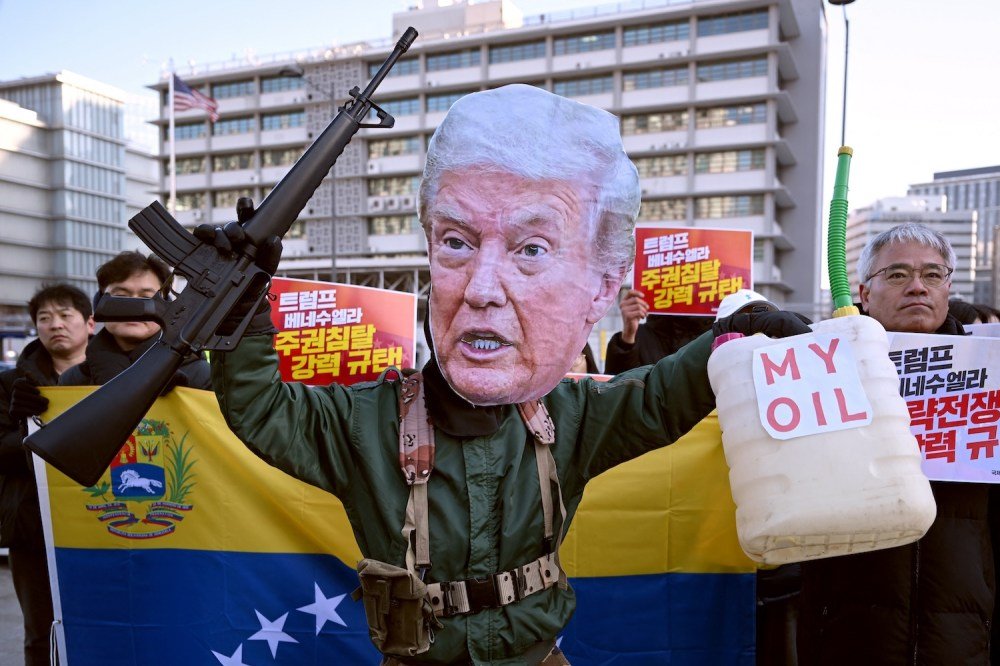
The most glaring features of the United States’ intervention in Venezuela over the weekend were its lawlessness and its breathtaking logical and political incoherence.
The world has just witnessed Washington use its armed forces to kidnap the leader of a sovereign foreign nation for the stated purposes of subjecting him to the U.S. criminal justice system. Most strikingly, this unilateral action was ordered up by a U.S. president—Donald Trump—whose own impunity has been immeasurably heightened by an extraordinarily pliant U.S. Congress that his Republican Party controls and a landmark 2024 Supreme Court decision that shockingly ruled that U.S. leaders generally cannot face criminal prosecution for their official acts.
The Trump administration has justified its actions in Venezuela using a mixture of flimsy and puerile rationales. It has ceaselessly called Venezuelan President Nicolás Maduro a dictator and decried his alleged corruption. But the premises behind these claims are remarkably weak. However corrupt Maduro may be, the central accusation used to justify the massing of U.S. forces in the Caribbean and his heavily armed extradition—that he was a major drug lord ultimately responsible for countless U.S. deaths—has never been supported with evidence and is strongly disputed by many experts.
What is more, if being a bad guy or even a rank dictator is sufficient justification to remove another country’s leader, this ridiculous standard will hasten the world down a path away from a more principled order—and toward a return to the jungle, where countries drop any pretext of respect for the principles of sovereignty, rules, and the rights of others, and simply do whatever they feel capable of getting away with. (It is also being applied with obvious inconsistency. Where does the list begin and end? Kim Jong Un? Vladimir Putin?)
A major part of Washington’s claim for the operation’s legitimacy lay in official boasts about the prowess of the U.S. military and its capacity to pull off complex and dangerous operations in distant lands. This, however, is a political fig leaf. The Pentagon’s capacities seem less awesome when one considers the extraordinary military expenditures of the United States, the world’s top defense spender, which amount to more than the next nine countries combined. In fact, Washington’s need to rely ever more on being muscle-bound is a symptom of the huge and accelerating erosion in recent decades of its claims to any moral, ethical, or democratic leadership in the world. No amount of bragging can overcome this, and praising this intervention as an extraordinary feat of arms also appallingly makes light of the reported loss of dozens of Venezuelan lives.
A global power more preoccupied with such things would have focused on electoral legitimacy before oil and committed to a swift democratic political process right away. Instead, the United States has done the opposite. Strikingly, Trump even brushed aside any consideration of handing over power to Venezuela’s exiled recent Nobel Peace Prize winner, María Corina Machado, whose political alliance is widely thought to have won the country’s last election; anonymous sources told the Washington Post that this was due to his envy toward her for having received this global distinction at his expense.
If the intervention had anything to do with human rights, it would have emphasized the immediate freeing of Venezuela’s reportedly large number of political prisoners. But given a chance to speak to this issue, Trump displayed disinterest, saying, “We haven’t gotten to that. Right now, what we want to do is fix up the oil.” For that matter, if Maduro’s dictatorship were a true central grievance, it would not have left in place virtually the entire state apparatus that Maduro founded his rule on, including his vice president, Delcy Rodríguez, and key ministers, some of whom also face U.S. drug indictments.
The winds of lawlessness could be heard above the frenetic claims of martial competence again and again over the weekend. They resounded loudly in Trump’s language when he said that the United States would “run” Venezuela; that U.S. oil companies would be given back the underground wealth of another country that was “stolen” from them; that Washington would make lots of money in the wake of this intervention; and that Venezuela’s de facto president, Rodríguez, now “doesn’t have a choice” but to comply with Washington’s directives about the running of her country.
They also howled in the strange formulations of Marco Rubio, Trump’s secretary of state and national security advisor, who said that the White House did not need to inform Congress about an intervention such as this because it was a “trigger” operation—the rhetorical equivalent of circus magic. Both Rubio and U.S. Defense Secretary Pete Hegseth repeatedly stated that whatever happens next in Venezuela, and by implication almost anywhere in the world, will be decided by Trump himself. They didn’t use the word “whim,” but they scarcely needed to.
For any doubters, speaking of U.S. intervention, an exultant Trump told Fox News on Saturday, “We can do it again, too. Nobody can stop us.”
Some Americans will inevitably celebrate all of this as a recovery of what they see as their country’s power in the world, which has been allowed to fade. To them, Trump represents an America unbound and unapologetic—an America that exerts its will on the world with renewed freedom. To say that they are mistaken has nothing to do with partisan politics.
Over recent decades, U.S. power in the world has diminished in objective and measurable ways. Some of this is down to the country’s own strategic mistakes, such as launching into costly and ill-reasoned wars in places such as Iraq and Afghanistan; some of it is due, rather, to a broadening distribution of global wealth, which over time inevitably expresses itself in terms of power.
First China, then India, and in their wake, a host of other “secondary” and “tertiary” powers have increased their stature in the world as their economies have grown relative to the United States and other global leaders of the last 70 years or so, particularly Europe and Japan. There is little or nothing that Washington can do to reverse history’s flow in this direction. But that does not mean that the United States can’t do anything to shore up its standing on the global stage.
Its wisest course of action would be to build a quieter and more consensual basis for its continued power and influence in the world. Instead of throwing its weight around through ill-conceived military might, as it has done in Venezuela—and, recently, in Nigeria—it should focus on inner strengthening and the patient renewal and expansion of principled alliances and coalitions.
This is almost the precise opposite of the Trump approach, which has been to gut scientific research, attack the country’s universities in the naked pursuit of political advantage, and continually downgrade and demean Washington’s allies.
Paradoxically, the greatest beneficiary of Trump’s recent actions stands to be the country that is routinely identified as the most serious threat to U.S. power: China. The weakening of Washington’s alliances under Trump has been an enormous boon to Beijing, as has his administration’s gratuitous attack on the country’s world-leading scientific and educational establishment.
As I watched the buildup of U.S. Navy assets in the southern Caribbean—and the almost vigilante-style attacks on small boats emanating from the South American coast, slaying their crews without any public evidence to back claims that they were smuggling drugs to the United States—I felt China must be savoring the spectacle. By acting as though the Western Atlantic is a U.S. lake, Washington is granting legitimacy to Beijing’s claims that its will alone equates to the writ of law in the Western Pacific. One struggles to imagine now how Washington can complain if Beijing decapitates Taiwan’s leadership as part of what it styles as a matter of China’s domestic law, much as the United States has pretended its Venezuelan intervention was.
How could I not think of China carrying out a vast naval exercise of its own to encircle Taiwan as the U.S. flotilla gathered near Venezuela? Or about how Beijing might invoke Washington’s expansive sense of its geopolitical prerogatives in its own region to excuse its own behavior?
In the wake of the U.S. military seizure of a foreign leader, though, my concerns in this regard have only deepened. In seeming ignorance, the United States is stumbling through history into the creation of a framework for international power that China perfected and operated thousands of years before the West devised the so-called Westphalian system after a series of disastrous European wars over religion in the 17th century. The name it eventually acquired was the “tribute system,” the central topic of my 2017 book, Everything Under the Heavens. Beginning with the Han dynasty, corresponding with Europe’s early Christian era, suzerains near and far were induced or compelled to defer to imperial China’s geopolitical primacy, accept its preferences in both politics and commerce, and finally to pay tribute, meaning an informal tax to China for the presumed benefit of living in a world where it provided both order and a civilizational example.
If this is indeed the kind of system that the unpracticed United States would now like to recreate, vulgarly extracting tribute in the form of oil after smash-and-grab invasions or putting the proverbial gun to the heads of leaders of small states, one senses that China would be the happiest country of all. After all, through centuries of practice, it refined and idealized ways of inducing its neighbors to bend to its will without the explicit resort to force whatsoever.