
Having premiered at Cinemalaya 2012 and won the NETPAC Award at the Warsaw Film Festival, “Wildlife” (aka “Kalayaan”) is one of the most decorated entries in the filmography of Adolfo Borinaga Alix Jr. and a rather intriguing production that moves toward a number of compelling narrative paths.
Julian, a Filipino soldier stationed on Kota Island, is ready to leave Kalayaan, having already completed his three months of service. However, because of a pending coup d’etat in Manila, he is ordered to remain on the island until further notice. With little to occupy his time, he spends his days walking along the beachfront, cleaning his rifle, watching porn, and listening to songs on his old radio in an effort to overcome boredom and loneliness. At the same time, he has to contend with the unsettling feeling that ‘someone’ is watching him, to the point that there are moments when he feels he must survive from something unseen.
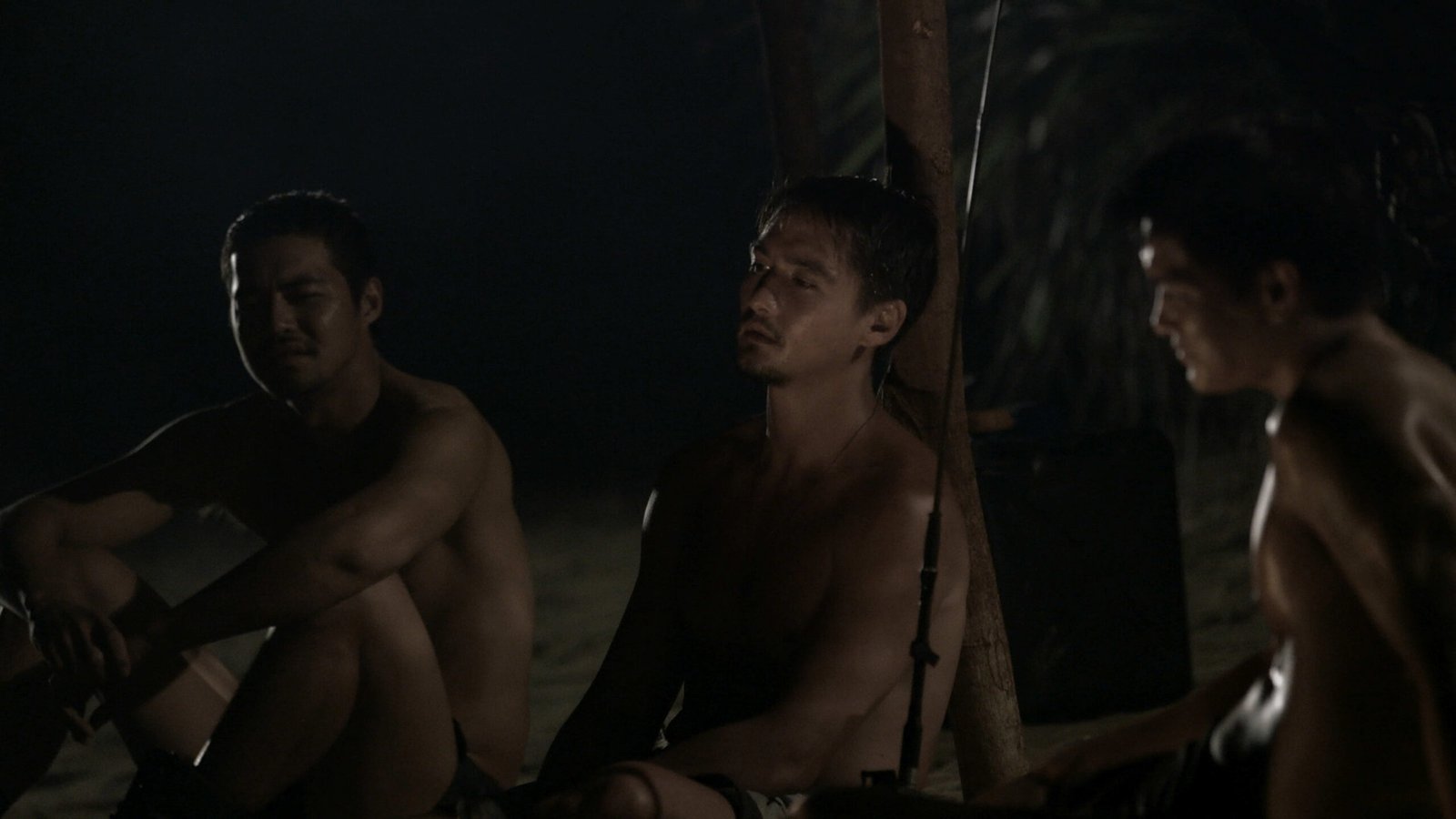
Eventually, his officer from the main island sends the loud-mouthed Lucio and the inexperienced Eric to join him. Their shared moments, including chatting, drinking, playing basketball, and exchanging stories about a ghost soldier, gradually bring to the surface things Julian has been trying to forget. Consequently, he is confronted with an increasing sense of isolation and memories of a traumatic past he refuses to discuss. Ultimately, his only option for survival is either to cope with reality or lose his sanity.
“Wildlife” is a peculiar work. For starters, there is not much happening throughout the narrative, particularly in the first part before the arrival of the two other men, aside from the opening scene where “something” clearly takes place. Nevertheless, even during this quieter stretch, a persistent sense of danger emerges from Julian’s belief that he is being watched, while the depiction of the mangroves evokes a distinctly nightmarish atmosphere, which essentially leads to the core of the story.
The narrative actually follows the structure of a dream, as eroticism, nightmare, secrets, hidden truths, reality, and the supernatural all intertwine. The story moves through these stages with Julian mostly acting as a passive observer, unable to intervene, much like in dreams. The arrival of Lucio and Eric, and even the ambiguity of their presence, reinforces this approach, while the increasing use of nudity and the sexual undertones introduce a subtle homosexual element that further enhances the oneiric quality of the piece. Moreover, the occasionally detached dialogue, the sexual references among the soldiers, and especially the finale, solidify this direction in a way that remains captivating.
At the same time, the presence of the radio, and particularly the repeated references to EDSA II, ground the narrative in reality to a degree, while also introducing a political dimension. However, the connection between this aspect and the main storyline remains somewhat elusive. Perhaps Alix intended to suggest that revolution itself carries a dreamlike quality, although such an interpretation may be somewhat far-fetched.
Albert Banzon’s cinematography captures these elements and the island setting in an impressive manner. In particular, the night sequences, the scenes of intimacy, and the mangrove landscapes remain memorable, as do the voyeuristic shots frequently used when Julian watches porn. Meanwhile, Aleks Castañeda’s editing results in a slow and oneiric pace. However, there are moments where the extended stretches of inactivity become somewhat tedious, and at 115 minutes, the duration does feel slightly excessive.
Ananda Everingham delivers a strong performance, effectively portraying Julian’s oscillation between detachment and involvement, with his silences often speaking volumes. At the same time, Zanjoe Marudo and Luis Alandy, as the two soldiers, provide entertaining performances through their contrasting personalities, occasionally injecting a subtle sense of humor into the narrative.
Although not always easy to fully interpret, “Wildlife” ultimately emerges as an engaging work within its own peculiar logic, distinguished by its intriguing visual approach and editing, and one that can certainly be counted among Alix’s most notable efforts.



