
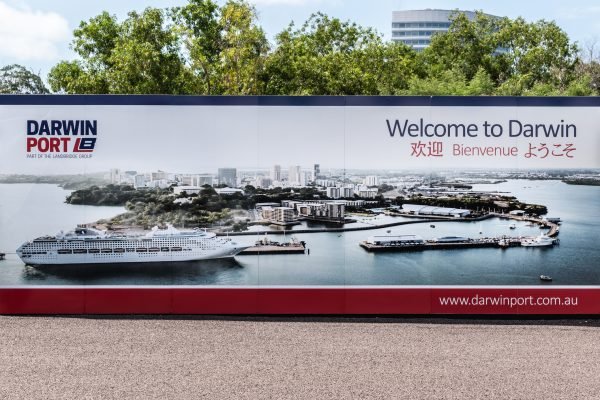
Nearly a decade after the semi-autonomous Northern Territory Government of Australia leased out operations of the northmost major harbor in Darwin to a Chinese company, Prime Minister Anthony Albanese made Australians a promise. Addressing the nation on the campaign trail in April 2025, Albanese boldly proclaimed that he planned on “getting [the port] back into Australian hands.”
The prime minister’s concerns about the port are shared by the Australian public, with at least one poll showing up to 90 percent of Australians surveyed insisting the deal carried either “some risk” or “a lot of risk” to national security. Even now, however, the port is still being operated by Landbridge Group, a privately owned Chinese company, leaving many to wonder whether that commitment was mere rhetoric.
After all, Australians were promised a similar change in 2022, when the Albanese administration authorized an official investigation of port activities and investments. Yet, ahead of plans to meet Chinese President Xi Jinping in 2023, the momentum slowly fizzled out.
Australia-China relations subsequently warmed and diplomatic efforts refocused on preserving stability in the relationship, eventually halting momentum toward reclamation of the port. The official report from the government review was muted: it found “no reason to cancel the lease.”
For Australia, the Darwin Port maintains commercial and national security significance. Sitting at the northern tip of the country, it is geographically closer to the capitals of five foreign nations than Canberra, and a good portion of commodities destined for Asian markets are shipped through this “northern gateway.”
The port is also located in the same vicinity as U.S. Marine Rotation Force – Darwin, where roughly 2,000 U.S. Marines train seasonally alongside Australian forces to strengthen combat interoperability. With Landbridge Group at the helm of port operations, this arrangement creates opportunities for espionage, selective denial of access, and interference with logistics in a conflict scenario.
While Albanese remains aware of the port’s strategic value and the concomitant security risks, the prime minister must wrestle with the same considerations that dampened earlier efforts – the trade-off between warmer ties with Beijing and defending national security. Beijing has already drawn a red line, warning that it would be obliged “to take measures to protect Chinese interests” if the port is taken back. However, new developments may tip the scales of Canberra’s strategic calculus.
For one, China’s unannounced live-fire drills early last year forced a sobering reckoning. In February, a flotilla of Chinese warships entered the Tasman Sea off Australia’s southeastern coast and commenced firing exercises, providing only brief notice to a nearby civilian aircraft. The sudden military exercises raised significant alarm among Australian officials, who within hours met with their Chinese counterparts to press for answers.
The incident underscored two realities for Canberra: Beijing can effectively project hard power into distant regions, and more startlingly, it can do so without being detected by Australian forces. Against this background, security concerns over Darwin Port are becoming more tangible. Indeed, while Canberra previously acknowledged that the port had strategic value, the recent live-fire drills, conducted well beyond China’s traditional spheres of operation, strongly imply Beijing’s actual willingness to use that advantage.
The worry that China may make good on its military threats – or at minimum engage in sporadic military harassment – has, in part, catalyzed the bolstering of peacetime defense capabilities. Shortly after the Tasman Sea exercises, Albanese met with New Zealand Prime Minister Christopher Luxon to discuss stronger military integration and signed a $6.5 billion contract with Japan for 11 new frigates for the Royal Australian Navy.
Additionally, following reforms to its foreign investment policies in 2024 and 2021, Canberra now possesses stronger legal mechanisms to reverse problematic foreign transactions. Under the new framework, the treasurer may initiate risk-based assessments of “critical infrastructure,” and if deemed contrary to national security interests, may compel a reversal of a transaction.
The newly granted authorities resolve long-standing legal matters that have hampered oversight efforts. At the time of the sale in 2015, then-Prime Minister Scott Morrison argued that the federal government lacked jurisdiction to review or alter the deal. More implicitly, there was also an understanding that once a sale was approved, retrospective changes were strictly prohibited.
The latest reforms addressed both these concerns. The “national security” litmus test was expanded to consider a slew of new factors, stretching authorization to encompass decisions made by the Northern Territory Government. And perhaps more importantly, the reforms enabled the “disposal of an interest that has been acquired,” allowing the government to reverse past contracts.
China has pushed back, adamant in arguing that reversing the lease is “not a way to do business.” According to the Chinese Embassy, Australia leased the port during a period of financial strain but now seeks to reclaim it after financial conditions have improved. This narrative may raise serious worry among prospective foreign investors, but that skepticism can be addressed. Canberra must make clear that Darwin Port remains unique in many regards – its strategic location, proximity to sensitive facilities, and the role as a major trade gateway.
A final wrinkle to this story is the financial distress facing the Chinese operator of the port. In late 2024, Landbridge Group was reportedly “scrambling to offload assets and pay down debt to stave off creditors and avoid a forced sale of [Darwin].” As of 2021, Landbridge had been sued at least 14 times by major financial creditors. In public statements, the group has warned that “an insolvency event could occur,” which would trigger formal bankruptcy proceedings, leaving ownership of Darwin Port in limbo.
Ultimately, mounting financial pressures may push Landbridge Group to divest from Darwin. The company has engaged in discussions for a deal with the government for the past six months, with Canberra signaling optimism that a private buyer could step forward with a credible offer. In any case, Landbridge’s receptiveness to engage has given the Albanese administration greater confidence that reclaiming the facility remains possible.
If Canberra ultimately moves to reclaim Darwin Port, it could face economic retaliation from Beijing. Yet, unlike previous instances, the balance of risks is shifting. Legal authorities are clearer, Landbridge is in a financially weaker position, and China’s military behavior has sharpened Australia’s threat perceptions. Taken together, the strategic environment is increasingly conducive to reclamation, raising the likelihood that Canberra will reverse course on this strategically misguided decision.



