For most of 2025, a sense of optimism pervaded Washington’s outlook on the Middle East. A Gaza cease-fire was implemented, which, despite continuing violence, helped end two years of brutal warfare. Hamas was hollowed out as a military organization capable of threatening Israel. Iran’s “axis of resistance” was shattered, and its ballistic missile and nuclear program was left reeling from 12 days of Israeli and U.S. bombing. Hezbollah was decapitated, leaving Israel’s northern border quieter than it had been in years. And in the most extraordinary change, a new regime in Syria opened closer relations with Washington, raising the prospect of a U.S.-brokered Israeli-Syrian security accord.
As 2025 draws to a close, however, these promising developments—which the Trump administration has cast in transformative terms—have collided with the harsh realities of regional politics and the recalcitrance of a variety of Middle Eastern players. Hamas, Hezbollah, and Iran are down but not out. Israel continues to use its military power to preempt and prevent hostile activity in Gaza, Lebanon, and Syria, occupying real estate in all three areas. The West Bank simmers as Israel continues its de facto annexationist policies.
And U.S. President Donald Trump, whose focus on Gaza, Lebanon, Syria, and Iran helped create opportunities, can easily lose interest. Seemingly satisfied that he has added the Middle East to the list of conflicts that he claims to have solved, his penchant is to move on to other issues, such as Russia and Ukraine. The recent meeting between Trump and Israeli Prime Minister Benjamin Netanyahu at Trump’s Mar-a-Lago resort, their sixth this year, seemed to suggest that the president—who is uniquely positioned to press the Israeli prime minister—chose to manage their differences rather than exploit them. Trump praised Netanyahu on the implementation of the Gaza plan and sided with him on Iran. The Trump administration did raise concerns about Israeli policies in the West Bank and pressed Israel to avoid taking provocative actions, but it remains to be seen whether this will result in tangible pressure.
Can anything in 2026 salvage the nascent achievements and forestall the resumption of conflict in this troubled region? The safe bet, sadly, is “no.” At best, we are talking not about transformations, but rather management, mitigation, and incremental gains if possible.
Trump may aspire to peace and normalization between Israel and the Arab world. But even maintaining the status quo calls for a degree of attention and skill that this administration has seldom shown.
It’s unclear if or how the Trump-Netanyahu meetings in Florida advanced the implementation of Trump’s Gaza plan from phase one to two. Trump made it clear that the demilitarization of Hamas remains the priority, but he gave little sense of how this could be done. He praised Netanyahu’s adherence to the Gaza plan while threatening Hamas if they didn’t comply. One issue to watch is the potential role for Turkey in Gaza security. Trump seemed to warm to the idea, while Netanyahu is definitely opposed.
Still there was no indication that the administration was any closer to forming, or even announcing, an international stabilization force to train Palestinian police, maintain order, and disarm Hamas. Hamas may be weakened, but it remains the most powerful Palestinian force in Gaza, far stronger than the Palestinian Authority, Palestinian technocrats, Israeli-backed Palestinian militias, clans, and criminal gangs. Hamas will not give up its weapons, nor will Trump find any international actors willing to try to forcibly disarm Hamas.
While one Hamas official has spoken of the possibility that Hamas will agree to store its weapons if Israel withdraws from all of Gaza, another official has ruled out disarming altogether. An international stabilization force that deploys to the roughly 53 percent of Gaza controlled by Israel will be little more than a performative stunt that will provide cover for Israeli efforts to hold on to the area that it controls.
Hamas’s survival in Gaza as a potentially potent force allows the Israeli government to put off any discussion of a Palestinian state. Netanyahu is absorbed with domestic political crises. The government has decided on a committee to study Oct. 7, 2023, and the Oslo Accords, while the opposition demands a state commission of inquiry with legal authority. Tensions remain high over the issue of Haredi draft exemptions. Far-right coalition members continue pushing for formal annexation of parts of the West Bank. And Netanyahu’s own ongoing criminal cases have now been complicated by new revelations about the influence of Qatar on Israeli policy regarding return of the hostages. Netanyahu thus would love to avoid the hard decisions required to move to phase two of Trump’s peace plan, an attitude that will clash with Trump’s goals.
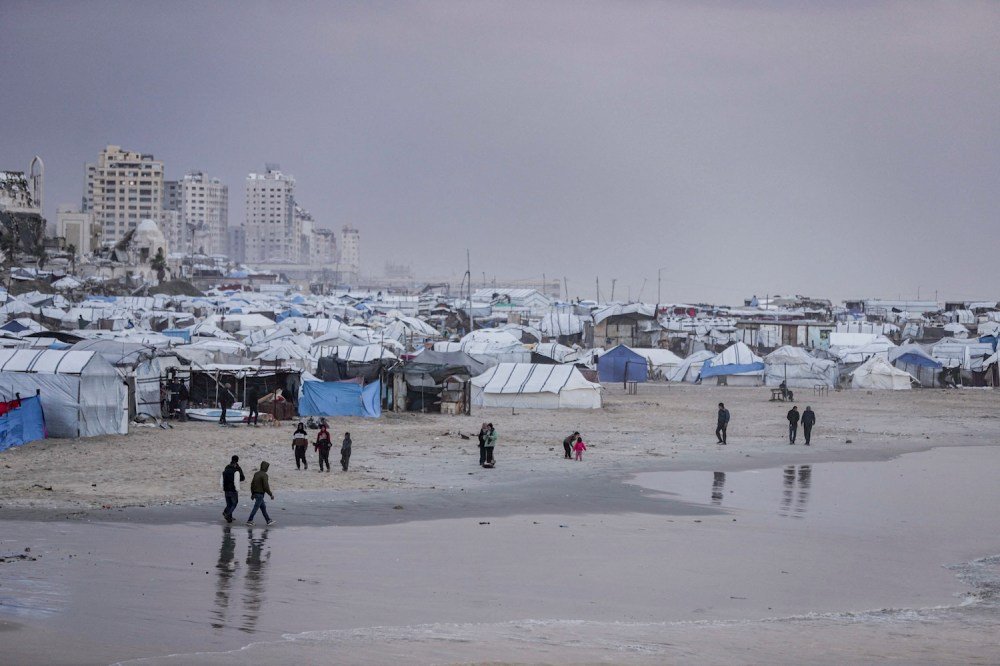
The inconvenient truth is that both Israel and Hamas are far more comfortable with the status quo of a divided Gaza than with the risks and pressures that they are under to change it. In this regard, 2026 could look a lot like 2025: Israeli escalation dominance, a smaller Hamastan, massive destruction of housing and infrastructure, a destitute population, and little fundamental change in the security situation.
Meanwhile, the situation in the West Bank is getting worse. The Palestinian Authority is taking baby steps toward reform, but none of this will matter in 2026 if the same sclerotic leadership remains in place. Israel’s policies—more settlements, outposts, and a generally permissive attitude toward settler violence—weaken what’s left of the Palestinian Authority’s diminished credibility. Hamas is popular in the West Bank, in large part due to public frustration with the absence of hope for a political solution.
A third intifada is always a possibility. But even if it does not erupt, 2026 will see more settlements, more violence, and more steps toward Israeli annexation. The result is what we would describe as a four-state reality—an area of increased Israeli control in one part of the West Bank, an area of truncated Palestinian control in another, the Israeli-controlled yellow zone in Gaza, and Hamastan in the rest of the strip.
One of the blind spots of the Trump administration’s strategy is its unwillingness to even try to restrain Israeli policies in the West Bank. Mouthing opposition to Israeli annexation is meaningless when Israeli policy and actions are moving, seemingly inexorably, toward that goal.
In Lebanon, it’s hard to anticipate any progress on disarming Hezbollah. Like Hamas, Hezbollah is down but not out, and it’s trying hard to rebuild. A Lebanese government worried about civil war and an internally divided Lebanese Army simply do not have the will and heft to disarm Hezbollah fighters north of the Litani River or prevent them from regrouping in the south. Israeli troops remain at five outposts in southern Lebanon and have taken it upon themselves to beat Hezbollah back, recently assassinating one of the group’s senior commanders in Beirut.
While we do not see a major Hezbollah-Israel escalation in the near term, the situation will remain combustible. And if the past is any guide, miscalculation could easily lead to escalation.
In Syria, President Ahmed al-Sharaa’s to-do list is extraordinarily difficult. If Syria can ever become a well-governed, cohesive state—very much an open question—it will take years. The challenges are phenomenal: reconstruction; checking the Islamic State; guaranteeing the equal rights of all Syrians, including Alawites, Kurds, and Druze; and opening a political system now centralized in the hands of a conservative, Sunni Muslim coterie of former jihadis. And all of this while dealing with external actors whose agendas do not necessarily align with Sharaa’s, including Turkey, Russia, Iran, the Gulf countries, and Israel.
Despite this, Israel has a historic opportunity in Syria. Earlier this year, Washington brokered senior-level Israeli-Syrian talks about a security accord that showed significant promise. But it’s not clear that progress on this front aligns with Netanyahu’s objectives in Syria—a weak and fractured state, with Israel supporting Druze factions, establishing a no-go zone for armed elements southwest of Damascus, and striking perceived threats inside the country as needed. A U.S.-brokered Israel-Syria security agreement could ease tensions and help Sharaa domestically, but it would need to assure Israel’s pullback from areas its occupied since the removal of former Syrian leader Bashar al-Assad.
Israel is understandably concerned about adversaries—be they Iran, Turkey, or Sunni extremists—gaining influence anywhere near its borders. But a strong and stable Syria on functional terms with Israel might ultimately be the best way to achieve this goal. U.S. pressure could help achieve such an outcome, making Syria an unexpected bright spot for 2026.
Prospects for 2026 would not be complete without a word about Iran. Clearly, Israeli and U.S. strikes severely weakened Iran and its proxies—once thought to be formidable. But the Iranian regime should not be counted out either.
It’s impossible to know how Tehran, focused on regime preservation and facing significant internal pressures, not the least of which is a severe water shortage, wants to play the next several years. It could look for a deal to relieve economic and social pressure. It could move to continue to rebuild its uranium enrichment facilities. It could rebuild its air defenses and restock its missile arsenal. Or it could try to do all of this. More than likely, Iran will not give up its nuclear ambitions or regional leadership pretensions. And the Houthis, while not a traditional Iranian proxy, remain reliably anti-Israel and anti-United States.
As a result, 2026 is likely to be a year of bubbling tensions in the U.S.-Israel-Iran triangle. Renewed activity at Iran’s nuclear sites might trigger an Israeli strike—as might reports that Iran is rebuilding its ballistic missile capacity.
The sad reality, as we usher in the new year, is that the prospects for peace in Gaza, the West Bank, and Lebanon are bleak. The threat of Iran reconstituting its power cannot be dismissed. And Syria’s democratic transition, such as it is, hangs in the balance.
Washington cannot fix all of these problems, but with real diplomacy and leadership, it can perhaps keep them from getting worse.
U.S. practice in the Middle East has accustomed the parties in the region to take the United States seriously only when either the president himself or a trusted, skilled, and empowered secretary of state is involved. Trump cannot be his own envoy. But he needs to rethink the negotiations model that he has used until now. Put simply, special envoys Steve Witkoff and Jared Kushner as well as U.S. Ambassador to Turkey Tom Barrack cannot and should not be expected to manage multiple complex files across the region—let alone the world—on their own. Each negotiation needs a coordinator, a team of experts, and a leader who has access to senior management in the departments of State and Defense and the White House.
Negotiations also require presidential determination and careful calibration, as well as a strategy and willingness to stay the course. Indeed, the Middle East, riddled with parties quite willing to wait out a U.S. negotiating effort, does not reward one-offs and quick wins. In other words, the Trump administration needs to be all in.
Trump has an advantage here. Alone among his predecessors, he has acquired extraordinary leverage over an Israel prime minister who needs his support to navigate his political travails and win an election next year in a country where Trump is more popular than he is. Trump owns the Republican Party; more mainstream Democrats are frustrated and angry with Netanyahu, and U.S. public opinion has soured on Israel in wake of Oct. 7. Hamas still remains the bigger obstacle when it comes to demilitarization. But Trump should use his leverage to shape Israeli policy and move from phase one to phase two in Gaza
For Washington to manage this dangerous moment in the Middle East will require a level of wisdom, commitment, and concentration that has been missing thus far from the United States’ mercurial president. But then again, we can always hope. After all, this is the season for wish lists and miracles.