
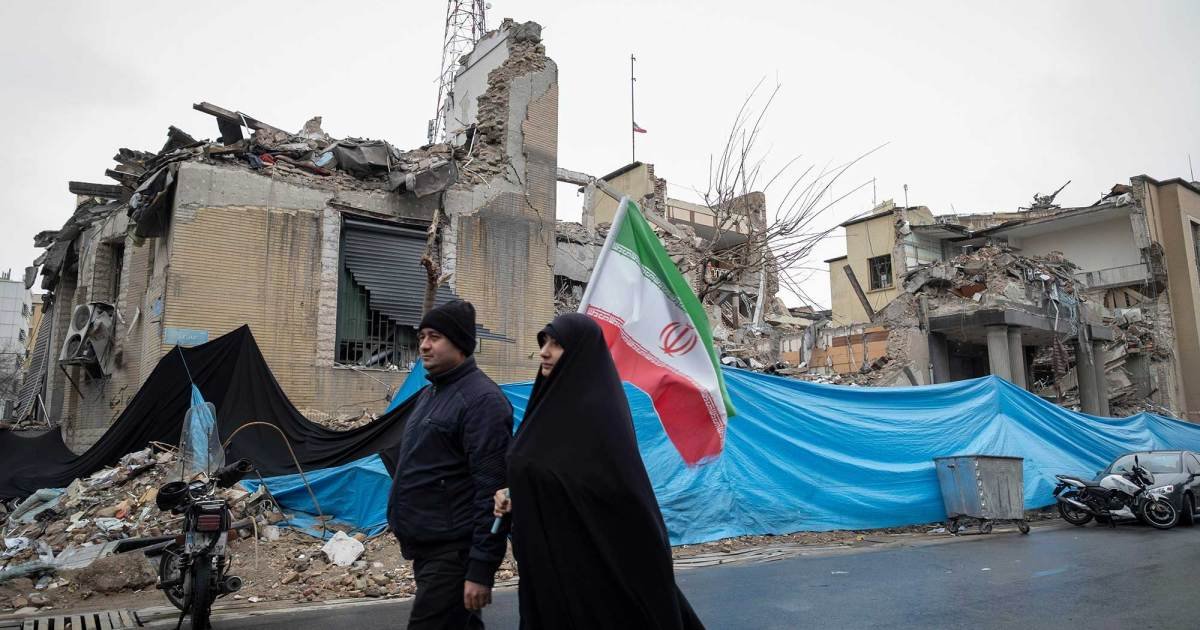
An Iranian couple carrying the national flag on March 13 walk past a police facility destroyed in an attack on Tehran. Morteza Nikoubazl/NurPhoto via AP
Last week, New York Times columnist Bret Stephens penned an article that captured the rah-rah-ness of the pro-war crowd and was breathtaking in its short-sighted triumphalism. Headlined “The War Is Going Better Than You Think,” Stephens called for “perspective on the panic over the war in the Middle East” and scolded critics who depict the Iran war as “an unprovoked and unnecessary attack on Iran, launched at Israel’s behest” that is “already a foreign-policy fiasco that has put the global economy at risk without any clear objective or endgame.” Not so, he cried.
His evidence? Comparisons to the past. In 1991, during Operation Desert Storm against Saddam Hussein, the US-led forces lost 75 aircraft. So far not a single piloted plane has been shot down over Iran. At the start of the invasion of Iraq 12 years later, President George W. Bush tried but failed to mount a strike to decapitate Saddam’s regime. This time around, Donald Trump killed Iran’s supreme leader and many high-ranking officials in the initial bombing. And in 2012, when Barack Obama was president, the price of Brent crude oil hit $123 a barrel ($175 in 2026 dollars). So the price of $108 a barrel this past week shouldn’t be such a bother.
Stephens presents a couple of other markers to suggest this war is proceeding just fine, while acknowledging the Trump administration’s “failures in planning, particularly its unwillingness to make a stronger public case for war and get more allies on our side before the campaign began”—which are hardly quibbles. Overall, his advice is to buck up and not be Debbie Downers: “If past generations could see how well this war has gone compared with the ones they were compelled to fight at a frightening cost, they would marvel at their posterity’s comparative good fortune. They would marvel, too, at our inability to appreciate the advantages we now possess.”
Looking at the number of bombs dropped or Iranian leaders killed or the fluctuation in the price of oil is not the best way to evaluate this war—especially in these first weeks of the conflict.
Stephens is grasping at tactical straws. Perhaps the US military is putting its hundreds of billions to effective use in terms of the prosecution of the war, though we probably won’t know for certain until there are after-action reports and investigations (if there are any). We do already know that a missile strike that was attributed to US military forces hit a girls’ school and killed about 175 Iranian civilians, most of them students. But looking at the number of bombs dropped or Iranian leaders killed or the fluctuation in the price of oil is not the best way to evaluate this war—especially in these first weeks of the conflict.
Wars are often not easy to judge because the chaos, conflict, and disruption they trigger will yield consequences that last for years, if not decades. It’s easy to gawk at Pentagon videos of Tomahawks raining “death and destruction from above,” as Defense Secretary Pete Hegseth calls it, and hail the war machine. Much tougher is perceiving the ripples. We have no idea where all this violence will lead. It’s theoretically possible we might end up with a less threatening regime in Tehran and more stability in the Middle East, though that does seem close to magical thinking. However, cheerleading the early stats and proclaiming they bode well for the long run seems purposefully naive.
There are other historical comparisons to keep in mind. The first Gulf War, in which President George H.W. Bush led a coalition that booted Saddam’s military out of Kuwait after he invaded his neighbor was considered a military success. Yet as part of that operation, Bush deployed troops to Saudi Arabia to protect the kingdom. That move—infidels on Saudi territory—infuriated Islamic fundamentalists, and it caused one of them to declare a fatwa against the United States. His name was Osama bin Laden.
Bush the Younger’s invasion of Iraq went so well that within six weeks he flew out to an aircraft carrier and declared victory beneath a banner that declared “Mission Accomplished.” The conflict was far from over. It spurred the rise of a civil war within Iraq and an insurgency that destabilized the region. In the fighting and violence that followed, thousands of American troops and about 200,000 Iraqi civilians were killed.
In Afghanistan, George W. Bush launched an attack against the Taliban regime on October 7, 2001. About a month later, Kabul fell. The following month, Kandahar, the spiritual home for the Taliban, toppled. A pro-American interim government was put in place. In May 2003, then–Defense Secretary Donald Rumsfeld proclaimed that combat operations in Afghanistan were “all but concluded.” The war went on for another two decades, cost about $2 trillion, and did not yield success.
No one can say how Trump’s war in Iran will end up. But we already see worrisome consequences.
In March 2011, President Barack Obama mounted military attacks by a NATO-led coalition in Libya. The initial aim was admirable: to prevent Moammar Qaddafi’s forces from waging a massacre in Benghazi. Seven months later, Qaddafi’s regime collapsed. Civil war ensued, resulting in what some have described as a failed state, which has led to instability in North Africa and the rise of extremist groups. In 2016, Obama said, the “worst mistake” of his presidency was “probably failing to plan for the day after what I think was the right thing to do in intervening in Libya.”
In all these instances, everything went well at first. Yet…It’s better if bombs land where they are supposed to and US planes are not blown out of the skies. The general competence of a military can be judged. But that’s a far cry from determining whether a war is working out.
No one can say how Trump’s war in Iran will end up. But we already see worrisome consequences. The conflict has led to Israeli attacks on Lebanon. The Ukrainian war is receiving less attention. (This week Russia, as it prepares a spring offensive, launched one of the four-year-old war’s largest bombardments, hurling 1,000 drones and 34 missiles at Ukraine.) Kim Jong Un has declared that Trump’s war against Iran justifies the expansion of North Korea’s nuclear weapons arsenal. (He has long been more of a nuclear threat than Tehran’s mullahs.) And counterterrorism experts fear a rise in terrorism aimed at American targets.
Meanwhile, the world and the global economy is at the mercy of Trump’s chaos, as each day brings contradictory statements and signs about his intentions and plans (if he has any) on how to end this war. The dislocation caused by the shutdown of the Strait of Hormuz—an easily foreseen development that Trump did not foresee—extends far beyond the uptick in the price of crude (which Stephens pooh-poohs). One-third of the world’s helium passes through the Strait. Helium is a critical ingredient in semiconductors—which are in just about everything—and it’s necessary for MRI machines. Cut off the flow of helium, and what won’t be made, what won’t happen, and what harm will be done?
If you let loose the dogs of war, they can run in many different directions. Clearly, Trump is ad hoc-ing this war as it proceeds—which is not reassuring. It’s tough enough to prosecute a war with a plan; leading a war without one is folly. For sure, the US military can be rather successful in killing and annihilating. That might look like winning to some. History tells us otherwise.



