
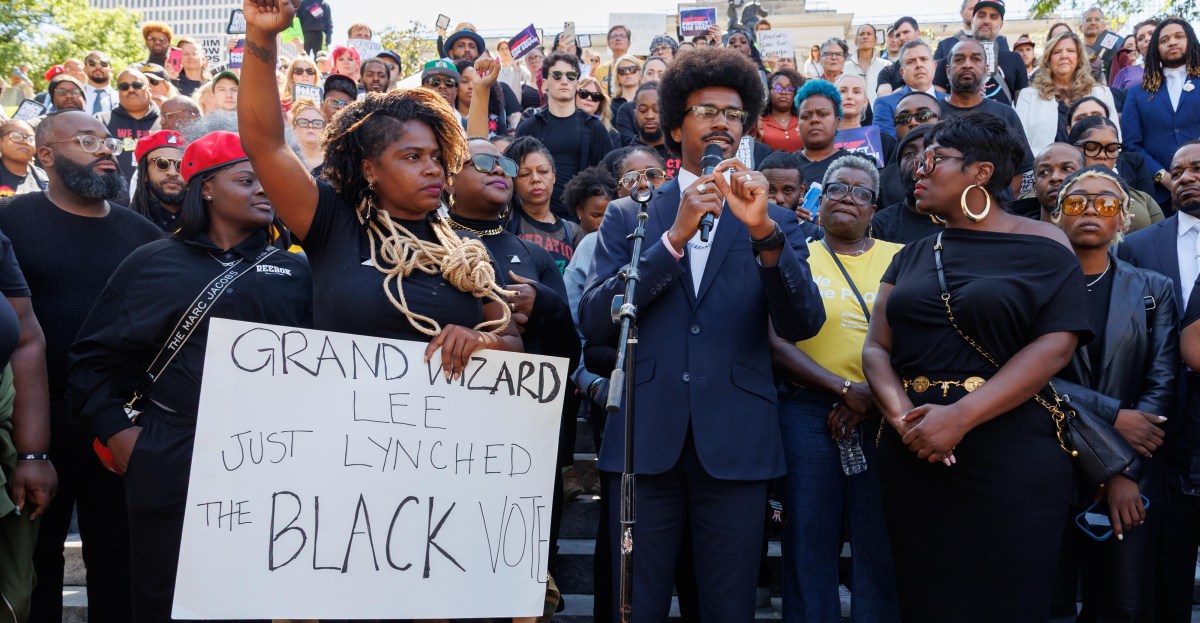
The dust from the first round of the “redistricting wars” — the unusual mid-decade redrawing of congressional maps in search of a partisan edge in the 2026 midterms — is settling, and Republicans have a clear advantage: about 10 congressional seats, give or take. But that clear-cut number obscures something else. While the GOP may have won a momentary victory, there’s potential for redistricting to backfire on Donald Trump and his party, in 2026 and beyond.
Trump kicked off the redistricting wars in 2025 by pressuring Texas lawmakers to redraw the state’s maps to create more likely Republican seats. Since then, seven other Republican states have passed new maps. On the other side of the ledger, only California successfully redrew its maps to benefit Democrats (Virginia voters approved a redistricting measure, only for it to be blocked by Virginia’s state Supreme Court). Democrats also got some good news in Utah, where a court decision created a new Democratic seat.
On the whole, the voters who have lost out are largely Democrats in red states, who could soon be without representation on a federal level.
Other voters are feeling disaffected, too. Take Mike Beltran, who runs a smoke shop in Kissimmee, Florida. The sun-baked city outside of Orlando falls within Florida’s 9th District, and it’s a hub for a large and growing Latino population. Florida Republicans recently redrew the district to make it more white, rural, and Republican, in hopes of ousting incumbent Democratic Rep. Darren Soto.
Beltran, who voted both for Soto and Trump in 2024, told Vox that he thinks the Republican-led redistricting was “a little messed up.”
“I think they’re trying to dilute the minority votes, especially the Hispanics and African American votes,” he said.
Beltran told us he was disappointed by the redistricting, but a lot of voters who are now casualties of redistricting are feeling something else — anger. As Jonathan Martin, politics bureau chief and senior political columnist at Politico, recently put it to Today, Explained co-host Sean Rameswaram, “I don’t think the juice is worth the squeeze for the Republicans.”
Martin recently wrote for Politico about how Republican redistricting in the South is firing up Black voters; he spoke with Sean about that column, why he thinks voters are more likely to be angry than apathetic, and the “profound cynicism” shaping American politics.
Below is an excerpt of their conversation, edited for length and clarity. There’s much more in the full podcast, so listen to Today, Explained wherever you get podcasts, including Apple Podcasts, Pandora, and Spotify.
You wrote for Politico that this whole operation that we’re seeing this year to redraw our political maps could backfire. How come?
In the short term, you’re only going to fire up Black voters more in a midterm election year in which Black turnout is crucial for Democrats. So why would you be helping the opposition by encouraging them to vote more? It’s giving [Democrats] an obvious turnout issue, which is: [Republicans are] trying to, basically, dilute your voice.
Secondly, from a raw political standpoint, when you start cutting the salami really thin district-wise, you risk imperiling some of your incumbents. Just take South Carolina, for example. Republicans backed off of the Trump demand to redistrict their state’s House seats, in part because they thought that by canceling out Jim Clyburn’s Black-majority district, they could have created as many as three competitive seats in a pretty good structural year for Democrats. Is it worth ending Clyburn’s career and carving up his seat? Because you’re going to run the risk of moving those voters somewhere else. They’ve got to go somewhere, and you could unwittingly create new competitive seats.
So you’re saying, instead of getting rid of one blue district in a red state, you might accidentally create three?
Precisely. And I think that was part of the concern in South Carolina, which is why legislators there resisted Trump’s demand. Because again, when the political weather, if you will, is favorable to your party — as it is for Democrats this year — some of these seats that could be a stretch get a lot more competitive if all of a sudden, the African American share in the district has gone from like 17 percent to 32 percent.
How much is this animating voters so far? Do we have a sense of how much people are aware of this kind of wonky issue?
Typically when you say “reapportionment” in a speech, the audience has fallen asleep before you even finish saying the word, right? This is pretty deep-in-the-weeds process stuff. That’s starting to change, I think. The question is, has it gotten to the point where it’s so obscene, and this arms race is so out of control, that the average voter says, ‘This is just too much, this has gone too far’?
More narrowly for this midterm election: Have the Republicans given Democrats a turnout weapon with Black voters, between the Trump-demanded reapportionment and the Supreme Court’s voting rights opinion? Could that juice Black turnout this year to levels that it typically doesn’t reach in midterms? That, to me, is the big question, because then a lot of these races get a lot more interesting.
Take Texas, for example. It’s a hard state for Democrats to win. They haven’t won a Senate race there since ’88. Talarico’s chances get a lot better to win that Senate race for Democrats if you’ve got historic Black turnout in places like Houston and Dallas.
We talked to some voters in Florida who were angry about redistricting. Some had just kind of given up. They felt just fed up with this political process. When you talk to party officials, politicians, about what they’re hearing from voters right now — what are they saying?
There is a profound cynicism among the electorate about not just politics, but about most every institution in America. We’re approaching our 250th birthday with a pretty sour electorate. It is curdled. People don’t trust institutions. They don’t think anything’s on the level. They think that they’re being screwed, and that people with privilege and means are flourishing.
Part of that’s economic, but it’s not just economic. I think part of this is that there’s just a sense that institutions are rigged. And I think part of the long tail of the Epstein story is because it proves some of the conspiracy theories. I think it’s driven, or at least reinforced, by social media, the algorithms they’re on. And that has led to an electorate that’s pretty fed up.
I saw data that had 17 percent of American voters saying that they have faith in their government. I mean, that’s really low. It’s hard to sustain a democracy when the voters don’t trust the government, don’t trust any institution.
It feels like Republicans were scared about these midterms, and that’s what put us in this position in the first place, to have this race to the bottom with redistricting. Now voters are angry and/or apathetic, which might mean lower turnout than usual in the midterms, which already historically have a bit of an issue with turnout.
Who does that favor? Do we know? If no one shows up, if people are fed up and cynical and just say, ‘Forget the midterms, I’m not interested,’ does that help the Republicans or the Democrats?
I think there’s a great alienation from people who otherwise don’t care about the system or don’t have faith in the system. For people with education, curiosity — that means the Democratic base in 2026 — they’re going to show up. They’re going to vote angry.
The question is the people who are apathetic, who are not engaged, who are not following this stuff day in, day out — can you ever get them back? Is there somebody that can bring folks back, that can inspire people to vote happy, to vote optimistic? We haven’t seen it yet.



